1:09:13
The archaeology of Solway salt
Siobhan Ratchford
Overview
This video explores the archaeological evidence of salt production in Dumfries and Galloway, Scotland, focusing on two main periods: the medieval era and the early post-medieval era (roughly 1650-1820). It details the 'sleaching' method used in medieval times, involving salty sand and brine extraction, and contrasts it with the later 'direct boiling' technique. The presentation highlights the challenges of finding surviving archaeological remains due to coastal erosion and land changes, but identifies key sites and discusses the economic and social significance of salt making, including its monastic connections, unique local exemptions, and potential for smuggling.
How was this?
Save this permanently with flashcards, quizzes, and AI chat
Chapters
- Salt is essential for human health and historically crucial for food preservation (meat, fish) and the leather industry.
- The presentation will focus on salt production sites in Dumfries and Galloway.
- Two main periods of salt making will be examined: medieval and early post-medieval (c. 1650-1820).
Understanding the historical importance of salt provides context for its production methods and the archaeological sites that remain.
- Medieval salt production primarily used a method called 'sleaching', involving salty sand.
- Salty sand was collected at high tide, placed in a 'kinch' (a lined pit), and seawater was added to create a salt-rich brine.
- This brine was then boiled in 'salt coats' (small buildings with salt pans) to evaporate the water and leave salt crystals.
- Pictorial evidence is scarce, but a 1750s illustration from Normandy shows a similar simple setup, likely reflecting medieval techniques.
The 'sleaching' method was a labor-intensive process that relied on specific coastal conditions and was foundational to early salt production.
A 1750s illustration from Normandy depicting a salt coat, salt pans, a conical salt collector, and a horse-drawn salt rake used to gather salty sand.
- Documentary evidence suggests medieval salt production was largely a monastic enterprise, with lords gifting salt coats to abbeys.
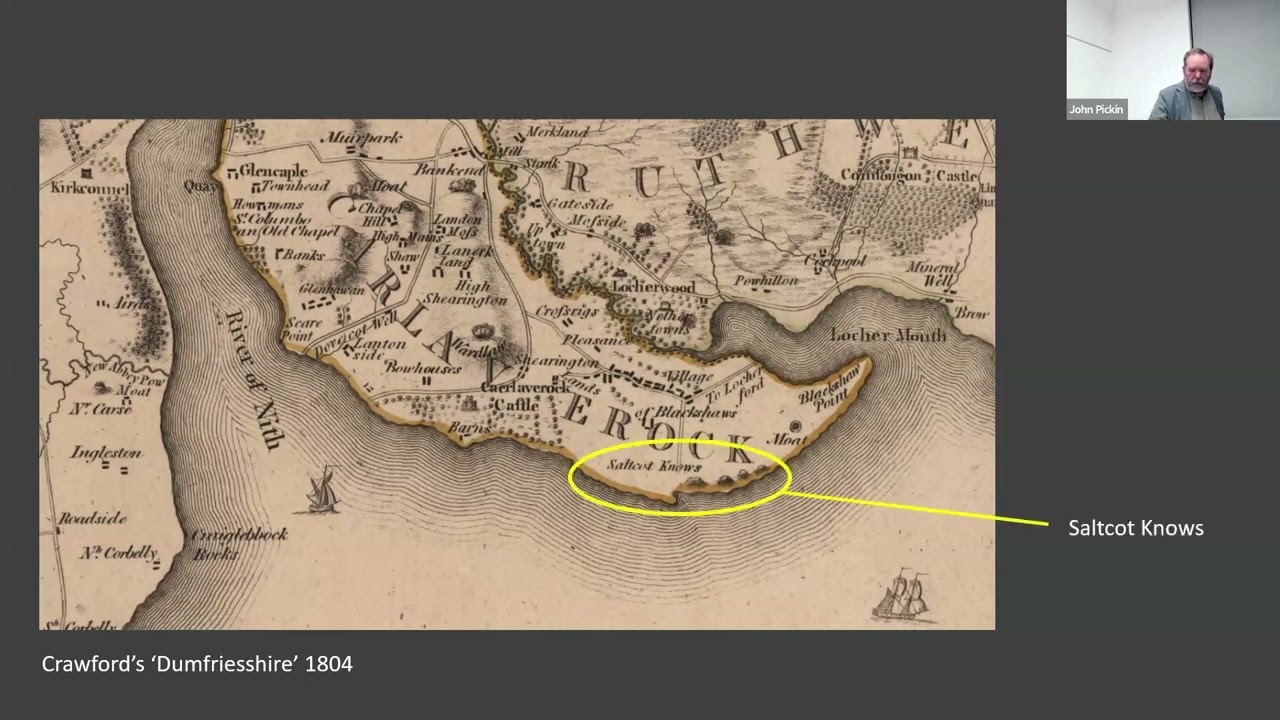
- Key sites in the inner Solway Firth included Red Coat Point, New Abbey, Caerlaverock, and Southerness.
- Abbeys like Melrose, St. Bees, and Holmcultram held multiple salt pans across the Solway.
- While evidence points to monastic activity from the 1150s-1200s, earlier pre-monastic salt making is undocumented.
The strong monastic connection reveals the economic power and organizational capacity of religious institutions in medieval salt production.
Roland, Lord of Galloway, gifting a salt pan at Caerlaverock to Melrose Abbey in 1170.
- Significant archaeological remains of medieval salt coats are rare due to coastal erosion and dynamic coastlines.
- Sites like Red Coat Point have been dramatically altered by erosion, with promontories disappearing.
- Surveys have found little surviving evidence at most documented medieval sites.
- Potential survival might exist at Mersehead, indicated by subtle mounds, but the tidal environment makes preservation unlikely.
- Modern technologies like LiDAR offer new possibilities for re-examining potential sites.
The scarcity of surviving physical evidence highlights the destructive power of natural forces and the difficulty in reconstructing past industrial activities.
The disappearance of Red Coat Point, once a prominent headland shown on a 1630s map, due to coastal erosion.
- Culbreck Hill (near East Park) shows strong evidence of 'sleach' salt making, despite not being a documented site.
- The site features a place name ('Salt Cot') and archaeological features like gentle mounds ('sleaching mounds') and rectangular hollows ('kinchots').
- Sleaching mounds are composed of waste sand dumped after brine extraction, and Culbreck Hill may be the only site in Scotland with surviving examples.
- The exact age is uncertain, but it likely represents early or medieval techniques, possibly extending into the early modern period.
Culbreck Hill offers rare, tangible evidence of the 'sleaching' process, providing crucial insights into the physical remains of this ancient industry.
The presence of large mounds of fine sand (sleaching mounds) and rectangular hollows (kinchots) at Culbreck Hill, indicative of the sleaching process.
- The 'sleaching' method uniquely continued in Annanale until around 1810, long after it ceased elsewhere.
- Annanale salt makers received a special tax exemption from the early 1600s until the 1810s.
- This allowed small, subsistence farming families to continue using the old-fashioned sleaching method.
- Waste from sleaching mounds was even used as fertilizer, potentially explaining the lack of surviving mounds elsewhere.
- The salt produced had a brackish taste but was noted for curing ham and bacon.
The Annanale exemption and persistence of sleaching demonstrate a unique socio-economic exception and the longevity of traditional practices.
An account describing the brine's strength being tested by floating an egg, and Reverend Henry Duncan's description of Annanale salt having an inferior, brackish taste.
- Around 1650, many areas shifted from 'sleaching' to 'direct boiling' of seawater.
- This involved collecting seawater in intertidal pits ('bucket pots') and boiling it in large iron pans within 'panhouses'.
- Fuel sources varied, with coal common elsewhere but peat predominantly used in Dumfries and Galloway.
- The Rins of Galloway saw a significant concentration of these panhouse sites.
- Modern techniques like windmills were sometimes used to pump water to the panhouses.
The shift to direct boiling represents a technological advancement and industrialization of salt production, requiring different infrastructure and fuel sources.
A reconstructed panhouse showing a building with a fuel store ('forehouse'), a raised area for iron pans, and furnaces below, fueled by peat in Dumfries and Galloway.
- Several panhouse sites in the Rins of Galloway show surviving archaeological evidence, though often degraded by erosion.
- Sites like Chapel Rosan, Ardwell Bay, and Port Gill show remains of pans, channels for water, and associated buildings.
- Port Gill may have been developed as part of a planned port, combining salt making with subsistence farming.
- Galdenoch (Salt Pans Bay) is a well-preserved example, with pans built into Iron Age fort ramparts, alongside worker housing and fields.
- Drumwhirly presents an unusual case, possibly a hidden salt pan site linked to illicit salt making or smuggling.
These sites provide concrete examples of the physical infrastructure of post-medieval salt production and its integration with other aspects of rural life.
The salt pan at Galdenoch, built into the ramparts of an Iron Age fort, with associated worker housing, fields, and a rock-cut bucket pot.
- Peat was the primary fuel for salt pans in Dumfries and Galloway, unlike coal used in other parts of Scotland.
- The Rans of Galloway had abundant peat resources, supporting numerous salt works.
- Salt production was often integrated with larger estates and subsistence farming.
- The repeal of the salt tax in the 1820s led to the closure of most rural salt works.
- Salt smuggling was prevalent, especially after the equalization of taxes between Scotland and England, and potentially involved reprocessing imported salt.
Understanding fuel sources and the economic context, including taxation and smuggling, reveals the practical and financial factors influencing salt production.
The 1688 lease for the Logan salt pan at Port Gill explicitly granting liberty to cut 3,000 loads of peat yearly.
- Historically, salt quality varied; Annanale salt was considered brackish, while French bay salt was higher quality.
- Good quality salt was essential for preserving fish and meat effectively.
- Modern artisanal salt production uses methods like filtering through blackthorn or solar evaporation, driven by demand for high-quality, flavorful salt.
- Location, seawater salinity, and access to fuel (like coal) were historically critical factors for large-scale production.
- Dumfries and Galloway's salt production was historically a 'sideshow' compared to more industrialized areas, but holds unique archaeological value.
The discussion on salt quality connects historical production methods to modern perceptions and the evolving market for artisanal salts.
Modern salt works using blackthorn filtering or solar evaporation, catering to a demand for artisanal salt.
Key takeaways
- Salt making in Dumfries and Galloway utilized distinct medieval ('sleaching') and post-medieval ('direct boiling') techniques, each leaving different archaeological traces.
- Coastal erosion poses a significant threat to the survival of salt-making heritage sites, making timely archaeological investigation crucial.
- Monasteries played a central role in medieval salt production, often receiving land and salt pans as gifts.
- The Annanale region uniquely preserved the ancient 'sleaching' method due to a long-standing tax exemption, highlighting its distinct economic history.
- Peat was the primary fuel for salt production in Dumfries and Galloway, contrasting with the coal-fired industry elsewhere.
- Salt smuggling was a significant factor, driven by taxation disparities and the demand for high-quality salt for preservation.
- While Dumfries and Galloway's salt industry was historically smaller-scale, its unique methods and surviving sites offer valuable insights into Scotland's broader salt production history.
Key terms
SleachingKinchSalt coatBrineSalt pansSleaching moundsDirect boilingPanhouseBucket potPeatSalt smuggling
Test your understanding
- What were the key differences between the medieval 'sleaching' method and the later 'direct boiling' method of salt production?
- Why is finding surviving archaeological evidence of medieval salt making particularly challenging in Dumfries and Galloway?
- How did monastic institutions influence salt production during the medieval period in this region?
- What made the Annanale salt makers unique in Scotland, and how did this impact their production methods?
- What role did fuel sources like peat and coal play in the development and geographical distribution of salt production sites?