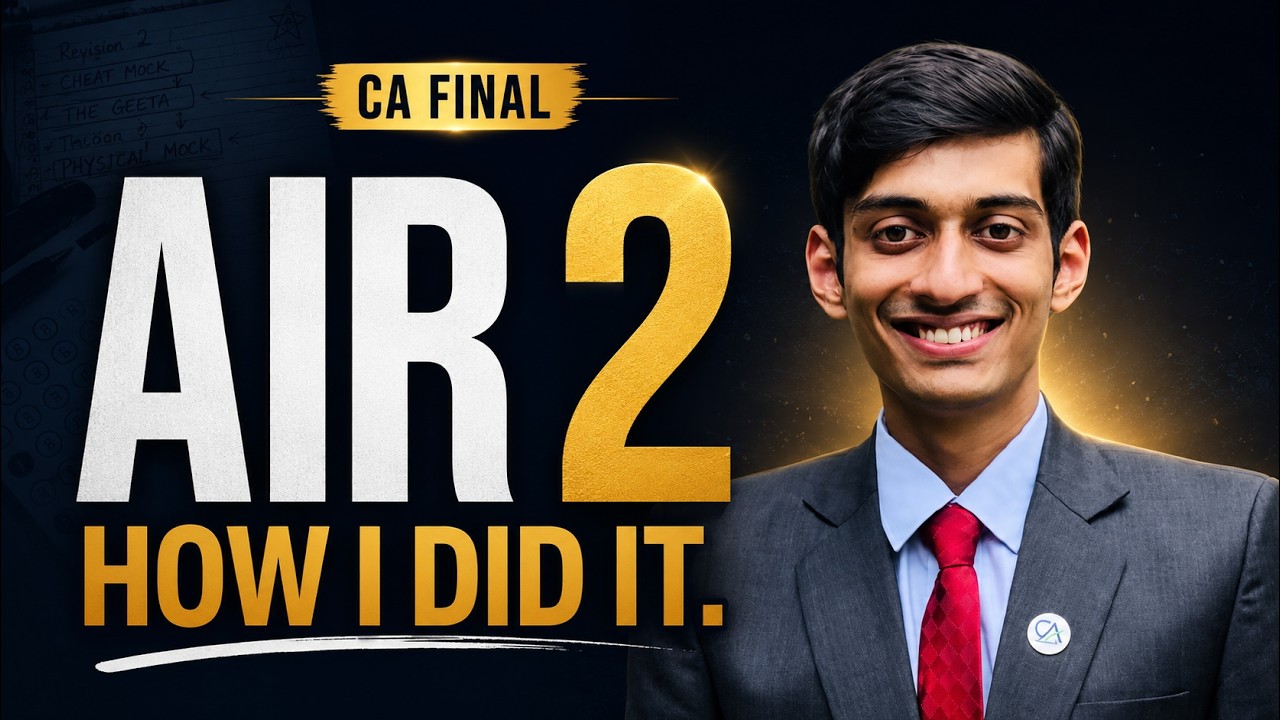
How I Secured AIR 2 in CA Final | My Complete Strategy
CA Ritij Saraf (AIR 2)
Overview
This video details the comprehensive strategy employed by CA Ritik Saraf, who secured All India Rank 2 in the CA Final exams. He emphasizes a blend of hard work and smart work, acknowledging his limitation of studying only 8-9 hours daily. The strategy focuses on disciplined, consistent effort and a well-defined plan. The video is divided into two parts: addressing common queries about study timelines, revisions, and mock tests, and then delving into specific challenges faced by CA aspirants, such as knowledge retention, confidence building, and managing exam day anxiety. Saraf offers actionable, replicable solutions based on his personal experience, aiming to help other students achieve similar success.
Save this permanently with flashcards, quizzes, and AI chat
Chapters
- Securing a top rank requires a mix of hard work and smart strategy, especially when daily study hours are limited.
- The first year of CA articleship was hectic, with minimal study progress (only 5-6 classes of FR completed).
- The second year involved a dedicated 2-3 hour study slot each morning, even if it meant breaking down classes.
- By August 2025 (end of second year articleship), classes for FR, AFM, and Audit were complete, with DT/IDT around 20-30% done.
- All classes for five subjects, along with SPCC and MCS training, were completed by the end of October, leaving six months for revisions.
- The first revision is in-depth and comprehensive, focusing on 100% coverage, with 20-25 days allocated per subject (30 days for FR).
- The second revision focuses on increased speed and addressing weak areas, taking 10-15 days per subject.
- The third revision is quicker, requiring only 5-6 days per subject.
- The overarching goal for each revision is to make the subsequent one shorter and more efficient.
- Divide the question bank into three buckets: Bucket 1 (tricky/tough questions), Bucket 2 (questions with tricky adjustments), and Bucket 3 (questions solved easily).
- The goal is to progressively move questions from Bucket 1 to Bucket 2, and from Bucket 2 to Bucket 3 with each revision.
- The ultimate aim is to have only a few critical questions left in Bucket 1 for revision just before the exams (approx. 30-40 per subject).
- Avoid using multiple question banks; trust your faculty's material and focus on mastering it, supplemented only by recent MTPs, RTPs, and PYQs.
- Implement 'cheat mocks' to revisit previously studied subjects while preparing for a new one.
- On a designated break day during the preparation of a new subject, spend time recalling the previous subject's concepts (approx. 7 hours) and take a short mock test (3-4 hours).
- The purpose of cheat mocks is not evaluation but to maintain touch with the subject and activate 'muscle memory'.
- Ensure no subject is left untouched for more than two weeks to prevent significant knowledge loss.
- Create a personal 'Geeta' (notes compilation) for each subject, divided into sections for tricky points, ambiguous concepts, and common silly mistakes.
- Jot down these critical points in your own language with references to the original material.
- The 'Geeta' acts as a repository of easily forgettable information, designed for frequent review.
- Regularly revise this compilation (weekly or bi-weekly) to internalize the information, making it easily recallable, especially during the crucial 1.5 days before exams.
- Enroll in and physically attend ICAI's mock test series to simulate the actual exam environment.
- This simulation helps identify mistakes made during the 1.5-day preparation window and allows for adjustments in study strategy.
- Experiencing an unknown exam environment beforehand reduces nervousness on the actual exam day.
- For subjects like IBS, physical mock tests provide invaluable practice in managing resources and time within a formal setting.
- Maintain a consistent daily study target of 8-10 hours, ensuring at least 7 hours of sleep.
- Dedicate 3-4 hours daily to Audit throughout the six months (November to April) due to its nature.
- Combine Audit with one other subject daily (e.g., FR, AFM, DT) for the remaining study hours.
- Incorporate a 1.5-2 hour physical activity break (gym or home exercise) daily for mental and physical well-being.
- During the final 1-2 months, reduce gym time to focus on daily practice of IBS case studies.
- Utilize a performance tracker to monitor progress in classes, revisions, self-study, and mock tests, noting weak areas.
- Break down long-term goals into monthly, weekly, and daily targets for strategic planning.
- Engage with a driven study group for doubt-solving, mutual motivation, and resource sharing, while maintaining focus.
- Cultivate a positive mindset through self-affirmations and visualization (manifestation), setting ambitious goals like achieving a rank.
Key takeaways
- Consistent, disciplined study, even for limited hours, can lead to top ranks with the right strategy.
- A structured, multi-phase revision approach is more effective than cramming.
- Efficiently managing your question bank by categorizing questions based on difficulty and familiarity is key.
- Regularly revisiting previously studied subjects through 'cheat mocks' is vital to combat knowledge decay.
- Creating personalized notes ('Geeta') for tricky and forgettable points aids in long-term retention.
- Simulating exam conditions through physical mock tests significantly reduces anxiety and builds confidence.
- A balanced daily routine incorporating study, physical activity, and adequate sleep is essential for sustained effort.
- Leveraging performance trackers, study groups, and a positive, goal-oriented mindset are critical for navigating the long CA preparation journey.
Key terms
Test your understanding
- How can a student effectively manage their study time if they can only dedicate 8-9 hours per day to studies?
- What is the 'bucketing' approach for question banks, and how does it help in making revisions more efficient?
- Explain the concept of 'cheat mocks' and why they are important for retaining knowledge across different subjects.
- How can a student create and utilize personalized notes ('Geeta') to remember tricky and minute details effectively?
- What steps can be taken to reduce exam nervousness and build confidence before the final CA exams?