28:11
Introduction to Projectile Motion - Formulas and Equations
The Organic Chemistry Tutor
Overview
This video explains the fundamental kinematic equations used to solve projectile motion problems. It breaks down projectile motion into three common scenarios: an object launched horizontally from a height, an object launched at an angle from the ground, and an object launched at an angle from a height. For each scenario, the video derives and explains the key equations for calculating time of flight, maximum height, and range, emphasizing the separation of horizontal (x) and vertical (y) motion and the role of gravity.
How was this?
Save this permanently with flashcards, quizzes, and AI chat
Chapters
- For constant velocity, displacement equals velocity times time (d = vt).
- For constant acceleration, four key equations relate initial velocity, final velocity, acceleration, displacement, and time.
- Displacement is the change in position (final - initial), which can be different from distance if direction changes.
These foundational equations are the building blocks for understanding more complex motion, including projectile motion, by providing the tools to quantify changes in speed and position over time.
The equation d = v_initial * t + 0.5 * a * t^2 is presented as a crucial formula for constant acceleration scenarios.
- This scenario involves an object launched horizontally from a cliff, falling under gravity.
- The vertical motion (height) is governed by H = 0.5 * a * t^2, where initial vertical velocity is zero.
- The horizontal motion (range) is governed by Range = v_x * t, as horizontal acceleration is zero (v_x is constant).
- The final velocity just before impact requires combining horizontal (v_x) and vertical (v_y) components using the Pythagorean theorem and inverse tangent for the angle.
Understanding this scenario helps in analyzing situations like a ball rolling off a table or a projectile fired horizontally, allowing prediction of where and when it will land.
An object launched horizontally from a cliff uses H = 0.5 * a * t^2 for height and Range = v_x * t for horizontal distance.
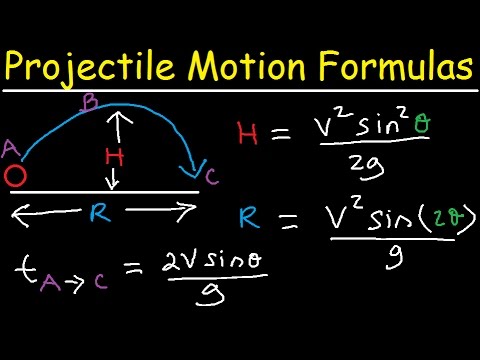
- An object is launched from the ground at an initial speed (v) and angle (theta) relative to the horizontal.
- The initial velocity is resolved into horizontal (v_x = v * cos(theta)) and vertical (v_y = v * sin(theta)) components.
- The time to reach maximum height is t = v * sin(theta) / g, where v_y becomes zero at the peak.
- The total time of flight is twice the time to reach the peak (2 * v * sin(theta) / g) due to symmetry.
- The maximum height reached is H = (v^2 * sin^2(theta)) / (2g).
- The range (horizontal distance) is R = (v^2 * sin(2*theta)) / g.
This is the classic parabolic trajectory seen in sports like basketball or baseball, enabling calculations for how far a projectile will travel and how high it will go.
A kicked ball follows a symmetrical path, with its range calculated using R = (v^2 * sin(2*theta)) / g.
- This scenario combines features of the first two: an object launched at an angle from an elevated position.
- The time of flight calculation requires using the kinematic equation for displacement in the y-direction, often involving the quadratic formula because the initial and final y-positions differ and the trajectory is not symmetrical.
- The range is calculated using Range = v_x * t, where t is the total time of flight determined from the vertical motion.
- Alternatively, time can be calculated by summing the time to reach the peak height (from the launch point) and the time to fall from that peak to the ground.
- Final velocity calculations involve finding both final v_x (which is constant) and final v_y (using kinematic equations and total time), then combining them.
This is the most general case, applicable to scenarios like launching a missile from a hill or a ball thrown from a building, requiring careful application of kinematic equations to both horizontal and vertical components.
Calculating the time for a projectile launched from a cliff at an angle to hit the ground below often requires solving a quadratic equation derived from y_final = y_initial + v_y_initial * t + 0.5 * g * t^2.
Key takeaways
- Projectile motion problems are solved by independently analyzing horizontal (x) and vertical (y) components of motion.
- Horizontal motion is typically characterized by constant velocity (zero acceleration), while vertical motion is affected by constant downward acceleration due to gravity.
- The time of flight is determined by the vertical motion, while the range is determined by the horizontal motion and the total time of flight.
- Understanding the initial conditions (launch speed, angle, height) is crucial for applying the correct kinematic equations.
- Symmetry in projectile motion (like launching and landing at the same height) simplifies calculations, but non-symmetrical trajectories often require more complex methods like the quadratic formula.
- The final velocity of a projectile is a vector sum of its final horizontal and vertical velocity components.
Key terms
Projectile MotionKinematic EquationsDisplacementVelocity (Initial, Final, Average)AccelerationHorizontal Velocity (v_x)Vertical Velocity (v_y)Time of FlightRangeGravity (g)
Test your understanding
- How does the independence of horizontal and vertical motion simplify the analysis of projectile problems?
- What are the key differences in how horizontal and vertical motion are treated in projectile motion calculations?
- Under what conditions can the time of flight for a projectile be easily doubled to find the total time in the air?
- Why is it important to use the quadratic formula when calculating the time of flight for a projectile launched at an angle from a height?
- How do you determine the final speed and direction of a projectile just before it hits the ground?