4:13
Entity Relationship Modeling Part 2
notyournormalbrother
Overview
This video introduces fundamental concepts in Entity Relationship (ER) modeling, focusing on attributes and entity types. It explains different types of attributes, including simple, composite, single-valued, multi-valued, and derived attributes, and how to handle them in database design. The video also differentiates between strong and weak entity types, highlighting their dependency relationships. Finally, it touches upon attributes that can be associated with relationships, suggesting they might represent an underlying entity that can be modeled explicitly.
How was this?
Save this permanently with flashcards, quizzes, and AI chat
Chapters
- Attributes are properties or characteristics that describe an entity.
- Primary keys are attributes with unique values within an entity set.
- Every attribute has a domain, which is the set of allowable values.
Understanding attributes is crucial for accurately defining the data that needs to be stored for each entity in a database.
The 'salary' of an employee is an example of an attribute.
- Simple attributes cannot be subdivided (e.g., 'name').
- Composite attributes can be broken down into smaller components (e.g., 'address' into 'street', 'city', 'postcode').
- Single-valued attributes hold only one value per entity occurrence (e.g., 'salesperson number').
- Multi-valued attributes can hold multiple values per entity occurrence (e.g., 'email addresses').
- Derived attributes can be calculated from other attributes (e.g., 'age' from 'date of birth').
Choosing the correct attribute type impacts how data is stored and queried, affecting database efficiency and complexity.
An 'address' can be a composite attribute, broken down into 'street', 'city', and 'postcode'.
- Multi-valued attributes like multiple email addresses can be handled by creating separate attributes (e.g., 'primary email', 'alternative email') or, for more than two values, by creating a new related table.
- Derived attributes, such as 'age', are calculated from other attributes ('date of birth') and do not need to be stored directly if they can be easily computed.
Effective strategies for managing multi-valued and derived attributes prevent data redundancy and simplify database management.
To store multiple email addresses for a user, you could create a separate 'email' table linked to the 'user' table.
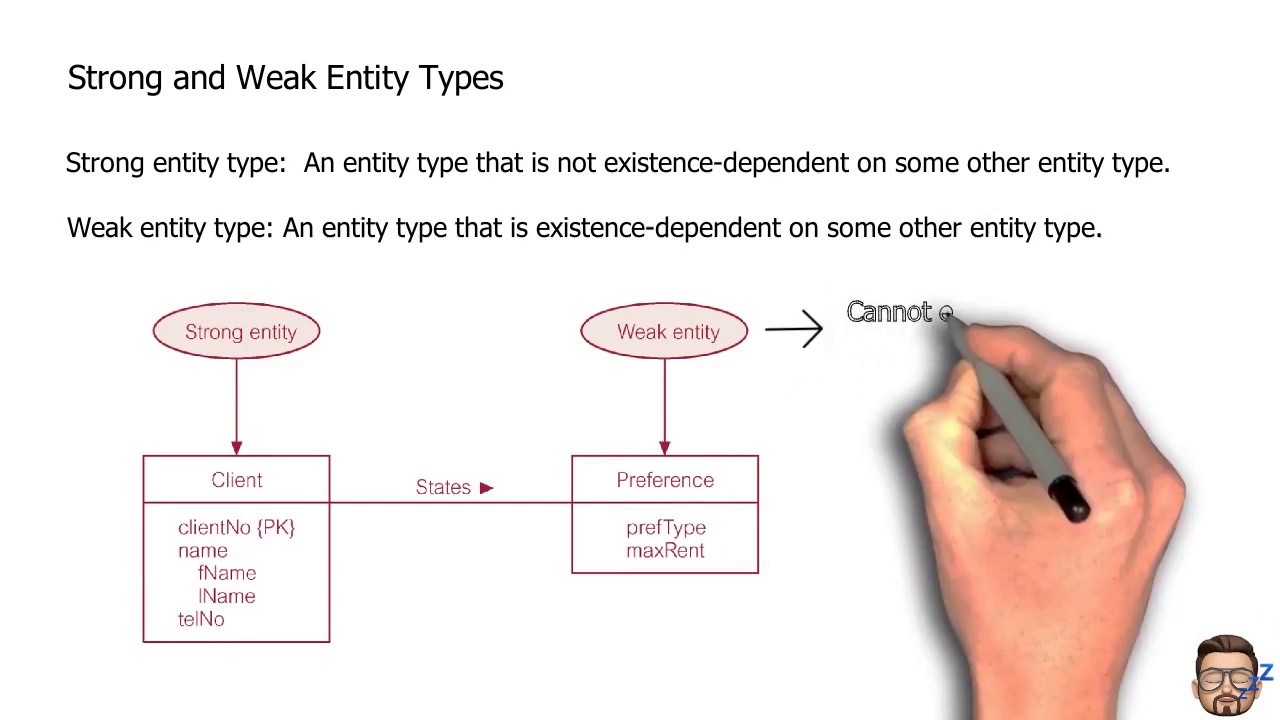
- A strong entity type can exist independently of other entity types.
- A weak entity type's existence is dependent on another entity type; it cannot exist without its owner entity.
- This dependency is often represented by a double diamond relationship in ER diagrams.
Identifying strong and weak entities helps in understanding the hierarchical structure and dependencies within a database, which is crucial for data integrity.
A 'preference' entity might be a weak entity dependent on a 'client' entity; if the client is deleted, their preferences are also meaningless.
- Relationships can sometimes have attributes associated with them.
- An attribute on a relationship might indicate that the relationship itself represents an entity that has not yet been explicitly modeled.
- These attributes can often be converted into a new entity type.
Recognizing attributes on relationships allows for a more complete and accurate representation of complex data interactions by potentially identifying and modeling implicit entities.
If a 'works for' relationship between 'Employee' and 'Department' has a 'start date' attribute, this might suggest creating a new 'Employment' entity to hold this information.
Key takeaways
- Attributes are the descriptive properties of entities, essential for defining database content.
- The type of attribute (simple, composite, single-valued, multi-valued, derived) dictates how it should be modeled and stored.
- Multi-valued attributes often require special handling, such as normalization into separate tables, to maintain database efficiency.
- Derived attributes can be calculated, saving storage space but requiring computation.
- Weak entities are dependent on strong entities, forming a hierarchical structure that must be preserved.
- Attributes on relationships can signal the need to model an implicit entity.
Key terms
Entity Relationship (ER) ModelingAttributeDomainPrimary KeySimple AttributeComposite AttributeSingle-valued AttributeMulti-valued AttributeDerived AttributeStrong Entity TypeWeak Entity Type
Test your understanding
- What is the difference between a simple and a composite attribute, and how does this affect database design?
- How should multi-valued attributes be handled in an ER model to avoid data redundancy?
- Why is it important to distinguish between strong and weak entity types?
- What does an attribute on a relationship typically signify in ER modeling?
- How can a derived attribute like 'age' be managed in a database compared to a stored attribute?