3:54
Surveys and Questionnaires
Economics from Home
Overview
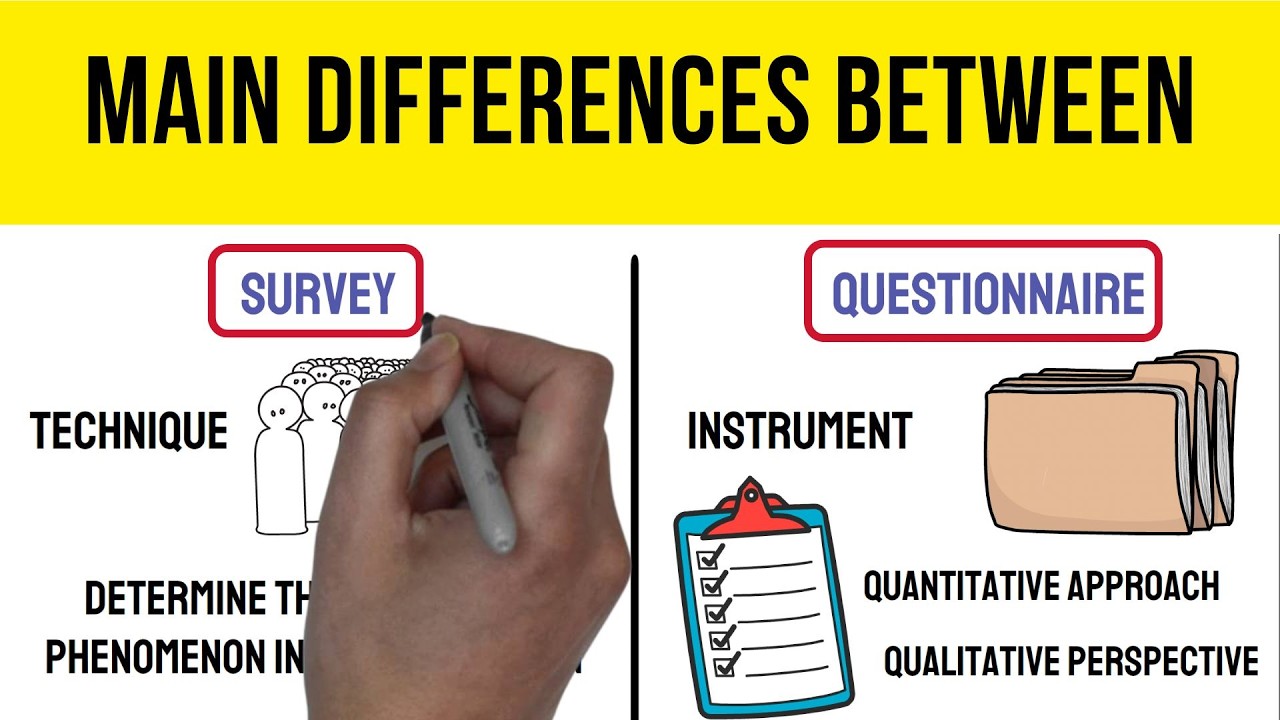
This video explains the distinction between surveys and questionnaires, two common methods for data collection. A survey is presented as a comprehensive research technique involving strategy development, respondent selection, interviewer training, instrument design, contact methods, and data analysis. A questionnaire, on the other hand, is an instrument, typically a document with questions, used within a survey or other data-gathering processes. The video details different types of questionnaires (open-ended, closed-ended, mixed) and highlights the key differences, emphasizing that a survey is a broad methodology while a questionnaire is a specific tool.
How was this?
Save this permanently with flashcards, quizzes, and AI chat
Chapters
- Surveys and questionnaires are methods for collecting information from people, often used for primary data gathering.
- The core difference is that a survey is a research technique, while a questionnaire is an instrument used within that technique.
- Surveys involve more than just questions; they can include observations, measurements, and researcher judgments.
Understanding the fundamental difference clarifies the scope and purpose of each term, preventing confusion in research contexts.
Both methods are used to gather primary data, whether to market a product or gather information on social issues.
- Developing a survey strategy involves defining variables, studying the target environment, and choosing the appropriate instrument and application method.
- Selecting respondents involves using sampling methods to choose a representative subset of the target population to ensure valid results.
- Training interviewers is crucial to standardize procedures and minimize bias.
- The method of contacting respondents (mail, web, phone, face-to-face) must be decided.
- The final step involves analyzing the collected data and drawing conclusions.
This outlines the systematic approach required for a survey, highlighting that it's a multi-step research methodology, not just a list of questions.
Studying the time, environment, and population to be surveyed to determine the instrument to be used, its format, and its application.
- A questionnaire is a tool, usually a document (printed or digital), used to collect information.
- It contains a series of questions presented in a logical order.
- Questionnaires can be open-ended, allowing respondents to formulate their own answers.
- They can be closed-ended, offering a limited set of response options (e.g., yes/no).
- Mixed questionnaires combine both open and closed questions.
Knowing the types of questionnaires helps in selecting the right format to elicit the desired type of information from respondents.
A closed-ended questionnaire might ask 'Do you prefer product A or product B?' with only those two options available.
- A survey is a broad technique for data collection and analysis, aiming to understand a phenomenon's extent in a population (often quantitative).
- A questionnaire is a specific instrument for data collection, its orientation (quantitative/qualitative) depends on its use.
- Surveys are generally time-consuming procedures, while questionnaires allow for quick data collection.
- Proper survey design ensures organized, standardized data collection, while good questionnaire design ensures validity and reliability.
- Surveys are typically for research, but questionnaires can be used in research, job applications, contests, and more.
This comparison reinforces the relationship between the two and clarifies their distinct roles and applications in various contexts.
A survey might be used to understand the overall customer satisfaction with a new product, while a questionnaire is the actual list of questions used to gather that satisfaction data.
Key takeaways
- A survey is a research methodology, while a questionnaire is a tool used within that methodology.
- Effective surveys require careful planning, including strategy, respondent selection, and interviewer training.
- Questionnaires can be designed as open-ended, closed-ended, or mixed to suit different data collection needs.
- The choice between survey and questionnaire depends on whether you need a comprehensive research approach or a specific data collection instrument.
- While surveys are primarily for research, questionnaires have broader everyday applications.
- The validity and reliability of collected data depend on both the survey's overall design and the questionnaire's specific construction.
Key terms
SurveyQuestionnairePrimary DataResearch TechniqueInstrumentRespondentsSampling MethodsInterviewer BiasOpen-ended QuestionsClosed-ended QuestionsValidityReliability
Test your understanding
- What is the fundamental difference between a survey and a questionnaire?
- What are the essential steps involved in conducting a survey?
- How do open-ended and closed-ended questionnaires differ in the type of responses they elicit?
- Why is interviewer training an important part of the survey process?
- In what ways can a questionnaire be used outside of formal research studies?