8:00
Alteration of Chromosome Number and Structure
Professor Dave Explains
Overview
This video explains how errors in chromosome number and structure can occur, leading to significant effects on organisms. It details nondisjunction during meiosis, which causes aneuploidy (abnormal chromosome numbers like monosomy or trisomy), and polyploidy (extra complete sets of chromosomes), which is common in plants. The video also covers structural alterations like deletions, duplications, inversions, and translocations, which can arise from chromosome breakage and have serious consequences.
How was this?
Save this permanently with flashcards, quizzes, and AI chat
Chapters
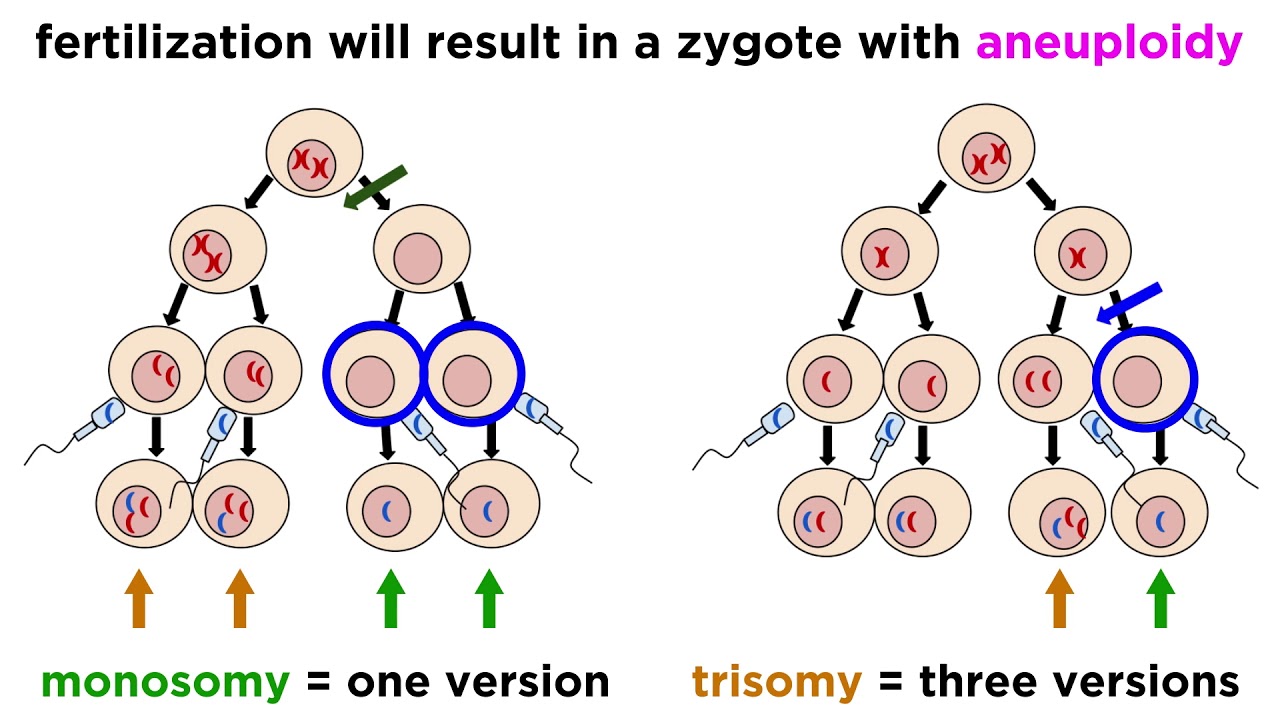
- Nondisjunction is an error during meiosis where chromosomes or sister chromatids fail to separate properly.
- This results in gametes with an abnormal number of chromosomes (N+1 or N-1).
- Fertilization with these gametes leads to aneuploidy in the zygote, characterized by monosomy (one copy) or trisomy (three copies) of a chromosome.
- Aneuploidy often causes severe developmental problems, miscarriage, or genetic disorders like Down syndrome.
Understanding aneuploidy is crucial because it explains the genetic basis for many developmental disorders and the high rate of early pregnancy loss.
Down syndrome, caused by trisomy 21, where an individual has three copies of chromosome 21 instead of the usual two.
- Polyploidy means having more than two complete sets of chromosomes (e.g., triploidy, tetraploidy).
- It can arise from nondisjunction of all chromosomes or failure of cell division after chromosome replication.
- Polyploidy is rare in animals but common in plants, often resulting in larger or more robust organisms.
- Many edible plants, like bananas and strawberries, are polyploid.
Recognizing polyploidy helps explain the diversity and characteristics of many plant species, including important food crops.
Bananas are triploid (3n), wheat is hexaploid (6n), and strawberries are octoploid (8n), meaning they have multiple complete sets of chromosomes.
- Chromosomes can undergo structural changes due to breakage, often caused by radiation or mutagens.
- Deletion occurs when a chromosome fragment is lost, leading to missing genes.
- Duplication happens when a fragment is repeated on the same chromosome.
- Inversion involves a chromosome fragment reattaching in a flipped orientation.
- Translocation occurs when a fragment attaches to a nonhomologous chromosome.
These structural changes can alter gene function and dosage, contributing to genetic disorders and evolutionary processes.
Unequal crossing over during meiosis can lead to one chromosome experiencing a deletion and its homologous partner experiencing a duplication.
Key takeaways
- Errors in chromosome number, like aneuploidy and polyploidy, arise from failures in cell division processes such as meiosis.
- Aneuploidy (monosomy, trisomy) typically results in severe health consequences or developmental issues.
- Polyploidy, while rare in animals, is a significant factor in plant evolution and the characteristics of many food crops.
- Structural alterations to chromosomes (deletion, duplication, inversion, translocation) can result from chromosome breakage and have profound genetic effects.
- Understanding these chromosomal alterations is fundamental to comprehending genetic disorders, evolution, and plant breeding.
Key terms
NondisjunctionAneuploidyMonosomyTrisomyPolyploidyDiploidDeletionDuplicationInversionTranslocation
Test your understanding
- What is nondisjunction and how does it lead to aneuploidy?
- How does polyploidy differ from aneuploidy, and in which organisms is it most common?
- Describe the four main types of structural alterations that can occur in chromosomes.
- Why can aneuploidy often lead to miscarriage or severe genetic disorders?
- What are the potential consequences of chromosomal deletions or translocations?