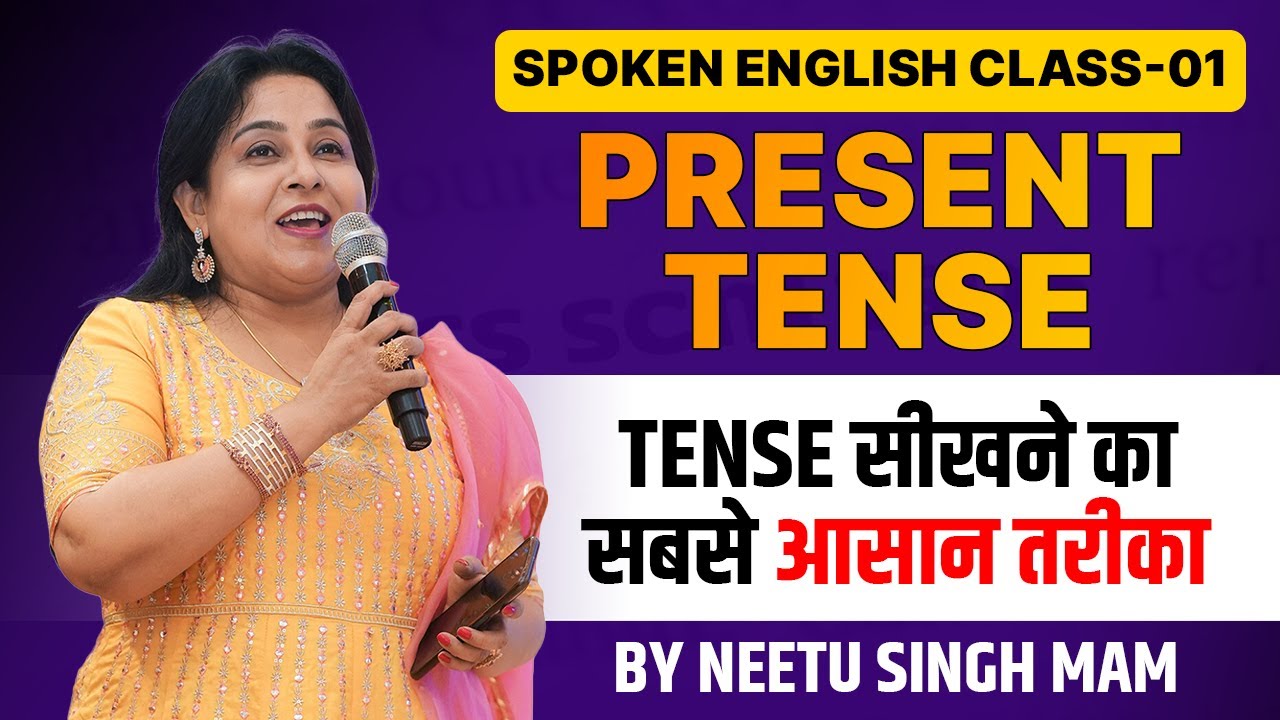
Present Tense | Tense सीखने का सबसे आसान तरीका 🔥 | Spoken English Class-01 | Neetu Singh Ma'am
Spoken English by Neetu Mam
Overview
This video introduces the fundamental concept of tenses in English, emphasizing their importance for constructing sentences. It begins by explaining the role of verbs and their forms (V1, V2, V3, V1-ing) in indicating time (present, past, future) and aspect (continuous, perfect). The lesson then focuses on the Simple Present tense, specifically using the 'be' verbs (is, am, are) to describe states of being, qualities, and characteristics. The instructor demonstrates how to form positive, negative, and interrogative sentences using these verbs and provides numerous examples related to weather, food, and personal descriptions, highlighting the use of adjectives.
Save this permanently with flashcards, quizzes, and AI chat
Chapters
- Tenses are essential for building sentence structure and conveying meaning accurately.
- Active voice sentences begin with the subject, followed by a verb.
- Verb forms (V1, V1s/es, V2, V1-ing, V3) are critical for indicating tense and aspect.
- V1/V1s/es signify present, V2 signifies past, V1-ing signifies continuous action, and V3 is for perfect tenses.
- Memorizing verb forms is necessary because irregular verbs do not follow predictable patterns.
- While commonly taught as Present, Past, and Future, tenses are internationally categorized into four aspects: Simple, Continuous, Perfect, and Perfect Continuous.
- Some Indian educational materials distinguish 'Simple' and 'Indefinite' tenses separately, which differs from international standards.
- The future tense lacks a dedicated verb form and must be constructed.
- The video will focus on practical application, starting with the present tense.
- The simplest structure in the present tense uses 'is,' 'am,' or 'are' followed by a noun or adjective (subject complement).
- Subject complements complete the meaning of the subject (e.g., 'I am a teacher,' 'He is honest').
- Negative sentences are formed by adding 'not' after 'is,' 'am,' or 'are.'
- Questions are formed by moving 'is,' 'am,' or 'are' to the beginning of the sentence.
- Specific pronouns pair with specific 'be' verbs: 'am' with 'I'; 'are' with 'you,' 'we,' 'they,' and plurals; 'is' with 'he,' 'she,' 'it,' and singular nouns.
- The lesson extensively uses adjectives to describe various subjects, enriching sentence construction.
- Adjectives can describe weather ('cloudy,' 'windy'), food taste ('sweet,' 'spicy'), and personal characteristics ('smart,' 'honest,' 'introvert').
- Understanding and using a wide range of adjectives is key to descriptive language.
- The video implicitly teaches adjective usage within the context of simple present tense sentences.
Key takeaways
- Tenses are the grammatical framework that dictates when an action occurs, making them fundamental to sentence construction.
- Proficiency in English requires a solid understanding of verb forms and how they change according to tense.
- The 'be' verbs (is, am, are) are essential for describing states of being and qualities in the present tense.
- Forming positive, negative, and question sentences follows consistent patterns with 'be' verbs.
- Mastering the basic sentence structures, like those using 'is, am, are,' is the first step towards fluency.
- Expanding vocabulary, particularly with adjectives, significantly enhances the ability to express oneself descriptively.
- Learning English is a step-by-step process that can be achieved at any age with proper guidance and practice.
Key terms
Test your understanding
- Why are verb forms crucial for understanding and using tenses correctly?
- How do the verb forms V1, V2, and V1-ing specifically indicate different aspects of time and action?
- What is the primary function of 'is,' 'am,' and 'are' in simple present tense sentences?
- Explain the process of forming a negative question using the 'be' verbs.
- How does the choice of pronoun (I, you, he, she, it, we, they) influence the selection of the correct 'be' verb?