1:38:59
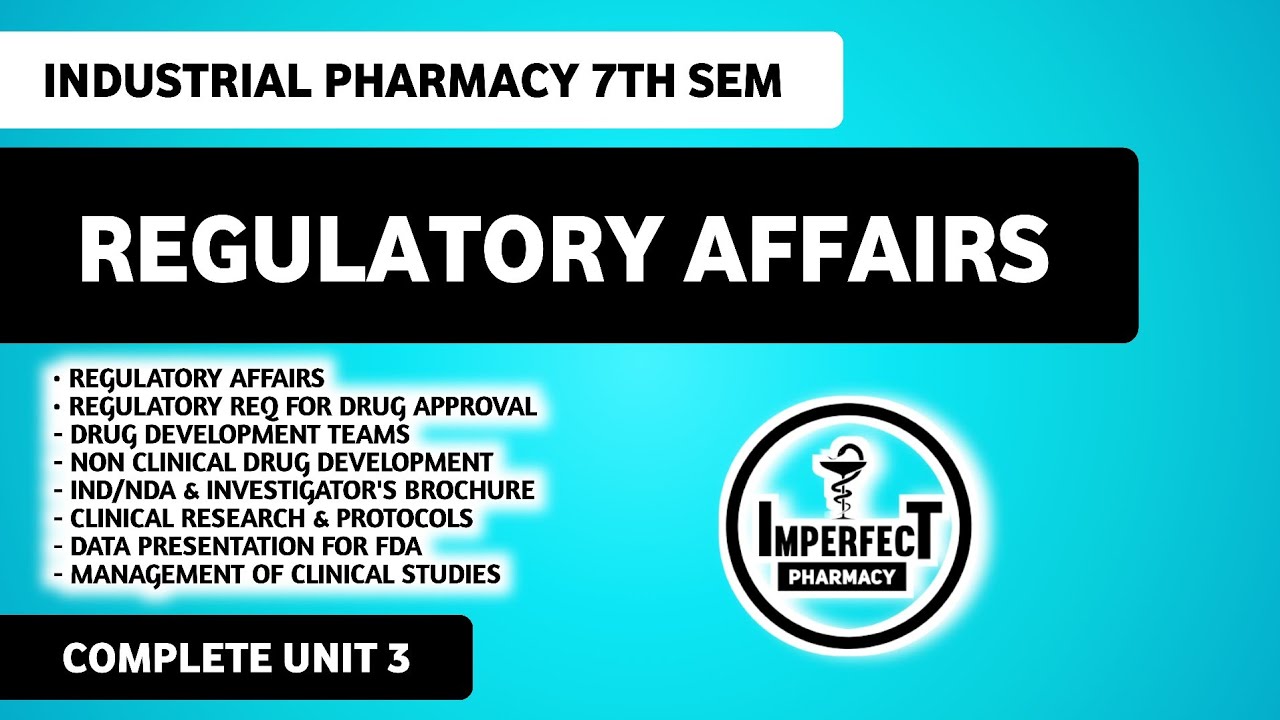
Regulatory Affairs | Regulatory Requirements | Unit 3 Industrial Pharmacy 7th Semester
Imperfect M Pharm
Overview
This video provides a comprehensive overview of Unit 3 of Industrial Pharmacy, focusing on Regulatory Affairs and Regulatory Requirements for drug approval. It delves into the historical evolution of regulatory bodies, the functions of regulatory authorities, and the crucial role of the regulatory affairs department and its professionals within pharmaceutical companies. The latter half of the video details the drug development process, including non-clinical (pre-clinical) studies, the drug development team structure, and the requirements for Investigational New Drug (IND) applications, essential for initiating clinical trials.
How was this?
Save this permanently with flashcards, quizzes, and AI chat
Chapters
- Regulatory Affairs is a department within pharmaceutical companies responsible for ensuring compliance with all rules and regulations related to drug development, testing, manufacturing, and marketing.
- Its primary goal is to protect public health by ensuring only safe and effective medicines reach the market.
- Regulatory Affairs professionals act as a crucial link between pharmaceutical companies and regulatory authorities (like CDSCO in India or FDA in the US).
- The department manages activities such as drug registration, licensing, clinical trial approvals, labeling, and post-marketing surveillance.
Understanding regulatory affairs is vital for ensuring that pharmaceutical products are safe, effective, and meet legal standards, ultimately protecting patient well-being.
The Regulatory Affairs department ensures that a company strictly follows government-set rules for manufacturing and testing drugs, preventing unsafe medications from reaching consumers.
- Early 20th century lacked strict regulations, leading to unsafe and mislabeled medicines, increasing public health risks.
- Tragic incidents like the Diphtheria Antitoxin contamination (1901), Elixir Sulfanilamide tragedy (1937), Cutter Incident (1955), and Thalidomide tragedy (1960) highlighted the urgent need for regulation.
- These incidents led to the establishment of laws like the Biologics Control Act (1902) and the Federal Food, Drugs, and Cosmetics Act (1938) in the US, strengthening safety proof requirements.
- The period from 1980-2000 saw expansion and global harmonization of regulations, including Good Manufacturing Practices (GMP) and the establishment of the International Council for Harmonisation (ICH).
Learning from historical failures demonstrates why stringent regulatory oversight is essential for drug safety and efficacy, shaping the current robust pharmaceutical landscape.
The Elixir Sulfanilamide tragedy, where over 100 people died due to diethylene glycol used as a solvent, directly led to the US Federal Food, Drugs, and Cosmetics Act, mandating proof of safety before marketing.
- Regulatory authorities (e.g., FDA in the US, CDSCO in India) are responsible for approving whether a drug can proceed to clinical trials and enter the market.
- They evaluate scientific and clinical data to ensure drugs are pure, therapeutically effective, and have acceptable side effect profiles.
- Key functions include approving new drugs and medical devices, issuing manufacturing and sales licenses, ensuring quality standards, and monitoring adverse drug reactions.
- These bodies also inspect manufacturing sites for GMP compliance and regulate labeling and promotional materials to prevent misleading claims.
Regulatory authorities act as gatekeepers, safeguarding public health by rigorously assessing drugs before they are made available to patients.
The FDA reviews all data from pre-clinical and clinical trials to decide if a new drug is safe and effective enough to be approved for sale to the public.
- A Drug Development Team comprises specialists like chemists, pharmacologists, toxicologists, and statisticians who guide a drug from lab idea to market.
- Non-clinical (pre-clinical) development occurs before human testing and involves laboratory and animal studies to evaluate a drug's safety, pharmacological activity, and metabolism.
- These studies include in silico (computer modeling), in vitro (tissue culture), and in vivo (animal testing) methods.
- Key objectives are to determine pharmacological activity, ADME (Absorption, Distribution, Metabolism, Excretion), toxicity, and establish a safe starting dose for human trials.
Understanding the structured approach of the drug development team and the critical role of pre-clinical studies ensures that potential risks are identified and minimized before human exposure.
Before testing a new drug on humans, researchers conduct in vivo studies on animals to assess its toxicity and determine a safe initial dosage, like finding the LD50 (Lethal Dose 50%).
- An Investigational New Drug (IND) application is submitted to regulatory authorities (like FDA or CDSCO) to request permission to begin clinical trials in humans.
- It includes data from pre-clinical studies (pharmacology, toxicology), manufacturing information, proposed clinical trial protocols, and investigator information.
- The IND ensures the drug is sufficiently safe for human testing and that the proposed trials are scientifically sound and ethical.
- There are different types of INDs, including Investigator IND (filed by a physician for research) and Emergency Use IND (for life-threatening situations).
- Successful pre-clinical studies showing safety and biological activity are prerequisites for filing an IND.
The IND application is a critical gateway, ensuring that only well-researched and potentially safe drugs are tested on human volunteers, protecting participants and the integrity of the research.
A pharmaceutical company submits an IND application to the FDA, containing animal study data and the plan for Phase 1 clinical trials, to get approval to test a new cancer drug in human patients.
Key takeaways
- Regulatory Affairs departments are essential for ensuring pharmaceutical products comply with national and international laws, safeguarding public health.
- Historical drug tragedies underscore the critical need for stringent regulatory oversight and rigorous safety testing.
- Regulatory authorities play a vital role in approving drugs for clinical trials and market release based on scientific evidence.
- Non-clinical (pre-clinical) studies are foundational, providing crucial safety and efficacy data before human testing begins.
- The Drug Development Team is a multidisciplinary group that systematically guides a drug from discovery through post-market surveillance.
- The Investigational New Drug (IND) application is a mandatory step to initiate human clinical trials, demonstrating the drug's safety and the scientific validity of the proposed trials.
- Compliance with Good Manufacturing Practices (GMP) and Good Clinical Practices (GCP) is paramount throughout the drug development lifecycle.
Key terms
Regulatory AffairsRegulatory AuthoritiesCDSCOFDABiologics Control ActFederal Food, Drugs, and Cosmetics ActICHGMP (Good Manufacturing Practices)Drug Development TeamNon-clinical (Pre-clinical) StudiesIn silicoIn vitroIn vivoPharmacologyPharmacokineticsToxicologyLD50IND (Investigational New Drug) ApplicationClinical TrialsEthical Committee
Test your understanding
- What is the primary function of the Regulatory Affairs department within a pharmaceutical company?
- How did historical drug tragedies influence the development of modern regulatory requirements?
- What are the key responsibilities of regulatory authorities like the FDA or CDSCO in the drug approval process?
- Why are non-clinical (pre-clinical) studies essential before a drug can be tested in humans?
- What information must be included in an Investigational New Drug (IND) application, and why is it important?