6:34
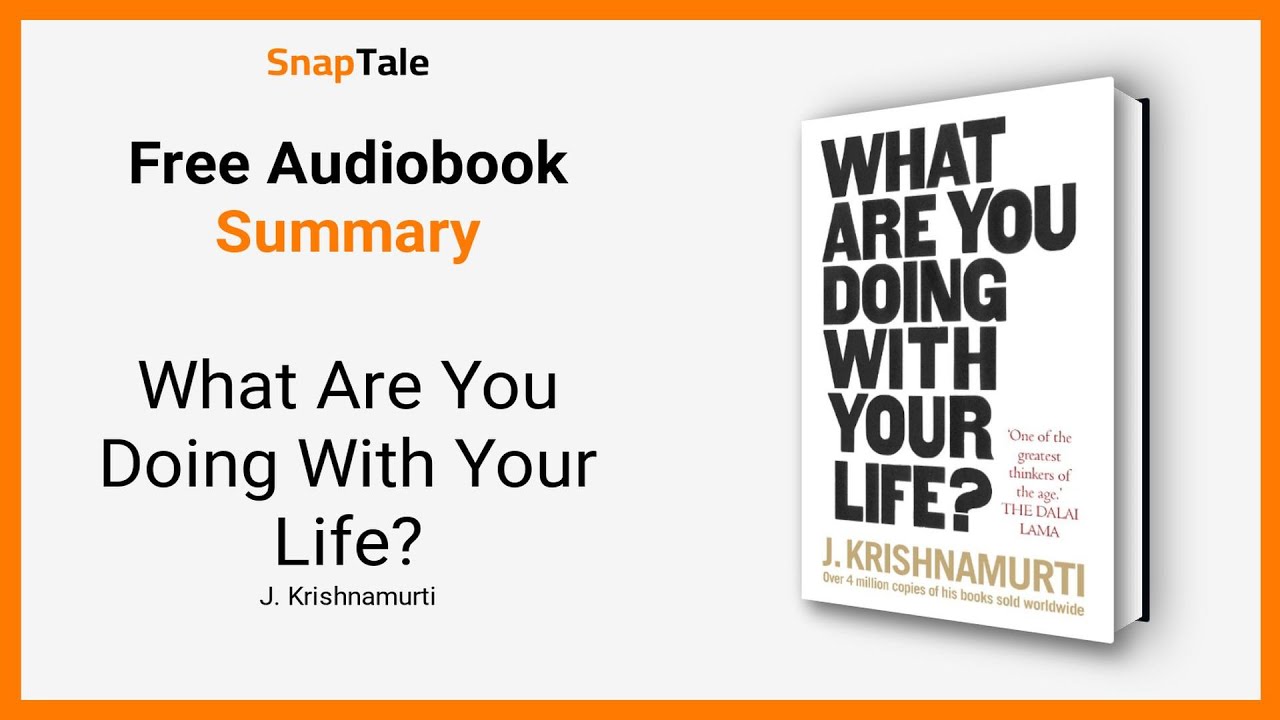
What Are You Doing With Your Life? by J. Krishnamurti: 6 Minute Summary
SnapTale Audiobook Summaries
Overview
This video summarizes J. Krishnamurti's "What Are You Doing With Your Life?", exploring how our conditioning shapes our perception of love, happiness, and life itself. It emphasizes the need to observe our minds objectively, break free from limiting beliefs, and understand that true transformation begins with the self. The summary also touches upon the difference between intellect and intelligence, the fleeting nature of happiness, the importance of confronting boredom, and the idea that life's purpose is found in living it fully, rather than seeking external definitions.
How was this?
Save this permanently with flashcards, quizzes, and AI chat
Chapters
- Our perception of the world is heavily shaped by conditioning, which limits our understanding.
- To see life clearly, we must observe our minds objectively and question our ingrained belief systems.
- Breaking free from conditioning allows us to perceive life's complexity and evolve with it.
Understanding conditioning is crucial because it reveals how our ingrained beliefs prevent us from seeing reality as it is, hindering personal growth and genuine understanding.
Observing the mind objectively to break free from grand theories and belief systems that restrict understanding.
- Global problems originate from individual issues and the ego-driven self.
- True world transformation starts with individual self-transformation, not external revolutions or theories.
- Escaping the ego involves observing the mind and recognizing destructive behaviors.
This highlights that societal change is not a distant event but an immediate personal responsibility, empowering individuals to be agents of positive change.
Taking individual responsibility for actions to address collective issues like economic inequality and war, rather than waiting for political solutions.
- The adult search for lasting happiness often leads to disappointment because nothing in life is permanent.
- Childhood happiness is simpler and less burdened by the need for security.
- True happiness is found by living in the present moment and accepting the transient nature of all experiences, including happiness.
Recognizing the impermanence of happiness helps us detach from the constant, often futile, chase for it, allowing us to find contentment in the present.
Accepting that happiness, like all things, is fleeting, and finding joy in the present moment rather than seeking a permanent state of bliss.
- Intellect is the analytical, conditioned part of the mind, shaped by education.
- Intelligence involves a harmonious blend of feeling and reasoning, requiring a quiet mind to perceive deeply.
- Recognizing intellect as a product of conditioning allows for a greater distance between the mind and perception, enabling truthful observation.
Distinguishing between intellect and intelligence helps us understand the limitations of purely analytical thought and cultivate a deeper, more intuitive way of knowing.
A quiet mind, free from the chatter of conditioned thought, is necessary to truly grasp the essence of something, going beyond mere analysis.
- Avoiding boredom through distractions prevents self-understanding and personal growth.
- Confronting and understanding boredom reveals underlying issues and unmet needs.
- Boredom can be an opportunity to reconnect with oneself and address the root causes of feeling uninspired.
Instead of seeing boredom as a negative state to be escaped, this perspective reframes it as a valuable signal for introspection and self-discovery.
Stopping to reflect on why one feels bored, rather than immediately seeking distractions like movies or social gatherings, to understand the root cause.
- The question 'What is the purpose of life?' is often misguided.
- Life itself, in its present existence, is its own purpose.
- Fulfillment comes from embracing the present moment and the richness of life, rather than seeking external definitions or certainty.
This shifts the focus from a future-oriented search for meaning to an appreciation of the present, suggesting that purpose is found in the act of living itself.
Focusing on the present moment and embracing life's beauty and complexity, rather than searching for a predefined roadmap or external validation of purpose.
Key takeaways
- Our conditioning acts as a filter, distorting our perception of reality; breaking free requires conscious observation of our own minds.
- Genuine transformation of the world begins with the individual's inner transformation, not with external societal changes.
- The pursuit of permanent happiness is futile; true contentment arises from accepting the impermanent nature of life and living fully in the present.
- Intelligence is more than just intellect; it involves a holistic understanding that requires a quiet, observant mind.
- Boredom is a valuable signal for self-reflection, offering an opportunity for growth rather than something to be avoided.
- Life's purpose is not a destination to be found, but the ongoing process of living itself, embraced in the present moment.
- Self-awareness is the foundation for both personal growth and contributing positively to the world.
Key terms
ConditioningEgoIntellectIntelligenceBoredomPresent MomentSelf-TransformationPerceptionBelief SystemsFleeting Nature
Test your understanding
- How does conditioning influence our perception of the world, and what is the proposed method to overcome its limitations?
- According to the video, why is self-transformation considered the key to transforming the world?
- What is the fundamental reason the pursuit of happiness often leads to disappointment, and where can true happiness be found?
- Explain the difference between intellect and intelligence as presented in the video, and how can one cultivate intelligence?
- What is the significance of embracing boredom, rather than avoiding it, for personal growth?