33:13
All of AQA CHEMISTRY Paper 1 in 30 minutes - GCSE Science Revision
Science Shorts
Overview
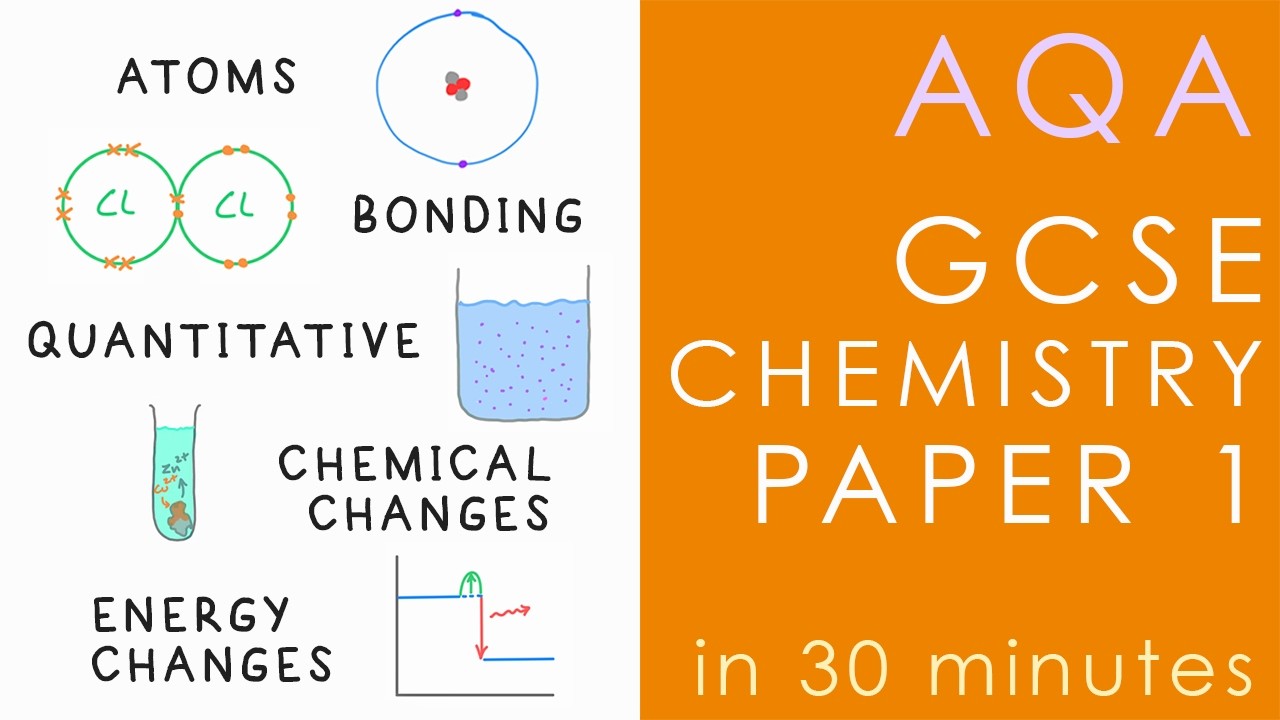
This video provides a comprehensive review of GCSE Chemistry Paper 1 topics, covering atomic structure, the periodic table, bonding, chemical calculations, and energy changes. It explains fundamental concepts like atoms, elements, compounds, and mixtures, and details different types of bonding (ionic, covalent, metallic). The summary also delves into calculations involving moles, mass, and concentration, as well as concepts like percentage yield and atom economy. Finally, it touches upon reactivity series, electrolysis, and exothermic/endothermic reactions, offering a structured approach to mastering the syllabus.
How was this?
Save this permanently with flashcards, quizzes, and AI chat
Chapters
- Substances are made of atoms, which are the basic building blocks of elements represented by symbols on the periodic table.
- A compound is formed when two or more different types of atoms are chemically bonded together, such as water (H2O).
- Chemical reactions involve the rearrangement of atoms, and equations must be balanced to ensure mass is conserved.
- Mixtures consist of substances not chemically bonded, like air or salt water, and can be separated by physical processes like filtration, crystallization, or distillation.
Understanding the fundamental nature of matter and how substances interact is crucial for comprehending all subsequent chemical concepts.
Balancing the chemical equation for the formation of water from hydrogen and oxygen, showing how to adjust coefficients to ensure the same number of atoms on both sides.
- Matter exists in three states: solid (vibrating particles in fixed positions), liquid (particles move past each other), and gas (particles are far apart and move randomly).
- Energy is required to change state (e.g., melting, evaporation) by overcoming forces between particles, but no new substances are formed.
- Atomic models evolved from Thomson's plum pudding model to Rutherford's nuclear model (with a small, dense nucleus) and Bohr's shell model, with Chadwick later discovering neutrons.
- Protons and neutrons are in the nucleus with relative mass 1, while electrons orbit with negligible mass and opposite charge to protons.
Grasping the particle theory of matter and the historical development of atomic models provides a foundational understanding of physical properties and the subatomic structure of elements.
The Rutherford gold foil experiment, where alpha particles mostly passed through a thin gold leaf, indicating that atoms are mostly empty space with a small, dense nucleus.
- The periodic table organizes elements by atomic number (number of protons), which defines the element.
- Atoms are neutral, so the number of electrons equals the number of protons; ions are formed when atoms gain or lose electrons.
- The mass number (protons + neutrons) indicates the total number of nucleons in the nucleus.
- Isotopes are atoms of the same element with different numbers of neutrons, leading to different mass numbers; the periodic table often shows the average relative atomic mass based on isotopic abundance.
The periodic table is a powerful tool that reveals patterns in elemental properties and allows prediction of behavior based on an element's position.
Chlorine, with isotopes Cl-35 and Cl-37, has an average relative atomic mass of 35.5 due to its relative abundance (75% Cl-35, 25% Cl-37).
- Electrons occupy shells around the nucleus, filling from the inside out (max 2, 8, 8, 2 electrons).
- Metals (left of the periodic table) tend to lose outer electrons to form positive ions, while nonmetals (right) gain electrons to form negative ions.
- The group number indicates the number of electrons in the outer shell, influencing reactivity.
- Reactivity generally increases down Group 1 (alkali metals) as the outer electron is further from the nucleus and easier to lose, while it decreases down Group 7 (halogens) as the electron is harder to gain.
Understanding electron configurations and periodic trends explains why elements behave the way they do and how their properties change across and down the table.
Alkali metals like sodium (Group 1) readily lose their single outer electron to form a +1 ion, making them highly reactive.
- Metallic bonding involves a lattice of positive ions surrounded by a 'sea' of delocalized electrons, allowing metals to conduct electricity and heat.
- Ionic bonding occurs between metals and nonmetals, where electrons are transferred, forming oppositely charged ions held together by electrostatic forces; ionic compounds have high melting points and conduct electricity when molten or dissolved.
- Covalent bonding occurs between nonmetals, where electrons are shared to form molecules; simple molecular structures have low boiling points due to weak intermolecular forces, while giant covalent structures (like diamond) are very hard with high melting points.
- Ionic compounds are formed when the total charges of the ions balance to zero (e.g., NaCl, BeCl2).
The type of bonding dictates a substance's physical and chemical properties, such as melting point, conductivity, and hardness.
Lithium (Li) donates its outer electron to Chlorine (Cl) to form Li+ and Cl- ions, resulting in lithium chloride (LiCl) through ionic bonding.
- Mass is conserved in chemical reactions; relative formula mass (RFM) is the sum of relative atomic masses (RAMs) of atoms in a compound.
- A mole is a unit representing 6.02 x 10^23 particles (Avogadro's constant); one mole of a substance has a mass in grams equal to its RAM or RFM.
- The number of moles can be calculated using: moles = mass (g) / RAM (or RFM).
- Stoichiometry (the ratio of moles in a balanced equation) is used to relate masses of reactants and products, often using moles as an intermediate step (mass -> moles -> moles -> mass).
- A limiting reactant is the one that is completely used up, determining the maximum amount of product that can be formed.
Quantitative chemistry allows us to predict the amounts of substances involved in reactions, essential for synthesis and industrial processes.
Calculating the mass of water produced from 64g of methane, involving converting methane mass to moles, using the mole ratio from the balanced equation to find moles of water, and then converting moles of water back to mass.
- Concentration can be expressed in g/dm³ or mol/dm³ (molar concentration).
- Percentage yield compares the actual amount of product obtained to the theoretical maximum, indicating reaction efficiency in practice.
- Atom economy measures the proportion of reactant atoms that end up in the desired product, highlighting waste in a reaction.
- One mole of any gas occupies 24 dm³ at room temperature and pressure (RTP).
These concepts help evaluate the efficiency and sustainability of chemical processes, guiding chemists towards more effective and less wasteful methods.
Calculating the atom economy for the production of CO2 from methane and oxygen, comparing the RFM of CO2 to the total RFM of the reactants.
- The reactivity series ranks metals by their tendency to lose electrons; more reactive metals displace less reactive ones from compounds.
- Metals more reactive than hydrogen displace it from acids to form salts and hydrogen gas; alkali metals react with water to form metal hydroxides (alkalis) and hydrogen.
- Acids contain H+ ions and have a pH < 7; alkalis contain OH- ions and have a pH > 7; neutral substances have pH = 7.
- Strong acids/alkalis fully dissociate in solution, while weak ones only partially dissociate; pH is a logarithmic scale, meaning a change of 1 pH unit represents a tenfold change in H+ or OH- concentration.
Understanding reactivity and acid-base chemistry is fundamental to predicting reaction outcomes and controlling chemical processes, from industrial synthesis to biological functions.
Zinc reacting with copper sulfate solution, where zinc (more reactive) displaces copper, forming zinc sulfate and solid copper.
- Electrolysis uses electricity to decompose ionic compounds; cations (positive ions) move to the cathode (negative electrode) and are reduced, while anions (negative ions) move to the anode (positive electrode) and are oxidized.
- In aqueous solutions, the reactivity of ions determines what is discharged at the electrodes; less reactive species are preferentially discharged.
- Exothermic reactions release energy (get hotter), while endothermic reactions absorb energy (get colder).
- Activation energy is the minimum energy required to start a reaction; bond breaking requires energy, and bond making releases energy.
Electrolysis is vital for extracting reactive metals and purifying substances, while understanding energy changes is key to controlling reaction rates and predicting heat transfer.
Electrolysis of molten aluminum oxide, where Al³⁺ ions gain electrons at the cathode to form aluminum metal, and O²⁻ ions lose electrons at the anode to form oxygen gas.
Key takeaways
- Chemical reactions are governed by the conservation of mass, meaning atoms are rearranged, not created or destroyed, necessitating balanced equations.
- The periodic table's structure reflects electron configurations, explaining trends in reactivity and the formation of ions.
- Different types of chemical bonding (ionic, covalent, metallic) result in distinct physical properties like conductivity and melting point.
- The mole concept provides a quantitative link between mass and the number of particles, enabling calculations of reactant and product amounts.
- Percentage yield and atom economy are critical metrics for assessing the efficiency and sustainability of chemical processes.
- Reactivity series and pH scales help predict reaction outcomes and the behavior of acids and alkalis.
- Electrolysis uses electrical energy to drive non-spontaneous chemical reactions, crucial for metal extraction and purification.
- Energy changes in reactions (exothermic vs. endothermic) are determined by the balance between energy required for bond breaking and energy released during bond making.
Key terms
AtomElementCompoundMixtureMoleIsotopeIonIonic BondingCovalent BondingMetallic BondingPeriodic TableAtomic NumberMass NumberRelative Atomic Mass (RAM)Relative Formula Mass (RFM)Limiting ReactantPercentage YieldAtom EconomypH ScaleElectrolysisExothermic ReactionEndothermic ReactionActivation Energy
Test your understanding
- How does the structure of an atom, specifically the number of protons and electrons, determine its chemical identity and charge?
- Explain the difference between a compound and a mixture, and describe one method used to separate them.
- What are the key differences in properties between substances with ionic, covalent, and metallic bonding, and why do these differences arise?
- How is the mole concept used to relate the mass of a substance to the number of particles involved in a chemical reaction?
- Why are concepts like percentage yield and atom economy important for evaluating the efficiency and environmental impact of chemical processes?