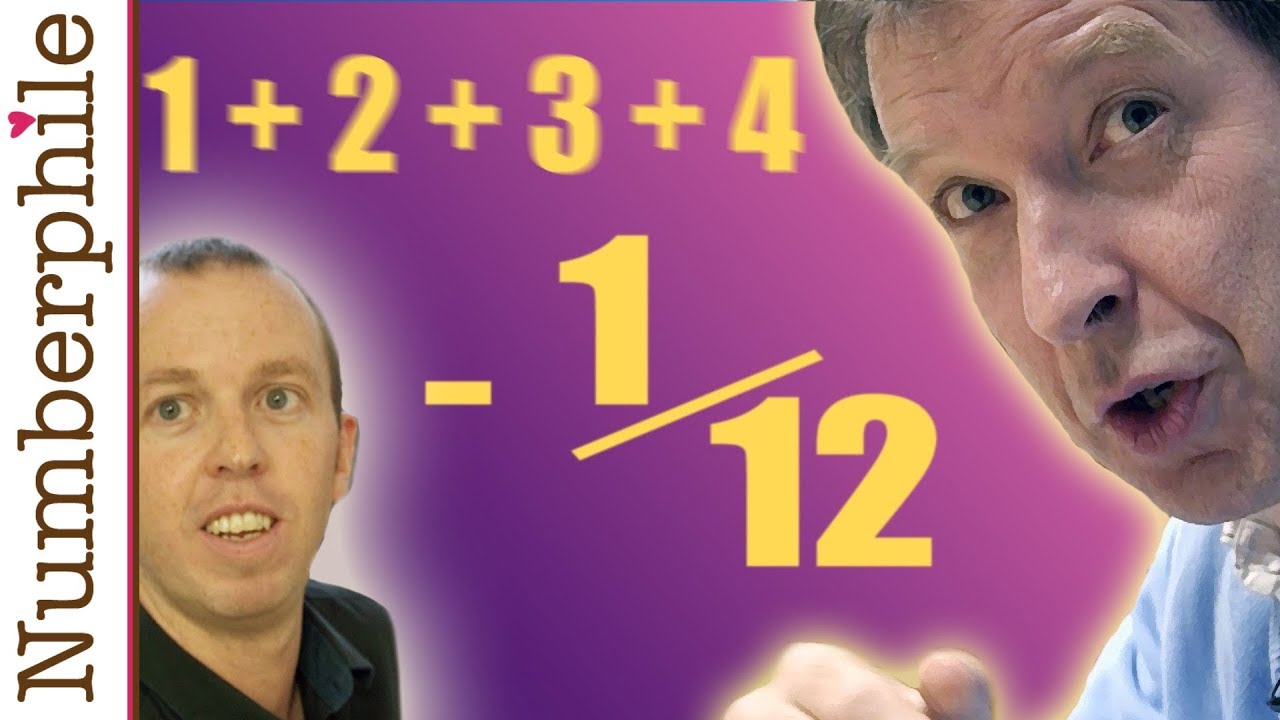
ASTOUNDING: 1 + 2 + 3 + 4 + 5 + ... = -1/12
Numberphile
Overview
This video explores the counter-intuitive mathematical result that the sum of all natural numbers (1 + 2 + 3 + ...) equals -1/12. While seemingly paradoxical, this result arises from specific mathematical techniques used to assign values to divergent series. The video demonstrates a simplified proof of this concept by first evaluating two related alternating series, S1 (1 - 1 + 1 - 1 + ...) and S2 (1 - 2 + 3 - 4 + ...), and then using these to derive the value of the sum of natural numbers. The presenter emphasizes that this result, though not intuitive, has practical applications in physics, particularly in string theory, and is a consequence of extending mathematical tools beyond their usual finite domains.
Save this permanently with flashcards, quizzes, and AI chat
Chapters
- The sum of all natural numbers (1 + 2 + 3 + ...) appears to diverge to infinity.
- However, a remarkable mathematical result states that this sum is equal to -1/12.
- This result is counter-intuitive because we typically expect the sum of positive numbers to be positive.
- This concept is utilized in advanced areas of physics, such as string theory.
- To understand the sum of natural numbers, we first analyze two related alternating series.
- The first series, S1 (1 - 1 + 1 - 1 + ...), is assigned a value of 1/2 by averaging its two possible finite sums (1 and 0).
- The second series, S2 (1 - 2 + 3 - 4 + ...), is shown to equal 1/4 by manipulating two copies of the series.
- These evaluations use methods to assign values to series that do not converge in the traditional sense.
- The sum of natural numbers (S = 1 + 2 + 3 + ...) can be found by subtracting the S2 series from S.
- Subtracting S2 (1 - 2 + 3 - 4 + ...) from S (1 + 2 + 3 + 4 + ...) results in a new series: 0 + 4 + 0 + 8 + 0 + 12 + ...
- This new series can be factored as 4 times the original sum S (4 * (1 + 2 + 3 + ...)).
- Setting up the equation S - S2 = 4S, and substituting S2 = 1/4, leads to S - 1/4 = 4S, which solves to S = -1/12.
- The result -1/12 is not obtained by simply summing numbers sequentially to infinity.
- It arises from specific mathematical regularization techniques that assign values to divergent series.
- The validity of this result is supported by its consistent appearance and utility in various areas of physics.
- While mathematically sound, the result remains counter-intuitive because our finite, everyday experience does not prepare us for such outcomes.
Key takeaways
- The sum of all natural numbers (1 + 2 + 3 + ...) can be mathematically assigned the value -1/12.
- This result is achieved through methods that extend standard arithmetic to handle divergent series.
- The derivation involves analyzing and manipulating related alternating series.
- Counter-intuitive mathematical results can have significant applications in theoretical physics.
- Mathematical tools can assign meaningful values to infinite sums that do not converge in the traditional sense.
- Our intuition about infinite sums is often limited by our experience with finite quantities.
Key terms
Test your understanding
- What is the seemingly paradoxical value assigned to the sum of all natural numbers?
- How does the video demonstrate a method for evaluating the sum 1 - 2 + 3 - 4 + ...?
- What is the relationship between the sum of natural numbers (S) and the alternating series S2 in the derivation?
- Why is the result that 1 + 2 + 3 + ... = -1/12 considered counter-intuitive?
- In what field of science is the result -1/12 applied, and why does its application lend credibility to the mathematical finding?