6:50
AICE International History chapter 1.3 review
Juliana Fernandez
Overview
This video explains how Japan transformed from an isolated, pre-modern nation into a major world power by the early 20th century. It details the Meiji Restoration's modernization efforts, including Western-inspired reforms in government, military, and industry, fueled by economic growth and a focus on export trade. The summary then covers Japan's expansionist foreign policy, highlighted by the Sino-Japanese War and the Russo-Japanese War, which led to international recognition. Finally, it touches upon Japan's role in World War I and its increasing influence in China, setting the stage for future global dynamics.
How was this?
Save this permanently with flashcards, quizzes, and AI chat
Chapters
- 19th-century Japan had a rigid, medieval social structure with a closed-door policy towards foreigners since the 17th century.
- Several Western powers, including Russia, Britain, and the USA, attempted to establish trade relations but initially failed.
- The USA specifically sought trade access to expand markets for its industrial output, resupply its whaling fleets, and address mistreatment of its sailors.
Understanding Japan's isolated state and the external pressures it faced is crucial for grasping the motivations behind its rapid transformation and subsequent expansion.
Commodore Perry's 1853 expedition, which used the threat of violence to force Japan to open two ports to US trade.
- The Meiji Restoration in 1868 replaced the Shogun with the Emperor, initiating a top-down drive for modernization to counter foreign imperialism.
- Japan adopted a centralized government, a German-inspired constitution, and Western models for its education, military, and industrial sectors.
- Significant investment in infrastructure like railways and telegraphs facilitated industrial growth and national unity.
- Economic modernization focused on export trade, particularly textiles, to fund these development efforts.
The Meiji Restoration was a pivotal moment, demonstrating Japan's ability to rapidly adopt Western technologies and systems, laying the foundation for its future military and economic strength.
Allocating one-third of the national budget to army and navy expansion and implementing compulsory military service for adult males.
- Driven by a need for resources like coal and steel, Japan's economic ambitions led to conflict with China.
- Japan's modernized military decisively defeated China, resulting in the acquisition of Korea and parts of China.
- The Treaty of Shimonoseki ceded territory to Japan, but European powers (Russia, France, Germany) intervened, forcing Japan to return key areas like Port Arthur.
- This 'triple intervention' humiliated Japan and spurred further military buildup, particularly in naval power.
This war marked Japan's emergence as a regional power, challenging established Chinese dominance and revealing the complex interplay between Asian powers and European imperial interests.
Japan's modern army defeating Chinese forces and gaining control over Korea.
- Russian expansion in the Far East threatened Japanese interests in Korea, leading to increased tensions.
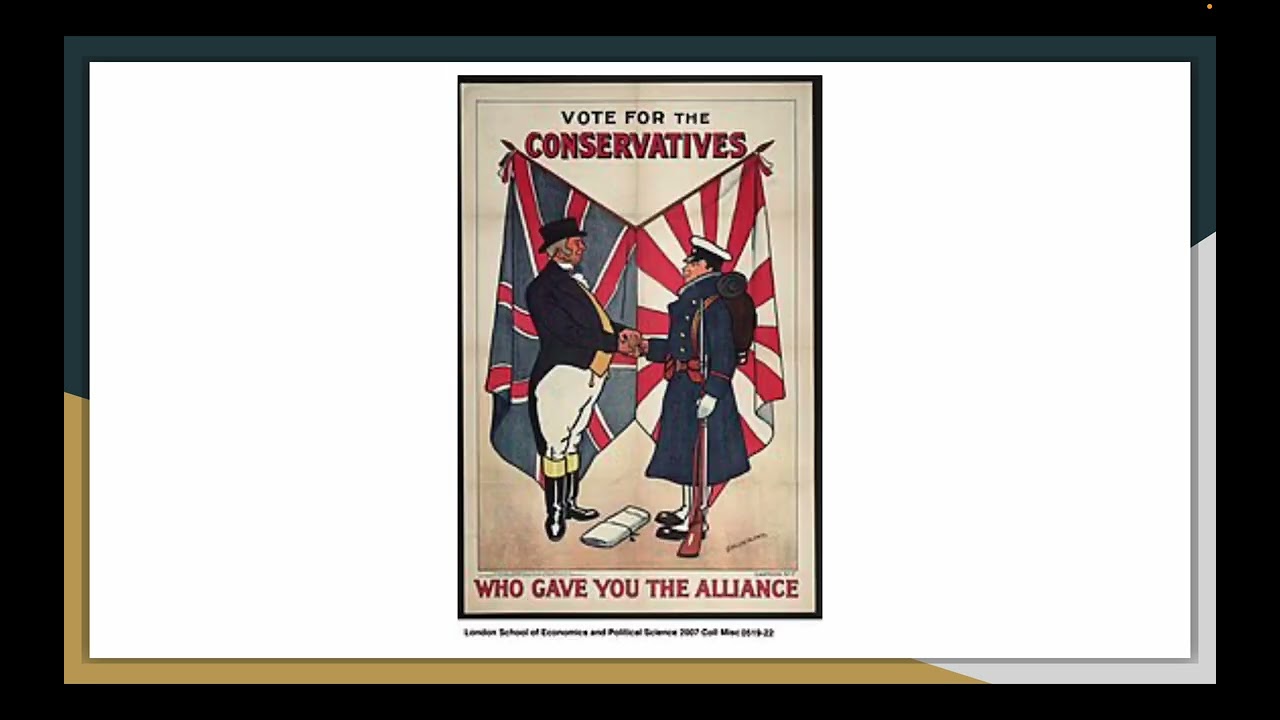
- Britain, concerned about Russian influence, formed the Anglo-Japanese Alliance in 1902, recognizing Japan's influence in Korea.
- The Russo-Japanese War (1904-1905) began with a surprise Japanese attack on Russian forces at Port Arthur.
- Japan's decisive victory, including the naval battle of Tsushima, led to the Treaty of Portsmouth, which acknowledged Japanese dominance in Korea and ended Russian influence in Manchuria.
The victory over Russia, a major European power, was a watershed moment, signifying Japan's arrival as a global military force and fundamentally altering the balance of power in East Asia.
Admiral Togo's fleet using modern warships to defeat Russia's outdated navy at the Battle of Tsushima.
- Honoring its alliance with Britain, Japan entered World War I by declaring war on Germany to secure Pacific sea lanes.
- During the war, Japan experienced significant economic growth, with exports tripling and heavy industry expanding due to reduced European competition.
- Japan exploited the situation by occupying German territories in China and presenting China with the '21 Demands,' seeking greater political and economic control.
- Post-war, Western powers grew wary of Japan's increasing economic and political ambitions in China, which threatened their own interests.
Japan's actions during and after WWI demonstrated its expanding global reach and its assertive approach to regional dominance, creating new tensions with Western powers.
Japan presenting China with the '21 Demands' in 1915, aiming to establish significant Japanese political and economic dominance.
Key takeaways
- Japan's rapid modernization was a deliberate, top-down response to the threat of Western imperialism.
- Economic development, particularly in textiles and heavy industry, was crucial for funding military expansion and modernization.
- Military strength and successful wars against China and Russia were key factors in Japan's recognition as a world power.
- The Anglo-Japanese Alliance demonstrated Japan's ability to form strategic international partnerships.
- Japan's expansionist policies in Asia, particularly towards China, created significant international friction.
- The Meiji Restoration's reforms created a strong, centralized state capable of rapid industrial and military development.
Key terms
ShogunMeiji RestorationCommodore PerryTriple InterventionAnglo-Japanese AllianceRusso-Japanese WarTreaty of Portsmouth21 DemandsShinto religion
Test your understanding
- What were the primary internal and external factors that motivated Japan's rapid modernization in the late 19th century?
- How did the Meiji Restoration fundamentally change Japan's political and social structure?
- Why was the outcome of the Russo-Japanese War significant for Japan's international standing?
- What impact did Japan's participation in World War I have on its economy and its relationship with China?
- Explain the role of economic needs and resource scarcity in driving Japan's foreign policy and military expansion.