14:00
Converting Between Moles, Atoms, and Molecules
Tyler DeWitt
Overview
This video explains how to convert between moles and the number of atoms or molecules, collectively referred to as particles. It demonstrates two methods: a straightforward conceptual approach and the use of conversion factors. The core concept relies on Avogadro's number (6.02 x 10^23 particles per mole), analogous to how 12 items make a dozen. The video covers conversions in both directions: from moles to particles and from particles to moles, emphasizing the importance of scientific notation and significant figures in calculations.
How was this?
Save this permanently with flashcards, quizzes, and AI chat
Chapters
- Conversions between moles and the number of atoms or molecules (particles) are explained.
- A 'particle' is a general term for an individual item, including atoms and molecules.
- Two methods will be shown: a conceptual approach and using conversion factors.
Understanding this fundamental relationship is crucial for quantitative chemistry, allowing you to relate macroscopic amounts of substances to the number of individual atoms or molecules present.
The video uses jellybeans, coins, and paperclips as analogies for 'particles' to illustrate the concept.
- A mole is a unit representing a specific, very large number of items, similar to a dozen.
- One mole is equivalent to 6.02 x 10^23 particles (Avogadro's number).
- The analogy of a dozen (12 items) helps in grasping the scale of a mole.
Grasping the mole concept as a counting unit is essential, as it bridges the gap between the number of items you can count and the mass of a substance you can measure.
Just as 1 dozen eggs means 12 eggs, 1 mole of atoms means 6.02 x 10^23 atoms.
- To find the number of atoms in a given number of moles, multiply the moles by Avogadro's number (6.02 x 10^23 atoms/mole).
- This is conceptually similar to finding the total number of items in multiple dozens by multiplying the number of dozens by 12.
- Calculations should be performed using scientific notation, and the final answer must be rounded to the correct number of significant figures based on the input values.
This method provides an intuitive way to calculate the vast number of atoms or molecules present in even small macroscopic samples.
To find the number of atoms in 5.5 moles of atoms, multiply 5.5 by 6.02 x 10^23, resulting in approximately 3.3 x 10^24 atoms after considering significant figures.
- Use the relationship '1 mole = 6.02 x 10^23 particles' to create conversion factors.
- To convert moles to particles, multiply the given moles by the conversion factor (6.02 x 10^23 particles / 1 mole).
- The moles unit in the starting value cancels out with the moles unit in the denominator of the conversion factor, leaving the desired particle unit.
Using conversion factors provides a systematic and reliable method for ensuring units cancel correctly, leading to the desired quantity.
To convert 5.5 moles to atoms, set up the calculation as: 5.5 moles * (6.02 x 10^23 atoms / 1 mole).
- To find the number of moles in a given number of particles, divide the number of particles by Avogadro's number (6.02 x 10^23 particles/mole).
- This is conceptually similar to finding the number of dozens by dividing the total number of items by 12.
- Ensure the calculation uses scientific notation and the result is rounded to the appropriate number of significant figures.
This method allows you to determine the amount of substance in moles when you know the count of individual atoms or molecules.
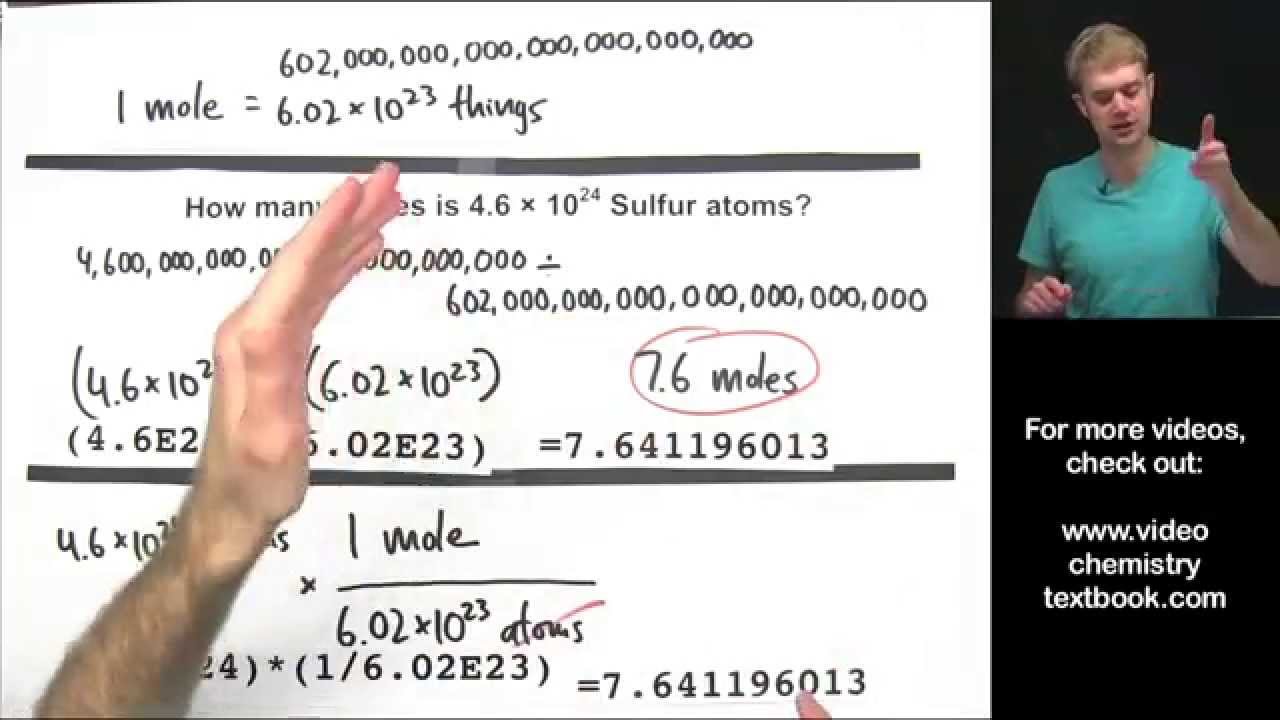
To find the number of moles in 4.6 x 10^24 Sulfur atoms, divide 4.6 x 10^24 by 6.02 x 10^23, resulting in approximately 7.6 moles.
- Use the relationship '1 mole = 6.02 x 10^23 particles' to create conversion factors.
- To convert particles to moles, multiply the given number of particles by the conversion factor (1 mole / 6.02 x 10^23 particles).
- The particle unit in the starting value cancels out with the particle unit in the denominator of the conversion factor, leaving the mole unit.
This systematic approach ensures accurate unit cancellation when converting from a count of particles to a quantity in moles.
To convert 4.6 x 10^24 atoms to moles, set up the calculation as: 4.6 x 10^24 atoms * (1 mole / 6.02 x 10^23 atoms).
Key takeaways
- A mole is a chemist's 'dozen,' representing a fixed number (6.02 x 10^23) of items.
- The value 6.02 x 10^23 is known as Avogadro's number and is fundamental for mole conversions.
- To convert from moles to particles, multiply by Avogadro's number; to convert from particles to moles, divide by Avogadro's number.
- Conversion factors, derived from the mole definition, provide a structured way to perform these calculations and ensure correct unit cancellation.
- Scientific notation is essential for handling the very large numbers involved in mole calculations.
- Always pay attention to significant figures when reporting the final answer in these calculations.
Key terms
MoleParticleAtomMoleculeAvogadro's numberScientific notationConversion factorSignificant figures
Test your understanding
- What is the fundamental relationship between moles and the number of particles?
- How does the concept of a dozen help in understanding the mole?
- Explain how to convert a given number of moles into the equivalent number of atoms using Avogadro's number.
- Describe the process of using a conversion factor to change from atoms to moles.
- Why is scientific notation important when performing calculations involving moles?