10:58
How Coca-Cola Is Made In Factory | Coca-Cola Factory Process
FoodMFG Lab
Overview
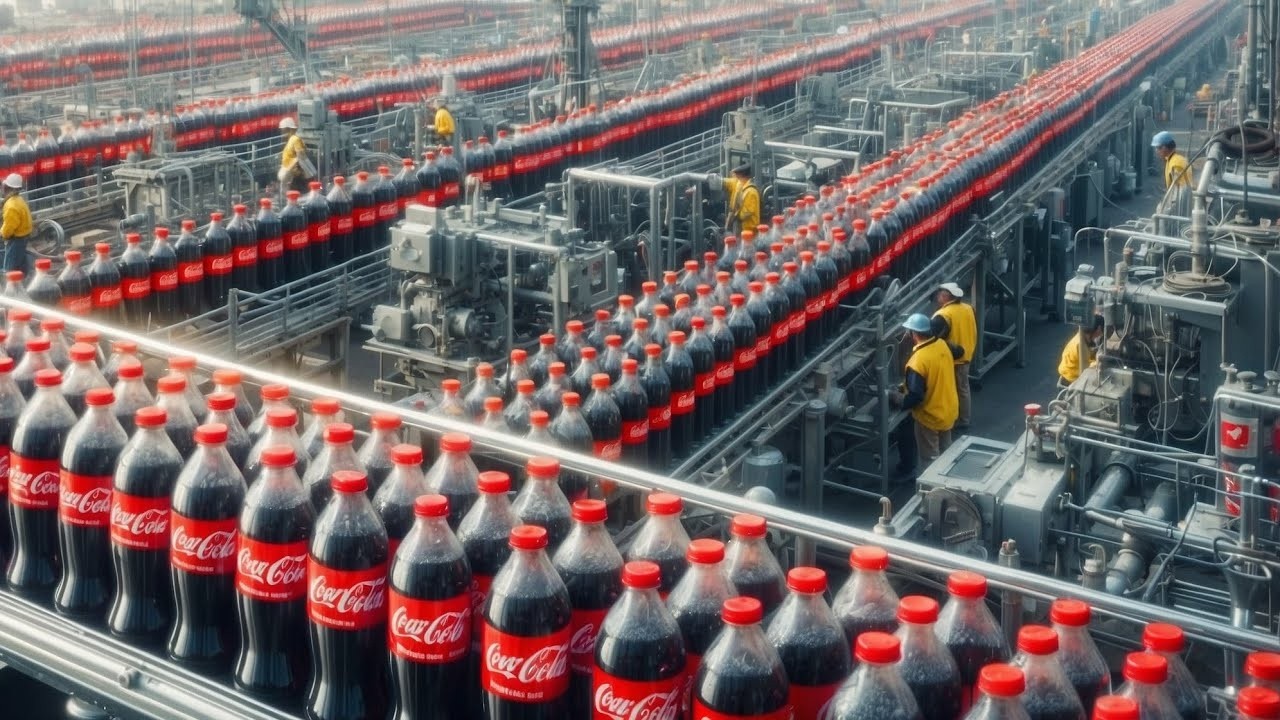
This video explores the intricate manufacturing and distribution process of Coca-Cola, highlighting how a beverage conceived in 1886 has become a globally ubiquitous product. It delves into the precise chemistry, advanced engineering, and complex logistics involved, from purifying water to the final packaging. The summary emphasizes that the process is a synchronized dance of science and technology, meticulously controlled to ensure consistent quality and taste across billions of servings daily, revealing that the secret formula is only a small part of the overall operation.
How was this?
Save this permanently with flashcards, quizzes, and AI chat
Chapters
- Coca-Cola originated in 1886 when John Pemberton created a syrup from coca leaves and cola nuts, initially as a personal remedy.
- The first sales were minimal, averaging nine glasses a day, a stark contrast to the nearly 2 billion servings consumed globally today.
- Pemberton sold the formula, known as Merchandise 7X, to Asa Candler, who recognized its commercial potential.
- The exact formula is one of the most closely guarded trade secrets, with only a few individuals knowing the complete recipe and taking extreme precautions to protect it.
Understanding the humble origins and the extreme measures taken to protect the formula provides context for Coca-Cola's enduring legacy and its status as a global brand.
John Pemberton, a wounded Civil War veteran, concocting the syrup in his backyard kettle in Atlanta, Georgia, in 1886.
- The vast majority (95%) of Coca-Cola is water, which undergoes an extensive purification process to ensure consistency across all global factories.
- Purification involves multiple stages: sand filtration for sediment, activated carbon for chlorine removal, reverse osmosis for molecular-level impurity blocking, and UV disinfection for microorganisms.
- The goal is not just clean water, but 'identical water' that is chemically neutral, serving as a blank canvas for the flavor.
- Sweeteners, either sugar or high fructose corn syrup, are processed into a simple syrup and stored in massive silos.
This chapter reveals that achieving a consistent global taste relies heavily on meticulous water purification, demonstrating that even seemingly simple ingredients require complex industrial processes.
Water passing through activated carbon towers, where the surface area is so large it's compared to a football field, to chemically strip out chlorine.
- The secret concentrate, Merchandise 7X, arrives in secure, unmarked containers, handled with extreme security protocols.
- The concentrate contains a blend of ingredients including vanilla, cinnamon, citrus oils, and other unconfirmed components.
- This concentrate is precisely mixed with the simple syrup, instantly transforming the clear liquid into the familiar deep brown color of Coca-Cola.
- Despite achieving the correct color and flavor profile at this stage, the liquid is still flat.
This stage highlights the critical role of the secret formula, emphasizing that its precise integration with purified water and sweetener is what creates the iconic Coca-Cola flavor and appearance.
The moment the concentrate is metered into the simple syrup, causing the clear liquid to immediately turn its characteristic deep brown color.
- Carbonation, the process of adding CO2, is crucial for Coca-Cola's signature 'bite' and crispness.
- The 'carbocoolers' precisely control three variables: flow rate, temperature (chilled to 2-4°C for optimal CO2 absorption), and pressure.
- Dissolved CO2 forms carbonic acid, which creates the tingling sensation on the tongue, enhancing the flavor perception.
- This chemical reaction is considered the defining transformation, turning a flat syrup into a refreshing beverage.
Carbonation is not just for fizz; it's a chemical process that creates carbonic acid, contributing significantly to the taste and sensory experience of Coca-Cola, making it crisp rather than syrupy.
The sharp, tingling bite on your tongue when drinking a carbonated Coke, which is caused by mild carbonic acid reacting with taste buds.
- Glass bottles undergo rigorous high-pressure sanitization and inspection by high-speed cameras to detect microscopic flaws, preventing costly line stoppages.
- Cans are filled and sealed at even higher speeds, with the seam thickness precisely controlled (1.0-1.2 mm) to prevent leaks or ruptures from internal pressure.
- Automated systems fill bottles and cans within milliseconds, ensuring exact fill levels and secure seals to preserve carbonation and flavor.
- Multiple quality checks, including fill level, cap seal, and label position, are performed using lasers and cameras, with immediate ejection of any imperfect product.
The packaging process showcases extreme engineering precision and speed, demonstrating that maintaining product integrity and quality at high volumes requires relentless automated inspection and control.
Laser sensors and high-speed cameras inspecting every bottle and can for defects, with faulty items immediately ejected from the line.
- Robots handle the final packaging stages, including wrapping, shrink-wrapping, and stacking cases onto pallets with geometric accuracy.
- The entire process from empty bottle to stacked pallet takes less than an hour, highlighting extreme efficiency.
- Quality control labs operate 24/7, conducting tests like Brix (sugar content), pH (acidity), and spectrophotometry (color) with strict tolerances.
- Deviations in key metrics like sugar content can trigger immediate line shutdowns to maintain product consistency.
This chapter emphasizes the role of automation and stringent, continuous quality control in ensuring that every product meets exact specifications, regardless of the massive production scale.
A quality control lab pulling samples every 15-30 minutes for Brix testing, where a deviation of just half a percentage point in sugar content will shut down the production line.
- Finished products are moved to massive warehouses that function like airport logistics hubs, managed by computer-guided systems.
- Pallets are efficiently scanned, assigned, and routed to distribution bays.
- The distribution network is designed to deliver products across vast regions, reaching consumers rapidly.
- The scale of distribution rivals that of major military logistics operations, enabling 1.9 billion servings daily.
The final stage illustrates that Coca-Cola's success is not just about manufacturing but also about an incredibly sophisticated and rapid distribution network capable of supplying billions of servings worldwide.
A bottle filled at 10:00 a.m. in a plant being available in a cooler 500 miles away before midnight the same day.
Key takeaways
- The consistent global taste of Coca-Cola is achieved through meticulous purification of water, making it a chemically neutral base.
- The secret formula (Merchandise 7X) constitutes only a small fraction of the final product, underscoring the importance of other components and processes.
- Carbonation is a critical chemical process that creates carbonic acid, contributing significantly to the refreshing taste and mouthfeel.
- High-speed manufacturing relies on advanced robotics and relentless automated quality control to ensure precision and prevent errors.
- Protecting the secret formula involves extreme security measures, reflecting its immense value as a trade secret.
- The entire Coca-Cola production and distribution system is a marvel of synchronized chemistry, engineering, and logistics operating at an unparalleled scale.
- Even minor deviations in key metrics like sugar content or fill level trigger immediate production halts, emphasizing a commitment to absolute consistency.
Key terms
Merchandise 7XWater PurificationActivated Carbon FiltrationReverse OsmosisUV DisinfectionSimple SyrupConcentrateCarbonationCarbonic AcidBrix TestingSpectrophotometerRobotic Palletizers
Test your understanding
- Why is the water purification process so critical to Coca-Cola's global consistency?
- How does carbonation contribute to the taste and sensory experience of Coca-Cola beyond just providing fizz?
- What are the key engineering challenges in packaging Coca-Cola at high speeds, and how are they addressed?
- Describe the role of automation and quality control in ensuring the final product meets precise standards.
- Explain the significance of the extreme security measures surrounding the Coca-Cola formula.