5:03
Signal detection theory - part 2 | Processing the Environment | MCAT | Khan Academy
khanacademymedicine
Overview
This video explains the core concepts of Signal Detection Theory (SDT) as applied to processing environmental stimuli. It introduces two key variables: d-prime (d') and the criterion (C). D-prime quantifies the separation between the noise and signal distributions, indicating how easy it is to detect a signal. The criterion represents an individual's response strategy, determining their threshold for saying 'yes' or 'no'. Different strategies (B, D, C, beta) are explained, along with how they relate to an observer's bias towards being liberal (more 'yes' responses) or conservative (more 'no' responses).
How was this?
Save this permanently with flashcards, quizzes, and AI chat
Chapters
- Signal Detection Theory uses two distributions: one for background noise and one for the signal plus noise.
- These distributions are plotted on a graph where the x-axis represents stimulus intensity.
- The separation between the means of these two distributions is a measure called d-prime (d').
Understanding these distributions is crucial because their overlap directly influences how accurately a signal can be detected and how prone an observer is to errors.
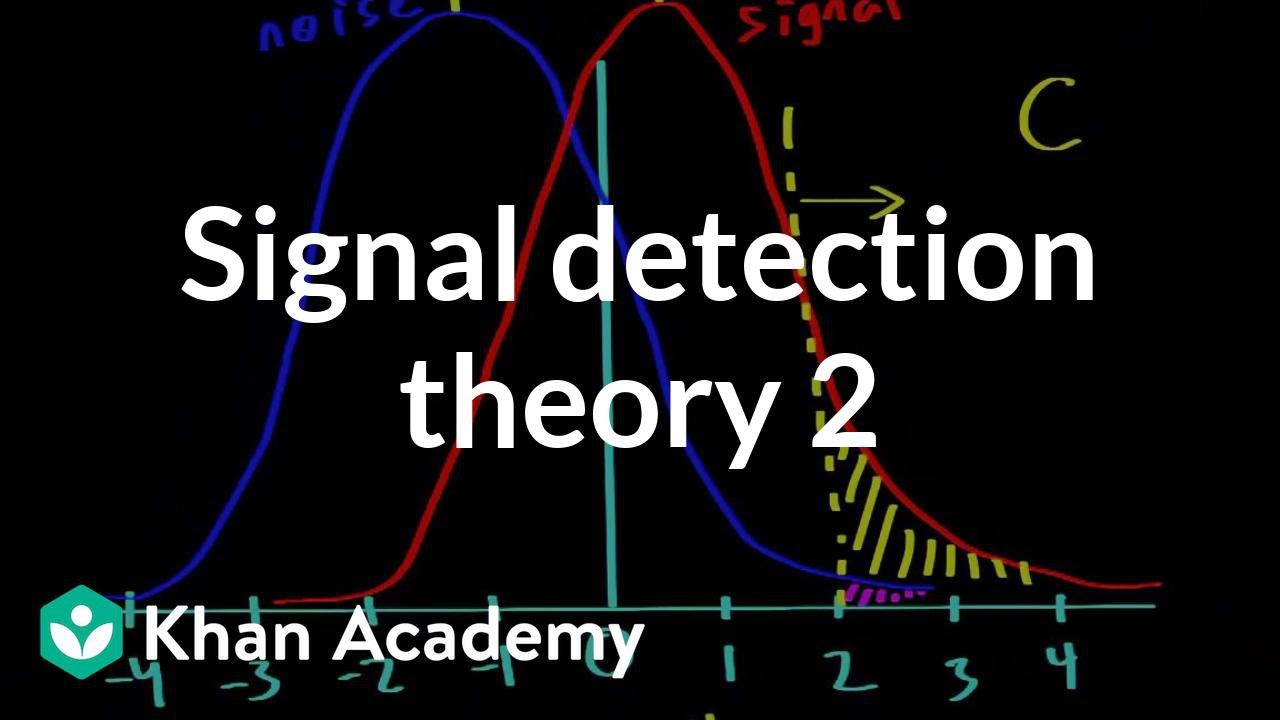
A graph showing a 'noise distribution' (blue) and a 'signal distribution' shifted to the right, illustrating a clear separation.
- D-prime (d') quantifies the ease of distinguishing a signal from noise.
- A large d-prime indicates a large separation between the signal and noise distributions, making detection easy.
- A small d-prime indicates a large overlap between the distributions, making detection difficult.
D-prime provides an objective measure of the sensory capability to detect a stimulus, independent of the observer's personal bias or strategy.
If the signal distribution is far to the right (high intensity), d-prime is large, signifying an easy task like detecting a bright green dot.
- The criterion (C) represents an individual's chosen threshold for responding 'yes' or 'no'.
- This threshold determines how much evidence is needed to confirm the presence of a signal.
- Different strategies (B, D, C, beta) are associated with different ways of setting this criterion.
The criterion explains why two people with the same sensory ability (d-prime) might perform differently on a detection task due to their response biases.
Setting a threshold of 'two' means responding 'yes' to anything above two and 'no' to anything below two.
- Strategy B: A fixed threshold is chosen, influencing the probability of hits and false alarms based on the overlap.
- Strategy D: The threshold is relative to the signal distribution (d' - B).
- Strategy C (Ideal Observer): Minimizes both misses and false alarms; mathematically represented as (B - d') / 2.
- Beta: Related to the ratio of the heights of the signal and noise distributions, often expressed as ln(beta) = d' * C.
Understanding these strategies helps in analyzing and predicting an individual's behavior in situations requiring signal detection, from medical diagnoses to everyday perception.
If d-prime is 1 and the threshold (B) is 2, Strategy D would set a threshold of 1 (2 - 1).
- When C equals 0, the observer is considered an 'ideal observer'.
- When C is less than 1, the observer is 'liberal', responding 'yes' more often than an ideal observer.
- When C is greater than 1, the observer is 'conservative', responding 'no' more often than an ideal observer.
These classifications (ideal, liberal, conservative) provide a framework for understanding and describing an individual's response bias in ambiguous situations.
A conservative observer might require very strong evidence before saying 'yes', thus reducing false alarms but increasing misses.
Key takeaways
- Signal Detection Theory separates the ability to detect a signal (d-prime) from the tendency to respond (criterion).
- D-prime reflects the actual difference between signal and noise, indicating the inherent detectability of a stimulus.
- The criterion represents a person's response bias, influenced by their strategy and willingness to say 'yes' or 'no'.
- A liberal strategy leads to more 'yes' responses (fewer misses, more false alarms), while a conservative strategy leads to more 'no' responses (more misses, fewer false alarms).
- Different mathematical formulations (B, D, C, beta) describe various ways an observer can set their criterion relative to the signal and noise distributions.
Key terms
Signal Detection TheoryNoise distributionSignal distributionD-prime (d')Criterion (C)ThresholdHitFalse alarmMissIdeal observerLiberal observerConservative observerBeta
Test your understanding
- How does d-prime relate to the difficulty of a signal detection task?
- What does the criterion (C) represent in Signal Detection Theory, and how does it influence responses?
- What is the difference between a liberal and a conservative response strategy?
- Explain the concept of an 'ideal observer' within Signal Detection Theory.
- How can the mathematical variables (like d-prime and C) be used to analyze an individual's performance in a signal detection task?