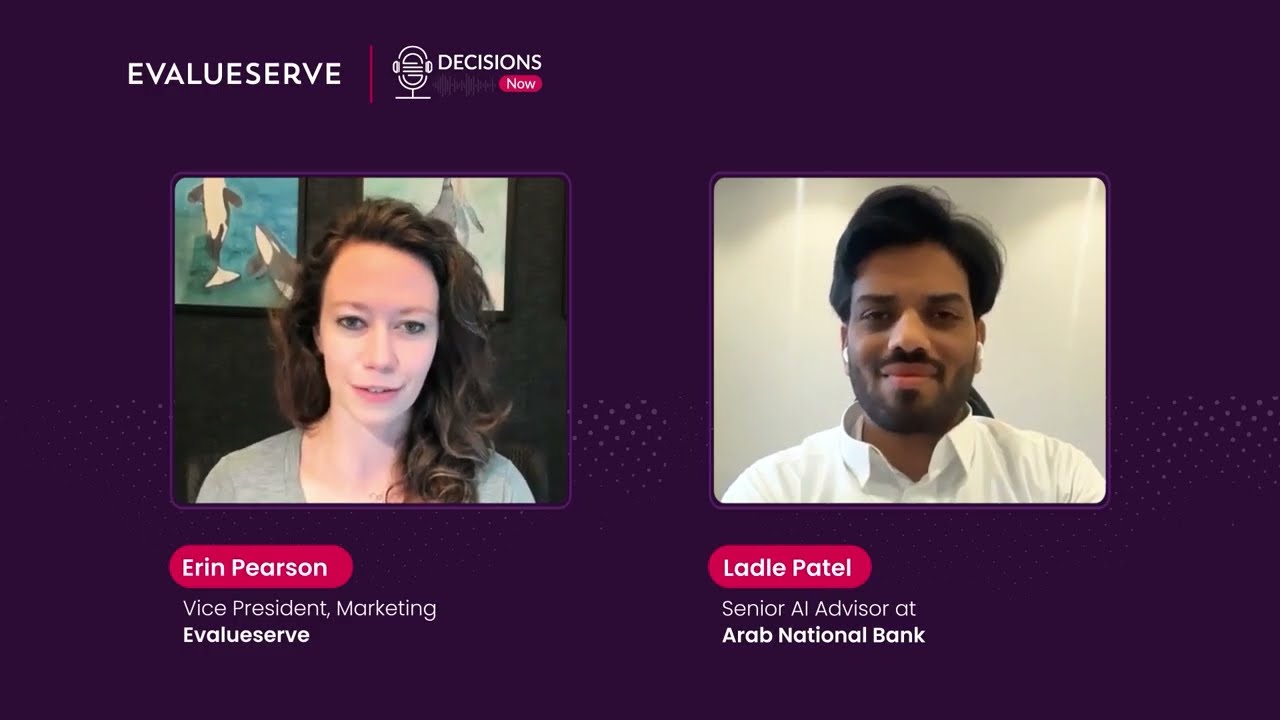
Decisions Now EP45: AI Strategy in Modern Banking with Ladle Patel
Evalueserve
Overview
This video discusses the strategic implementation of Artificial Intelligence (AI) in modern banking, particularly within the context of Saudi Arabia's Vision 2030. Llay Patel, Senior Advisor of AI and ML at Arab National Bank, shares insights on how AI is accelerating national digital transformation goals, the unique opportunities presented by Saudi Arabia's young, tech-savvy population, and the government's supportive infrastructure and regulatory environment. The conversation delves into developing a bank-wide AI strategy, prioritizing use cases based on strategic alignment, value assessment, and feasibility, and overcoming challenges in moving from basic AI applications to advanced task automation and workflow integration. It also covers building business cases for AI initiatives, demonstrating ROI through tangible metrics and prototypes, and the importance of an AI target operating model to streamline deployment and adoption. Finally, it touches upon the future of autonomous AI in redefining banking operations.
Save this permanently with flashcards, quizzes, and AI chat
Chapters
- AI is a cornerstone of Saudi Arabia's Vision 2030, expected to contribute significantly to the GDP.
- The country's young, mobile-first population creates a fertile ground for AI-driven customer experiences and tailored recommendations.
- Government initiatives, like the Saudi Data and AI Authority (SDAIA), provide crucial support through Arabic language models, AI governance frameworks, and research investment.
- Significant infrastructure investments by cloud providers and regulatory support from the Saudi Central Bank (SAMA) create a robust ecosystem for AI deployment at scale.
- AI strategy must be strategically aligned with overall business objectives, tailoring use cases to specific departmental goals (e.g., retail banking, wholesale banking, customer service).
- Value assessment is critical to prioritize AI use cases based on their potential impact across customer-facing, internal product innovation, or business support functions.
- Feasibility checks, considering data readiness, execution complexity, team capabilities, and regulatory alignment, are essential before deployment.
- Avoid simply copying trending AI use cases; instead, reverse-engineer them to support the bank's unique strategic direction and needs.
- Many banks are stuck in the 'query phase,' primarily using AI for internal FAQs or simple chatbots.
- Moving to task automation (e.g., updating customer information) requires deep integration with core banking systems and APIs, often hindered by fragmented technologies.
- Workflow automation, involving coordination between multiple AI agents, demands significant context memory, AI platform maturity, and robust infrastructure.
- Adoption challenges include fostering a culture where AI is seen as a collaborator, not just a tool, and managing change effectively.
- Start by strategically aligning AI initiatives with business goals to ensure buy-in.
- Develop simple Proofs of Concept (PoCs) or Minimum Viable Products (MVPs) using accessible open-source technologies and smaller language models to minimize initial investment.
- Demonstrate tangible value through interactive demos and pilot programs, focusing on measurable KPIs like time saved per employee.
- Use A/B testing for AI-driven campaigns to provide concrete evidence of effectiveness before scaling to enterprise-level solutions requiring significant investment and governance.
- The AI Target Operating Model aims to drastically reduce the time-to-deployment for AI use cases, moving from over a year to a few months.
- It involves clearly defining roles and responsibilities using frameworks like RACI (Responsible, Accountable, Consulted, Informed) across all stages, from ideation to monitoring.
- Establishing reusable templates and design patterns accelerates development by leveraging previously engineered features and code.
- Forming dedicated 'squads' with product owners to orchestrate use cases ensures accountability and streamlines execution.
- Autonomous AI is poised to fundamentally redefine current banking operations within the next 3-5 years.
- The pace of AI evolution is exponential, making predictions challenging but indicating a significant industry shift.
- Banks need to anticipate how autonomous agents will upend current assumptions about financial services and prepare for this transformation.
Key takeaways
- AI strategy must be deeply integrated with and derived from the bank's overall business strategy.
- Leveraging national initiatives and a tech-savvy population provides a unique advantage for AI adoption in Saudi Arabia.
- Moving beyond basic AI requires overcoming significant technical challenges related to system integration and data fragmentation.
- Demonstrating AI's value through tangible MVPs and clear ROI metrics is essential for securing stakeholder buy-in and investment.
- An AI Target Operating Model is crucial for streamlining the deployment lifecycle and managing complex AI initiatives efficiently.
- The future of banking will be significantly reshaped by the rise of autonomous AI agents, necessitating strategic preparation.
- Open-source technologies and smaller language models can accelerate the development and testing of AI use cases with lower initial investment.
Key terms
Test your understanding
- How does Saudi Arabia's Vision 2030 specifically create an advantageous environment for AI adoption in banking?
- What are the three core components of a framework for developing a successful bank-wide AI strategy?
- What are the primary challenges banks face when trying to advance from basic AI applications (like FAQs) to more complex task automation and workflow integration?
- How can banks effectively build business cases and demonstrate the ROI of AI initiatives to CXO stakeholders, especially when dealing with new technologies?
- What is the main objective of an AI Target Operating Model, and what key elements help achieve it?