1:22:10
JCCC Human A&P Chapter 17 & Chapter 20 part 1 - Lecture 04/28/26
Amanda Cobb
Overview
This lecture covers the anatomy and some physiology of the digestive and urinary systems. It begins with an overview of the digestive process, including mechanical and chemical digestion, and the roles of the alimentary canal and accessory organs. Key structures like the mouth, esophagus, stomach, and intestines are detailed, along with the four layers of the alimentary canal wall and the mechanisms of movement within it. The lecture then delves into the accessory organs: salivary glands, liver, gallbladder, and pancreas, explaining their functions and locations. Finally, it briefly introduces the urinary system, focusing on the kidneys.
How was this?
Save this permanently with flashcards, quizzes, and AI chat
Chapters
- The digestive system breaks down food mechanically and chemically to extract energy and nutrients.
- Mechanical digestion involves physically breaking down food into smaller pieces without altering molecular structure.
- Chemical digestion breaks down food by altering molecular structure using enzymes and chemicals like hydrochloric acid.
- Key functions include ingestion, propulsion, mixing, absorption, and defecation.
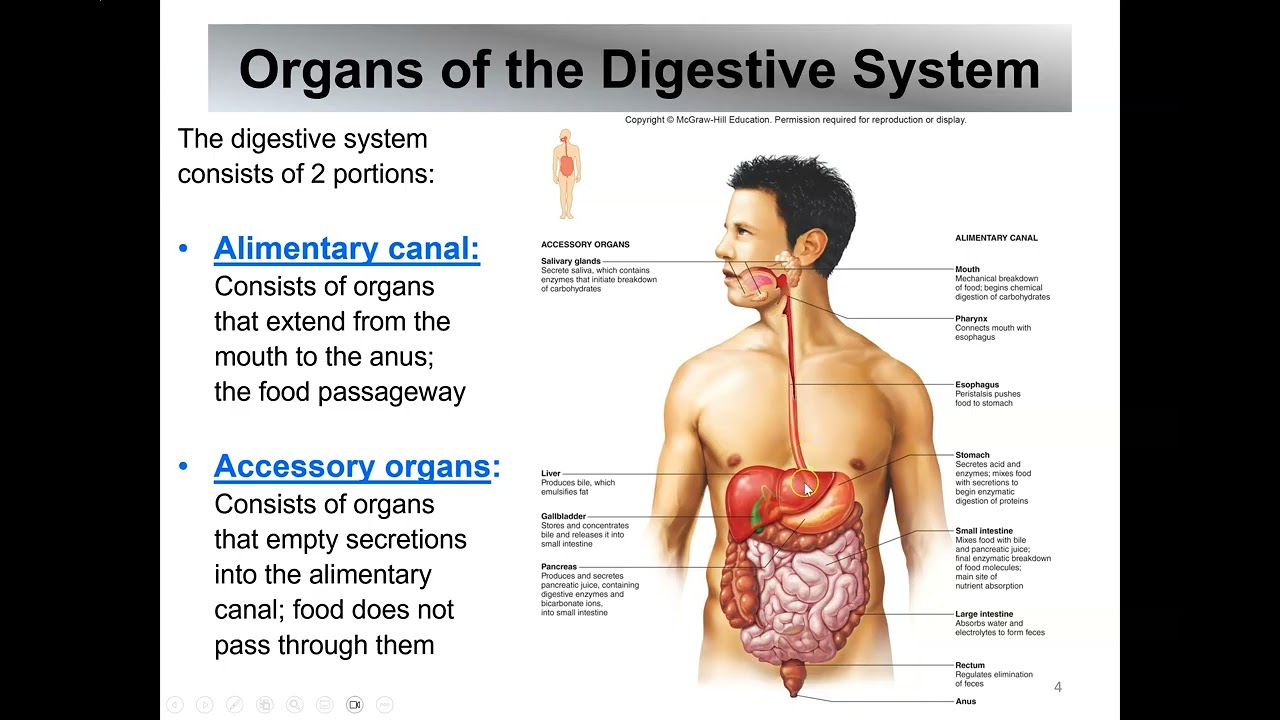
- The alimentary canal is where food passes, while accessory organs secrete substances to aid digestion without direct contact with food.
Understanding the fundamental processes of digestion and the roles of different organs is crucial for comprehending how the body obtains energy and nutrients from food.
Mechanical digestion is like chopping a cheeseburger into smaller pieces; chemical digestion involves breaking chemical bonds using enzymes.
- The four accessory organs are the salivary glands, liver, gallbladder, and pancreas, which produce secretions but do not directly contact food.
- The alimentary canal includes the mouth, pharynx, esophagus, stomach, small intestines, large intestines, rectum, and anus.
- The small intestines are named for their small lumen diameter, not their length, and are typically located centrally.
- The large intestines have a larger lumen diameter and typically surround the small intestines.
- The wall of the alimentary canal consists of four layers: mucosa, submucosa, muscularis, and serosa.
Differentiating between the structures food directly passes through and the organs that support digestion helps in understanding the overall pathway and functional organization of the digestive tract.
The liver produces bile, the gallbladder stores it, and the pancreas secretes enzymes, none of which directly touch the food being digested.
- Segmentation is a back-and-forth mixing motion within the alimentary canal.
- Peristalsis is a wave of contractions that propels food from one organ to the next.
- The enteric nervous system, with its submucosal and myenteric plexuses, controls digestive secretions and motility.
- The autonomic nervous system influences digestion, with 'rest and digest' states promoting activity and stress states inhibiting it.
- Stress can lead to indigestion because blood flow is diverted from the digestive system.
Understanding how food moves through the digestive tract and how its activity is regulated by the nervous system explains both normal function and common digestive issues like indigestion.
Peristalsis is the same mechanism that moves food down the esophagus as moves urine from the kidneys to the bladder.
- The mouth is where ingestion occurs, and mechanical digestion begins with mastication (chewing) by teeth and tongue.
- Chemical digestion of carbohydrates starts in the mouth with salivary amylase.
- The hard palate separates the oral cavity from the nasal cavity.
- The pharynx is divided into nasopharynx, oropharynx, and laryngopharynx, with only the oro- and laryngopharynx used for digestion.
- Swallowing (deglutition) involves voluntary and involuntary phases, including the elevation of the soft palate to close off the nasal cavity and the epiglottis closing over the airway.
The initial stages of digestion in the mouth and pharynx are critical for preparing food for further breakdown and preventing it from entering the respiratory system.
During swallowing, the soft palate rises to block the nasal cavity, and the epiglottis covers the opening to the trachea.
- Adults typically have 32 permanent teeth, including incisors, canines, premolars, and molars, each with a specific function.
- A tooth consists of a crown (enamel, dentin, pulp cavity) and a root, anchored by cementum and periodontal ligaments.
- Enamel is the hardest substance in the body but cannot be repaired once damaged.
- There are three pairs of salivary glands: parotid, submandibular, and sublingual.
- The parotid glands secrete salivary amylase, which begins carbohydrate digestion.
The structure of teeth is adapted for breaking down food, while salivary glands initiate chemical digestion and provide lubrication, highlighting the specialized functions within the oral cavity.
Salivary amylase, secreted by the parotid glands, starts breaking down carbohydrates in the mouth.
- The stomach has three muscle layers (oblique, circular, longitudinal) allowing for churning.
- Its regions include the cardia, fundus, body, and pylorus.
- Gastric pits contain cells that secrete mucus, pepsinogen (by chief cells), and hydrochloric acid and intrinsic factor (by parietal cells).
- Hydrochloric acid activates pepsinogen into pepsin, which digests proteins, and creates an acidic environment (pH 1-2).
- Intrinsic factor is essential for Vitamin B12 absorption, preventing pernicious anemia.
The stomach's unique structure and secretions are vital for both mechanical churning and the initial chemical breakdown of proteins, while also protecting its lining from self-digestion.
Chief cells secrete pepsinogen, which is activated by hydrochloric acid from parietal cells into pepsin to digest proteins.
- The pancreas functions as both an endocrine (insulin, glucagon) and exocrine organ, secreting pancreatic juice to neutralize stomach acid and provide enzymes for digestion in the small intestine.
- The liver produces bile, which aids in fat digestion and emulsification, and performs numerous other metabolic functions.
- The gallbladder stores and concentrates bile produced by the liver.
- Bile salts, the main component of bile, are derived from cholesterol and are crucial for emulsifying fats.
- Cholecystokinin (CCK) is a hormone that stimulates the gallbladder to release bile and the pancreas to secrete juices, also promoting satiety.
These accessory organs play indispensable roles in digestion by providing essential enzymes, acids, and emulsifiers, and by performing vital metabolic functions that support overall health.
When you eat a fatty meal, cholecystokinin is released, causing the gallbladder to contract and release bile to help break down the fats.
- The small intestine, consisting of the duodenum, jejunum, and ileum, is the primary site for nutrient absorption.
- The duodenum and jejunum are most active in nutrient absorption, while the ileum plays a role in immune function (Peyer's patches).
- The large intestine, named for its larger lumen, absorbs water and electrolytes and forms feces.
- The greater omentum is a fatty apron that covers the small intestines, providing protection and storing adipose tissue.
- The mesentery suspends the intestines and contains blood vessels, lymphatics, and nerves.
The small intestine's extensive surface area is optimized for absorbing nutrients, while the large intestine's role in water absorption is critical for maintaining hydration and waste elimination.
The small intestine absorbs the majority of nutrients from digested food, while the large intestine absorbs water from the remaining indigestible material.
- The lecture briefly introduces the urinary system, focusing on the kidneys.
- The urinary system's primary role is to filter waste products from the blood and excrete them as urine.
- Further details on the urinary system will be covered in the next lecture.
Understanding the urinary system is essential for comprehending how the body eliminates metabolic waste and maintains fluid and electrolyte balance.
Key takeaways
- Digestion involves both mechanical breakdown and chemical alteration of food to extract energy and nutrients.
- The digestive system is composed of the continuous alimentary canal and accessory organs that secrete digestive aids.
- The stomach's highly acidic environment and specialized enzymes are crucial for initiating protein digestion.
- Accessory organs like the liver, gallbladder, and pancreas provide essential substances for digestion, particularly for fats and neutralizing stomach acid.
- The small intestine is the primary site for nutrient absorption due to its specialized structure and large surface area.
- The nervous system, both intrinsic (enteric) and extrinsic (autonomic), tightly regulates digestive processes.
- Proper chewing (mastication) and swallowing mechanisms are vital for efficient digestion and preventing aspiration.
Key terms
Mechanical DigestionChemical DigestionAlimentary CanalAccessory OrgansPeristalsisSegmentationMasticationSalivary AmylasePepsinogenHydrochloric AcidIntrinsic FactorBileEmulsificationCholecystokinin (CCK)DuodenumJejunumIleumGreater OmentumMesentery
Test your understanding
- What is the difference between mechanical and chemical digestion, and provide an example of each?
- How do the accessory organs (liver, gallbladder, pancreas) contribute to digestion without directly processing food?
- Explain the roles of the submucosal and myenteric plexuses in regulating digestive activity.
- Describe the key events that occur during the second phase of swallowing to protect the airway.
- What are the primary functions of the stomach, and how does its structure facilitate these functions?
- Why is the small intestine the primary site for nutrient absorption, and what structures contribute to this efficiency?
- How does the hormone cholecystokinin (CCK) influence digestion and satiety?