1:07:50
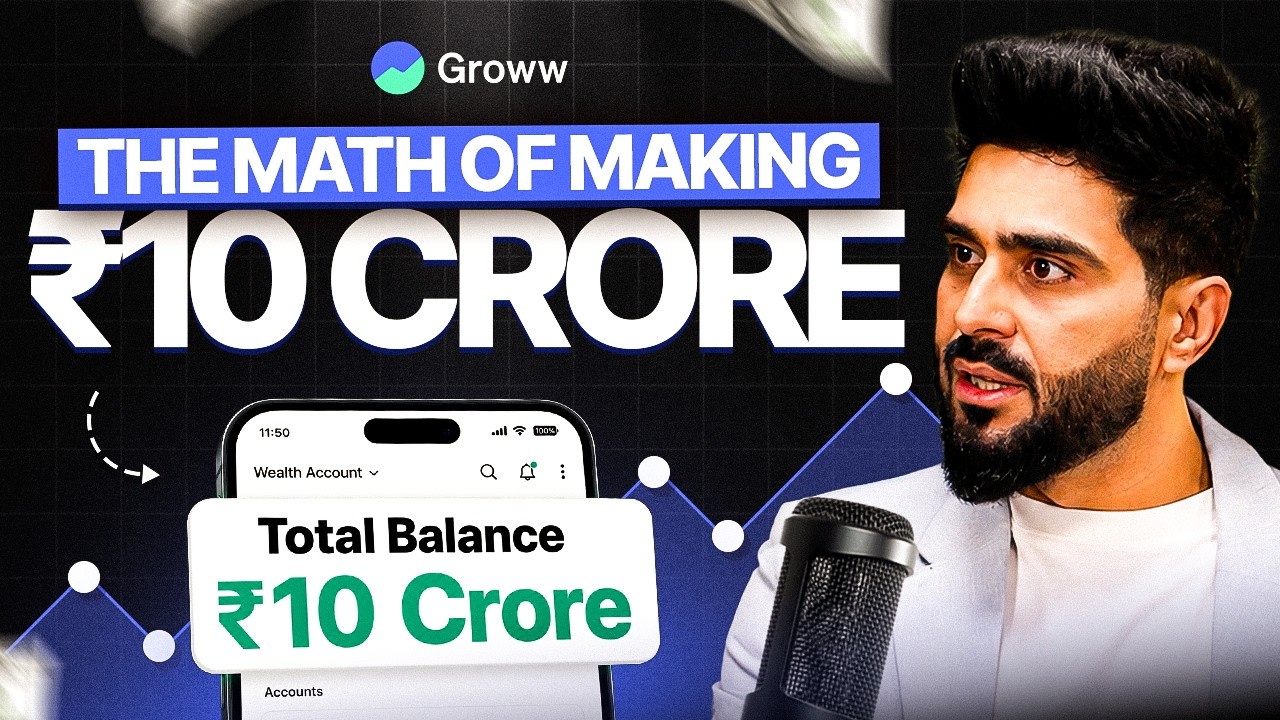
₹93,000 Crore Wealth Manager Explains How to Build Wealth | ₹10 Crore Roadmap ft. Feroze Azeez
Moneytalks by Groww
Overview
This video features wealth manager Feroze Azeez discussing strategies for building wealth, emphasizing the importance of a disciplined approach, understanding risk, and leveraging compounding. Azeez shares his personal journey from a teacher to a wealth manager, highlighting lessons learned from financial instability and market volatility. He debunks common investing myths, advocates for a long-term perspective, and stresses the intelligence of Indian retail investors. The discussion covers goal setting, the role of profession versus market returns in wealth accumulation, and practical advice on mutual fund investing, risk management, and portfolio allocation.
How was this?
Save this permanently with flashcards, quizzes, and AI chat
Chapters
- Feroze Azeez transitioned from a well-paying teaching job to wealth management due to family financial instability, driven by necessity.
- Experiencing poverty and financial hardship instilled resilience and a strong work ethic.
- Growth, both personal and financial, is crucial for happiness and professional success.
- Aspirations, fueled by past hardships, can be powerful motivators for hard work and financial achievement.
Understanding the speaker's personal journey provides context and credibility, illustrating how life experiences shape financial philosophies and drive ambition.
Azeez recounts walking 11 kilometers to see his niece because he couldn't afford bus fare, which fueled his aspiration to own cars and work harder.
- Spending is not inherently bad; it can drive professional hard work and ambition.
- The key is to align spending with increased earning potential and future goals.
- Desires should be a catalyst for hard work, not just immediate gratification.
- A balance is achieved when spending is matched by professional effort and appropriate investment allocation.
This section addresses a common dilemma for younger generations, offering a framework to enjoy life's experiences without derailing long-term financial health.
If buying an iPhone provides a 'kick' that motivates increased professional hard work, it's balanced; if it doesn't, it's not.
- Indian retail investors are more sensible than often portrayed, demonstrating resilience during market downturns.
- Despite global and domestic uncertainties, SIP (Systematic Investment Plan) inflows have shown consistent growth.
- Retail investors actively bought during market dips (like FY21), contrasting with HNI (High Net Worth Individual) behavior.
- Investor education initiatives by SEBI and media have contributed to this improved financial literacy.
This challenges common perceptions and highlights the growing financial acumen of everyday investors, encouraging confidence in their investment strategies.
Despite a challenging year in 2020-2021 with events like the pandemic and trade tensions, SIP inflows increased from ₹26,000 crore to ₹31,000 crore.
- Financial goals can be number-based (for initial wealth accumulation) or emotional (for mid-life responsibilities).
- The first crore is primarily built through professional hard work, not market returns.
- Reaching ten crores relies on disciplined compounding after the first crore is achieved.
- Avoid FOMO (Fear Of Missing Out) and speculative investments after crossing the first crore.
This provides a clear roadmap for wealth building, differentiating the strategies needed for initial accumulation versus sustained growth.
A client with ₹96 crores is given a target of ₹200 crores by 2030, illustrating a number-based goal for significant wealth.
- Risk is the primary variable to manage in investing; returns are expected.
- Beta is a key metric to measure relative risk against a benchmark like the Nifty.
- Understanding and measuring portfolio risk (e.g., using Beta, Standard Deviation, Value at Risk) is crucial for wealth management.
- Professionally managed portfolios often exhibit negative Jensen's Alpha, indicating poor risk-adjusted returns.
This section introduces sophisticated risk management concepts, empowering investors to make more informed decisions beyond just chasing returns.
A portfolio with a beta of 0.5 means it takes half the risk of the Nifty; a beta of 2 means it takes double the risk.
- For DIY investors, avoid fancy strategies and FOMO.
- Consider following a model portfolio from a reputable firm if unsure.
- Over-diversification (having many schemes) is not necessarily detrimental if the overall portfolio performs well.
- Focus on long-term compounding and consistent investment, especially in equity for a 5-10 year horizon.
This offers actionable advice for individual investors, demystifying complex investment decisions and providing clear steps to follow.
Azeez's firm found that 87% of analyzed portfolios would have performed better if managed by them, while some individuals with 28+ schemes outperformed even their model portfolio.
- Achieving a 10-crore corpus is possible with consistent investment and a 10% annual step-up in contributions.
- Equity investments are recommended for long-term goals (5-10 years) due to their potential for higher returns.
- A balanced portfolio might involve 65% in mutual funds and 35% in structured products, with potential for limited leverage.
- The goal is to achieve a target return (e.g., 15%) with controlled risk (e.g., beta of 0.6) and positive risk-adjusted returns (Jensen's Alpha).
This chapter provides a quantitative approach to wealth building, showing how mathematical principles and strategic allocation can lead to significant financial goals.
With a 10% annual step-up in investments and an assumed 13-15% annual return, reaching 10 crores could take approximately 16-22 years.
Key takeaways
- Personal financial stability is often built on a foundation of resilience forged through past hardship.
- Spending can be a positive motivator for hard work and financial success if aligned with future goals.
- Indian retail investors demonstrate significant financial intelligence and resilience, often outperforming expectations.
- The first crore of wealth is primarily generated through professional effort, while subsequent wealth growth relies heavily on compounding.
- Focus on managing risk (e.g., understanding Beta) rather than solely chasing high returns.
- Long-term investment strategies, particularly in equity through SIPs, are crucial for wealth accumulation.
- Achieving significant financial goals like 10 crores is attainable through disciplined saving, consistent investing, and strategic asset allocation.
- Avoid speculative 'FOMO' trades and unrealistic return expectations; focus on data-driven, long-term strategies.
Key terms
Wealth ManagementSystematic Investment Plan (SIP)High Net Worth Individual (HNI)Retail InvestorCompoundingVolatilityRisk ManagementBetaJensen's AlphaAsset AllocationFOMO (Fear Of Missing Out)
Test your understanding
- How did Feroze Azeez's personal experiences shape his investment philosophy?
- What is the recommended approach to balancing spending and saving for long-term financial health?
- Why does Feroze Azeez consider Indian retail investors to be intelligent and resilient?
- What is the difference between building the first crore and building subsequent crores of wealth?
- How can investors measure and manage portfolio risk effectively using metrics like Beta?
- What are the key principles for a DIY investor to follow to avoid common investment pitfalls?