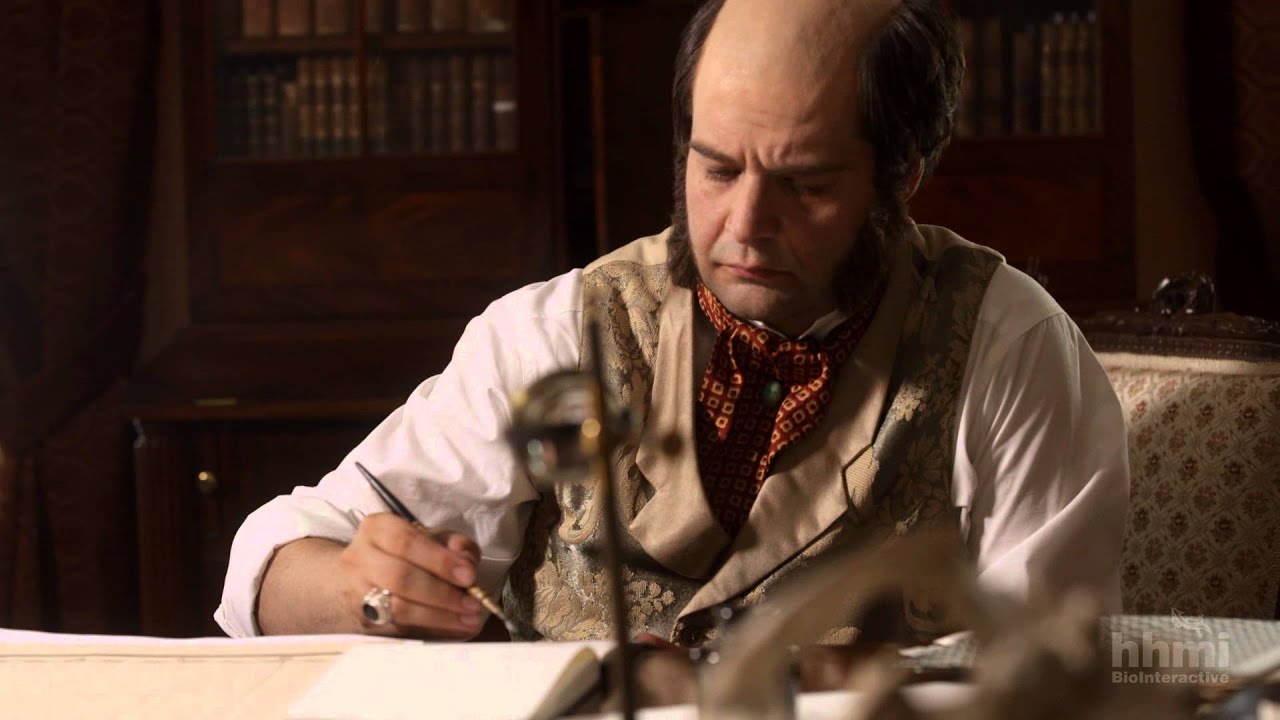
The Making of a Theory: Darwin, Wallace, and Natural Selection — HHMI BioInteractive Video
biointeractive
Overview
This video chronicles the independent discovery of the theory of evolution by natural selection by Charles Darwin and Alfred Russel Wallace. It details their respective journeys, observations, and the intellectual leaps that led them to propose that species change over time, rather than being fixed. Darwin's extensive voyage on the HMS Beagle, particularly his observations in the Galapagos, provided crucial evidence. Wallace's parallel research in the Malay Archipelago, spurred by a near-fatal shipwreck, led him to similar conclusions. The narrative highlights their shared insights into variation, competition, and the geographical distribution of species, culminating in their joint presentation of the theory and Darwin's subsequent influential publication, 'On the Origin of Species'.
Save this permanently with flashcards, quizzes, and AI chat
Chapters
- Alfred Russel Wallace faced a shipwreck returning from the Amazon, losing all his collected specimens and notes.
- His lost notes contained clues to the origin of species, a major scientific mystery.
- This disaster nearly prevented Wallace from contributing to the theory of evolution.
- Charles Darwin embarked on a five-year voyage on the HMS Beagle, initially to serve as a companion.
- He collected vast numbers of specimens and was troubled by seemingly purposeless beauty in nature and the relationship between fossils and living species.
- Fossils of giant extinct animals (like glyptodons and ground sloths) found near similar, smaller living species suggested a connection over time.
- The Galapagos Islands, despite their harsh environment, provided Darwin with critical insights.
- He observed that tortoises and mockingbirds on different islands had distinct variations in shell shape and plumage, respectively.
- These subtle differences on geographically close islands suggested that species might change or adapt to their specific environments, rather than being created independently for each location.
- Upon returning to England, Darwin synthesized his observations, leading to the revolutionary idea that species evolve from other species over time.
- He proposed that species are connected in a 'family tree,' with new species arising from older ones through gradual change.
- This concept of natural origin contradicted the widely held belief in special creation and was considered heretical, leading Darwin to keep his theory secret for years.
- Undeterred by his shipwreck, Wallace embarked on an eight-year expedition in the Malay Archipelago.
- He observed patterns in the distribution of species, noting that closely related species often lived near each other.
- He also observed distinct faunal boundaries, like the Wallace Line, which separated Asian-like mammals from Australian-like marsupials, suggesting historical geological connections rather than random creation.
- Wallace, inspired by Thomas Malthus's ideas on population growth, conceived of natural selection during a bout of fever.
- He realized that variation within a species, combined with the struggle for existence and high mortality rates, leads to differential survival and reproduction.
- Individuals with advantageous variations are more likely to survive and pass those traits to their offspring, driving evolutionary change.
- Wallace sent his manuscript on natural selection to Darwin, who was shocked to find it mirrored his own long-held, secret theory.
- To ensure both were credited, Darwin's colleagues arranged for Wallace's paper and excerpts of Darwin's work to be presented together.
- Darwin subsequently published 'On the Origin of Species,' which became a foundational text in biology, while Wallace continued to contribute to evolutionary thought, even naming his own book 'Darwinism'.
Key takeaways
- Scientific theories often arise from extensive fieldwork, meticulous observation, and the synthesis of diverse evidence.
- Environmental pressures and competition are key drivers of evolutionary change, favoring individuals with advantageous traits.
- The geographical distribution of species provides critical clues about their evolutionary history and relationships.
- Independent discovery by multiple scientists can strengthen a theory and accelerate its acceptance.
- Challenging established scientific or religious beliefs requires significant evidence and personal conviction.
- Evolutionary change occurs gradually over many generations through the differential survival and reproduction of individuals.
- Vestigial structures and similarities between extinct and living species suggest common ancestry.
Key terms
Test your understanding
- How did Darwin's observations in the Galapagos Islands challenge the idea of special creation?
- What mechanism did Wallace propose to explain how species change over time, and what inspired this idea?
- Why did Darwin initially keep his theory of evolution a secret, and what event prompted him to share it?
- What is the significance of the Wallace Line in understanding the distribution of species?
- How do fossils of extinct giant animals relate to the theory of evolution by natural selection?