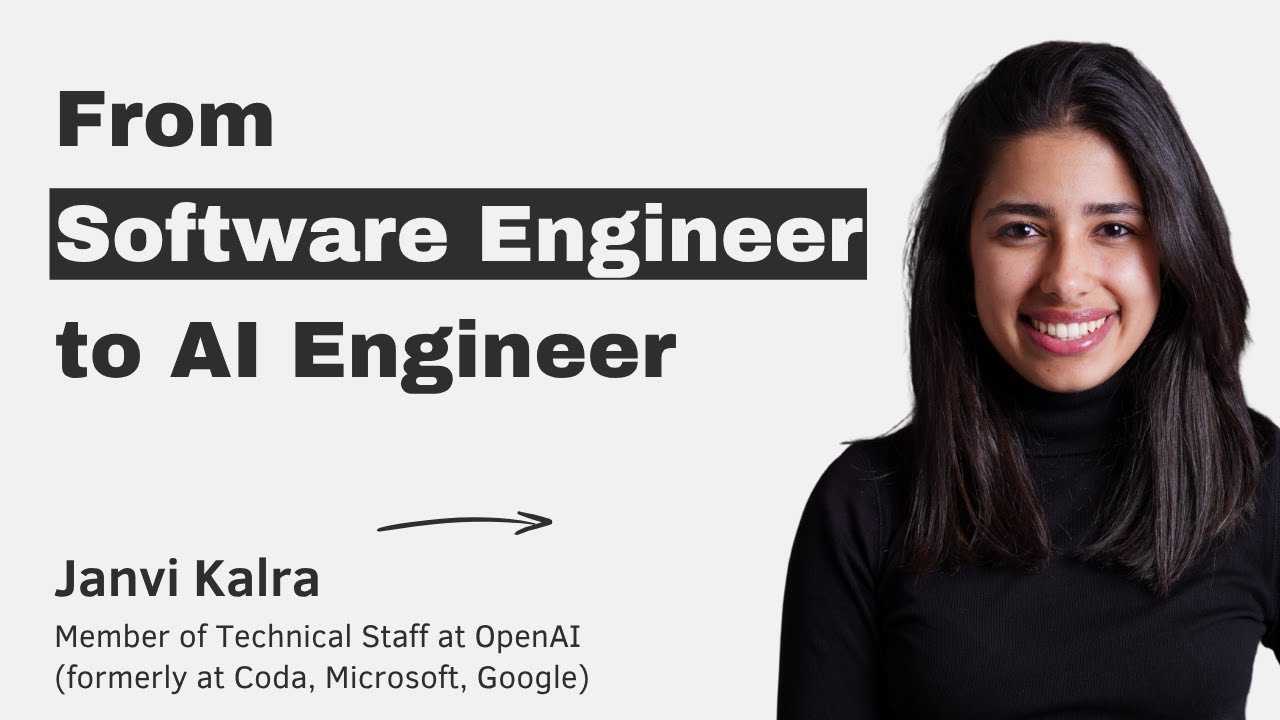
From Software Engineer to AI Engineer – with Janvi Kalra
The Pragmatic Engineer
Overview
This video follows Janvi Kalra's journey from a software engineer to an AI engineer, culminating in her role at OpenAI. It details her experiences with internships at Google and Microsoft, her decision to join a startup (KOD), and her transition into AI engineering. The discussion covers the AI job market, the importance of due diligence when selecting startups, and the practical aspects of AI engineering, including learning new technologies and the transition from traditional software development. Janvi shares insights into the interview process for AI roles and highlights the unique aspects of working at OpenAI, emphasizing speed, scale, and a mission-driven culture.
Save this permanently with flashcards, quizzes, and AI chat
Chapters
- Secured internships at Google and Microsoft by applying through portals and highlighting personal projects in essays.
- Prepared for interviews using 'Cracking the Coding Interview' book, emphasizing the importance of structured preparation.
- Internships provided exposure to large codebases, operational best practices like unit testing, and valuable mentorship.
- Learned that expressing career preferences, like working on operating systems, can influence internship assignments.
- Big tech offers learning in building scalable, reliable software and working on long-term, 'moonshot' projects.
- Startups offer rapid code shipping, a broad range of technical and business skills, and greater agency in project ownership.
- The decision involves trade-offs: big tech provides stability and potentially faster green card processing, while startups offer intense learning and impact.
- Janvi chose a startup (KOD) for its growth and breadth of learning opportunities, despite having offers from big tech.
- Initial startup selection focused on smart, passionate people and product alignment.
- A more robust rubric for evaluating startups includes high revenue growth, large market potential, customer obsession, and competitive advantage.
- Due diligence is critical; engineers should verify claims about growth, revenue, and customer satisfaction through independent research.
- Lack of transparency from a startup regarding financials is a significant red flag, akin to gambling with one's career.
- Janvi proactively pursued AI engineering after ChatGPT's release, initially being denied a spot on KOD's AI team.
- She self-studied deep learning fundamentals (tokens, embeddings, transformers, attention) in her free time.
- Participated in hackathons to gain practical experience building with AI models, which demonstrated her commitment.
- After five months of self-study and side projects, she was invited to join the AI team, highlighting the value of initiative.
- AI engineering involves experimenting with new tools, prototyping solutions, and building production-ready AI products.
- Core skills overlap significantly with software engineering, augmented by domain-specific knowledge like fine-tuning, prompt engineering, and hosting models.
- Evaluation and testing of AI models, especially non-deterministic ones, present unique challenges and costs.
- Learning is continuous, often driven by hands-on practice, reading blogs, papers, and engaging with open-source communities.
- The AI market is segmented into product companies (building on models), infrastructure companies (tools for LLMs), and model companies (building foundational AI).
- Janvi focused on model and infrastructure companies to broaden her experience beyond product-focused roles.
- Interview processes are varied, including coding, system design, and project-based assessments.
- Evaluating companies requires understanding their business model, margins (especially for infrastructure), and competitive landscape.
- Janvi works on AI safety, focusing on detecting and mitigating harmful model behavior.
- OpenAI uniquely combines the speed of startups with the scale of large organizations.
- The company fosters an open culture, encouraging questions and knowledge sharing.
- Engineers are trusted with significant autonomy, enabling rapid iteration and shipping of features, even on high-traffic services.
Key takeaways
- Proactive learning and initiative are crucial for career advancement, especially in rapidly evolving fields like AI.
- Thorough due diligence on potential employers, particularly startups, is essential for making informed career decisions.
- The transition to AI engineering often leverages and builds upon existing software engineering skills.
- Understanding the different segments of the AI industry (product, infrastructure, model) helps in career planning and job searching.
- Continuous learning through hands-on projects, hackathons, and community engagement is vital in the fast-paced AI landscape.
- Even in highly technical roles, understanding the business context and impact of your work is increasingly important.
- AI engineering involves not just building models but also ensuring their safe, reliable, and scalable deployment.
Key terms
Test your understanding
- How can aspiring engineers effectively prepare for technical interviews at companies like Google and Microsoft?
- What are the key differences and trade-offs between working at a large tech company versus a startup?
- What criteria should an engineer use to evaluate the growth potential and viability of a startup?
- Describe the process Janvi followed to transition from a software engineer to an AI engineer, and what motivated her?
- How does the role of an AI engineer differ from, and overlap with, a traditional software engineer?
- What are the main categories of companies within the AI ecosystem, and why is it helpful to understand these distinctions?
- What are the unique aspects of working at a company like OpenAI, particularly regarding speed, scale, and culture?