8:59
Tensile Test
MaterialsScience2000
Overview
This video explains the tensile test, a fundamental method for evaluating the mechanical properties of materials. It demonstrates the process using two distinct material types: one with a clear yield point phenomenon (plain carbon steel) and another without (aluminum alloy). The video details how to set up the test, record force and elongation data, and interpret the resulting force-elongation diagrams. Key concepts like elastic and plastic deformation, yield strength, tensile strength, and percentage elongation/reduction in area are explained, highlighting the differences in material behavior and how these properties are calculated.
How was this?
Save this permanently with flashcards, quizzes, and AI chat
Chapters
- The tensile test measures a material's response to being pulled apart.
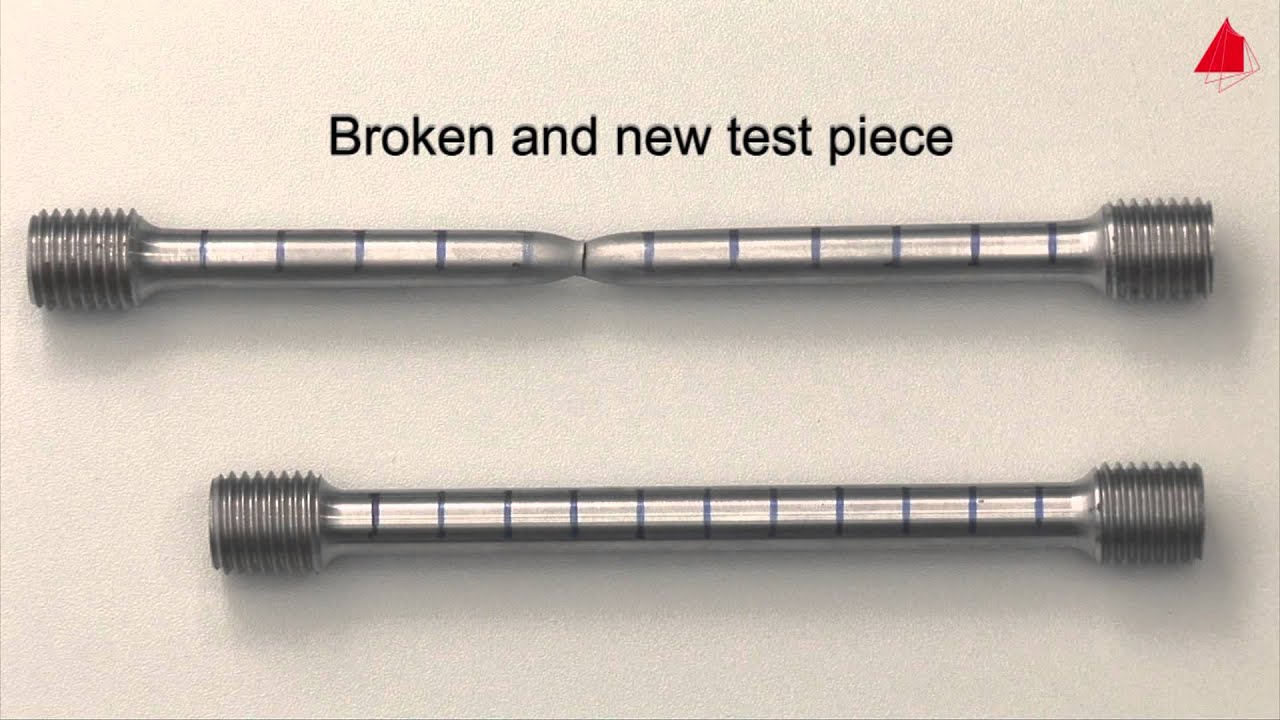
- A test piece with specific dimensions (e.g., 10mm diameter, 100mm gauge length) is used.
- Markings on the test piece help visualize deformation.
- The testing machine grips the specimen, and an extensometer measures elongation accurately.
Understanding the setup and initial steps is crucial for correctly performing and interpreting the results of a tensile test.
A cylindrical test piece with distance marks is placed into the grips of a testing machine, and an extensometer is attached to measure elongation.
- The test begins with elastic deformation, where force and elongation are proportional (linear graph).
- Upon reaching the yield point, the material undergoes sudden plastic deformation, often with a drop in force.
- The 'Lüders effect' is observed as a period of nearly constant force after initial yielding.
- Strain hardening occurs as the material resists further elongation, leading to a maximum force.
- Fracture happens after necking, where deformation concentrates in a localized area.
Recognizing the yield point phenomenon is vital for understanding how certain materials behave under stress, particularly in applications where sudden failure is a concern.
For plain carbon steel, the force-elongation graph shows a sharp peak, followed by a drop and then a plateau before rising again towards the maximum force.
- Upper yield strength (Re) is calculated using the force at the upper yield point divided by the original cross-sectional area.
- Lower yield strength is calculated similarly using the force at the lower yield point.
- Tensile strength (Rm) is determined by dividing the maximum force reached by the original cross-sectional area.
- Percentage elongation after fracture indicates the material's ductility.
- Percentage reduction in area quantifies the localized deformation at the fracture point.
These calculated values provide engineers with critical data to select appropriate materials for specific applications based on their strength and ductility.
Calculating the upper yield strength by dividing the peak force recorded at the yield point by the initial diameter squared times pi.
- Materials without a distinct yield point show a smooth transition from elastic to plastic deformation.
- The elastic region is linear, but the end of elasticity is not marked by a sudden force drop.
- Necking and fracture occur similarly to materials with a yield point.
- The 0.2% proof strength is used as a substitute for yield strength in these materials.
- The 0.2% proof strength is the stress required to cause 0.2% permanent (plastic) deformation.
Understanding how to assess the plastic deformation limit in materials lacking a clear yield point is essential for designing with a wider range of alloys.
For an aluminum alloy, a line parallel to the initial elastic slope is drawn from the 0.2 mm (0.2% of 100mm gauge length) elongation mark on the x-axis to intersect the force-elongation curve.
- To find the 0.2% proof strength (Rp0.2), first determine the elongation corresponding to 0.2% strain.
- A line parallel to the elastic portion of the curve is drawn from this offset point.
- The force at the intersection of this offset line and the actual force-elongation curve is identified (Fp0.2).
- The 0.2% proof strength is then calculated by dividing Fp0.2 by the original cross-sectional area (s0).
The proof strength provides a standardized measure of a material's resistance to permanent deformation, crucial for applications requiring dimensional stability.
Finding the force on the curve where a line starting at 0.2mm elongation and parallel to the initial elastic slope intersects the curve.
Key takeaways
- The tensile test is a fundamental method for characterizing material behavior under tension.
- Materials exhibit either elastic (reversible) or plastic (permanent) deformation under stress.
- Materials with a yield point phenomenon show a distinct stress level where plastic deformation begins abruptly.
- For materials without a clear yield point, the 0.2% proof strength is used to quantify resistance to permanent deformation.
- Key material properties derived from a tensile test include yield strength, tensile strength, percentage elongation, and percentage reduction in area.
- The force-elongation diagram is a critical tool for visualizing and analyzing material response during a tensile test.
- Understanding these properties allows for informed material selection in engineering design.
Key terms
Tensile TestElastic DeformationPlastic DeformationYield Point PhenomenonYield StrengthLüders EffectStrain HardeningNeckingTensile StrengthPercentage ElongationPercentage Reduction in AreaProof Strength
Test your understanding
- What is the primary purpose of a tensile test?
- How does the force-elongation diagram differ for materials with and without a yield point phenomenon?
- What is the significance of the 'necking' phenomenon observed during a tensile test?
- How is the 0.2% proof strength calculated and why is it important for certain materials?
- What do the percentage elongation after fracture and percentage reduction in area tell us about a material's properties?