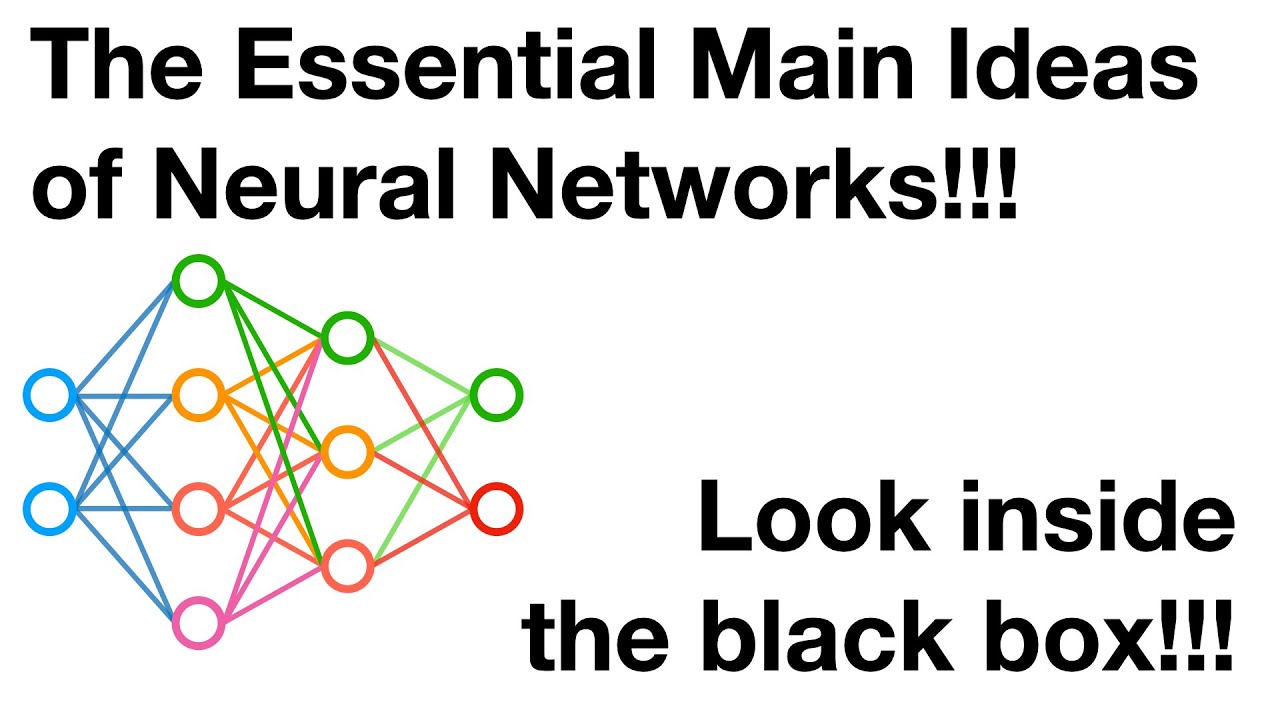
The Essential Main Ideas of Neural Networks
StatQuest with Josh Starmer
Overview
This video introduces neural networks by demystifying their internal workings, moving beyond the 'black box' perception. It explains that neural networks are essentially sophisticated 'squiggle fitting machines' capable of modeling complex data relationships. The explanation breaks down a simple neural network, illustrating how input data is transformed through weighted connections and activation functions in hidden layers to produce an output that can predict outcomes. The core idea is that by combining and transforming basic curved shapes (activation functions) using learned parameters (weights and biases), neural networks can create intricate functions to fit data.
Save this permanently with flashcards, quizzes, and AI chat
Chapters
- Neural networks, often seen as complex 'black boxes,' are powerful tools for fitting data with non-linear shapes, or 'squiggles.'
- Unlike a straight line, which can only model simple relationships, neural networks can capture more complex patterns in data.
- This video series aims to demystify neural networks by breaking them down into understandable components, focusing on 'what they do' and 'how they do it' in this part.
- The fundamental components of a neural network are nodes and connections, where parameters (weights and biases) on connections are learned from data.
- Neural networks use activation functions, which are specific curved or bent lines (like softplus, ReLU, or sigmoid), as their basic building blocks.
- These activation functions transform numerical inputs into outputs, shaping the network's ability to learn complex patterns.
- Nodes between the input and output layers are called 'hidden layers,' and they are where the initial transformations and shape creations occur.
- The choice and number of hidden layers and nodes within them are design decisions that influence the network's complexity and fitting capability.
- Data enters the neural network through input nodes.
- Each connection between nodes has a 'weight' (a multiplier) and a 'bias' (an added value), which are learned parameters.
- The input value is multiplied by the connection's weight and then the bias is added to produce an intermediate value.
- This intermediate value is then fed into an activation function, producing an output that is passed to the next layer or the final output node.
- Multiple transformations (weighting, adding bias, applying activation function) occur across layers, progressively building the final 'squiggle'.
- Outputs from different nodes in a hidden layer are scaled by their respective connection weights.
- These scaled outputs from the hidden layer are then added together to form a combined shape.
- A final bias is subtracted from this combined shape to shift it vertically.
- The resulting combined and shifted shape is the 'green squiggle' that represents the neural network's prediction function for the given data.
- The specific shape of the final squiggle is determined by the learned weights and biases, which are optimized during the training process (backpropagation).
Key takeaways
- Neural networks are fundamentally 'squiggle fitting machines' designed to model complex, non-linear relationships in data.
- The core components of a neural network are nodes and weighted connections, with biases added to these connections.
- Activation functions (like softplus or ReLU) are essential non-linear transformations applied to the outputs of nodes.
- Hidden layers allow neural networks to build increasingly complex functions by combining and transforming basic shapes derived from activation functions.
- The specific shape a neural network learns is determined by the values of its weights and biases, which are estimated by fitting the network to data.
- Even simple neural networks with one hidden layer can create sophisticated output shapes by combining and manipulating basic activation functions.
- The ultimate goal of a neural network is to learn a function that accurately maps inputs to outputs for prediction or classification tasks.
Key terms
Test your understanding
- What is the primary function of a neural network, and why is it often called a 'black box'?
- How do activation functions contribute to a neural network's ability to fit complex data shapes?
- Explain the role of weights and biases in transforming data as it passes through a neural network.
- How are the individual shapes generated in the hidden layers combined to form the final output squiggle?
- Why is understanding the internal components of a neural network important for a learner?