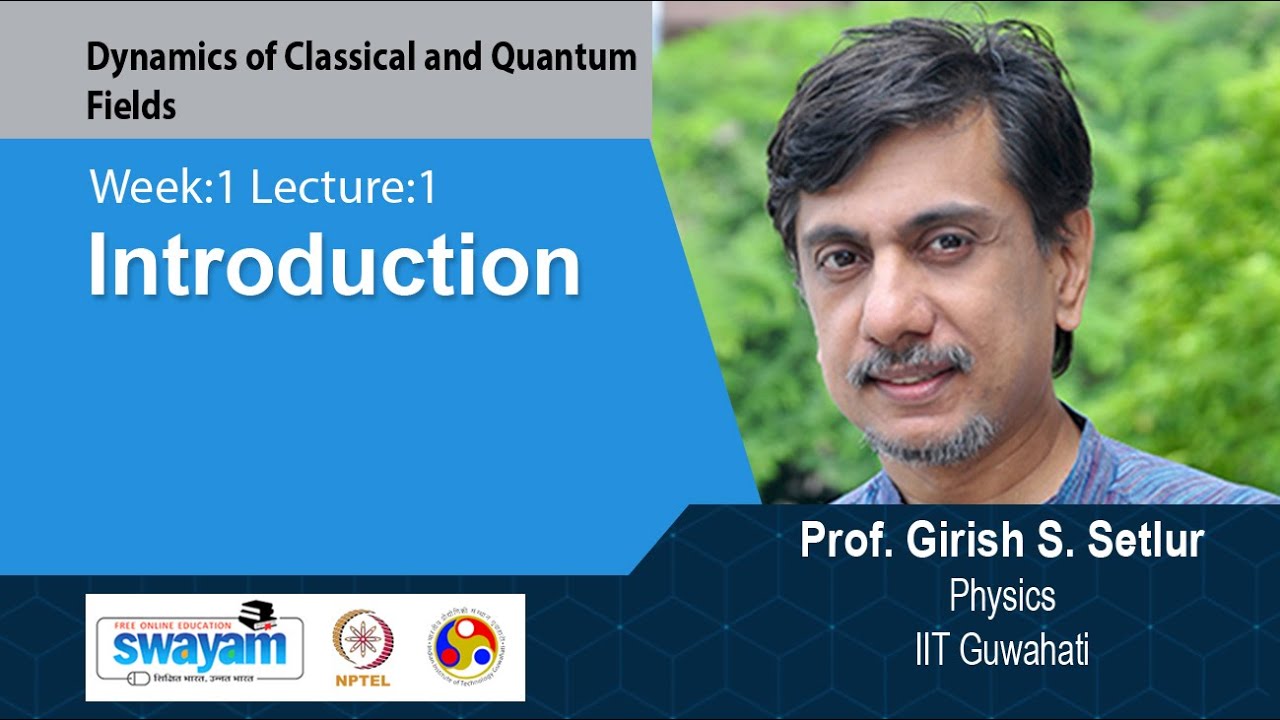
Lec 1: Introduction
NPTEL IIT Guwahati
Overview
This introductory course on the Dynamics of Classical and Quantum Fields, based on Professor Girish Setlur's textbook, aims to bridge foundational classical mechanics with advanced quantum field theory, particularly for condensed matter applications. The course begins with a review of Lagrangian and Hamiltonian mechanics, symmetries, and variational principles. It then delves into classical fields like electromagnetism and elasticity, before transitioning to quantum fields. Key mathematical tools like functional integration are introduced, along with the path integral formulation of quantum mechanics and concepts like creation/annihilation operators. The latter half focuses on condensed matter applications, including the tight-binding model and Green's functions, providing a steep but logical learning curve for advanced undergraduate or graduate students interested in theoretical physics.
Save this permanently with flashcards, quizzes, and AI chat
Chapters
- Introduces the fundamental concept of fields and how they differ from point particles.
- Reviews prerequisite classical mechanics concepts: Lagrangian and Hamiltonian formalisms.
- Explains the significance of symmetries and conservation laws via Noether's theorem.
- Illustrates variational methods through historical problems like the brachistochrone and Fermat's principle, and practical applications like least squares fitting.
- Details the electromagnetic field, introducing its tensor representation and the stress-energy tensor.
- Demonstrates the relativistic nature of electromagnetism, showing its consistency with special relativity.
- Explores applications of field theory in elasticity and fluid mechanics, including concepts like stress, strain, Euler, and Navier-Stokes equations.
- Connects fundamental principles like Bernoulli's principle to more general fluid dynamics.
- Motivates the shift from classical to quantum fields by examining solutions to the Schrödinger, Dirac, and Klein-Gordon equations.
- Argues that relativistic systems are best described by fields rather than particles.
- Introduces the concept of variable particle numbers, allowing for creation and annihilation, crucial for quantum field theory.
- Introduces functional integration, a technique for integrating over spaces of functions rather than just real numbers.
- Explains the necessity of functional integration for a proper understanding of quantum fields.
- Discusses exact and approximate methods for solving functional integrals, including perturbation theory.
- Presents the path integral formulation of quantum mechanics, an alternative to the Hamiltonian approach.
- Highlights the Lagrangian perspective on quantum mechanics, developed by Feynman.
- Emphasizes the importance of this formalism, often omitted in standard quantum mechanics courses.
- Applies quantum field theory concepts to condensed matter systems, such as electrons in solids.
- Introduces the tight-binding model for describing electron behavior in crystalline structures.
- Explains the concept and utility of Green's functions in many-body physics for analyzing systems with variable particle numbers.
- Briefly touches upon advanced topics like coherent states and turbulence.
Key takeaways
- Fields, not just point particles, are fundamental entities in describing physical phenomena, especially at relativistic speeds.
- Symmetries in physical systems are deeply connected to conserved quantities, as formalized by Noether's theorem.
- Variational principles offer a powerful method for solving optimization problems across various fields of physics and mathematics.
- Electromagnetism is inherently relativistic, and Maxwell's equations provide a consistent framework with special relativity.
- Quantum field theory requires advanced mathematical tools like functional integration to handle the complexity of quantum systems.
- The path integral formulation provides an alternative and insightful perspective on quantum mechanics, rooted in Lagrangian mechanics.
- Quantum field theory has significant applications in condensed matter physics, explaining phenomena like electron behavior in solids and material properties.
- Understanding Green's functions is crucial for analyzing complex many-body systems where particle numbers can change.
Key terms
Test your understanding
- How does the concept of a field fundamentally differ from that of a point particle in physics?
- What is the significance of Noether's theorem in connecting symmetries to conservation laws?
- Why is functional integration a necessary tool for understanding quantum fields, and how does it differ from standard integration?
- Explain the core idea behind the path integral formulation of quantum mechanics and its relationship to Lagrangian mechanics.
- How are concepts from quantum field theory applied to understand phenomena in condensed matter physics, such as electron behavior in solids?