3:29
Formation of the Planets
Lincoln Learning Solutions
Overview
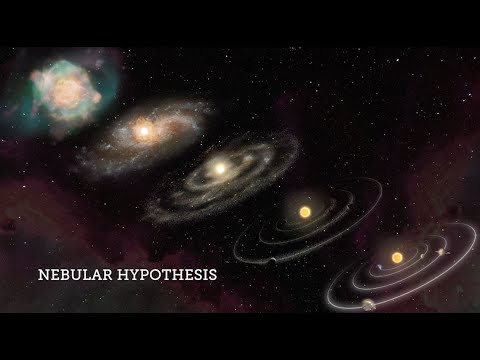
This video explains the nebular hypothesis, the leading scientific theory for how our solar system formed. It describes the process starting with a vast, cold, spinning cloud of gas and dust called the solar nebula. Gravitational forces caused this cloud to condense and flatten into an accretion disk, with a protostar forming at the center. As the protostar ignited into a star (our Sun), the remaining material clumped together to form protoplanets, which eventually grew into the planets we see today. The theory also accounts for the arrangement of planets, with rocky planets closer to the Sun and gas giants farther out, due to heat and solar winds.
How was this?
Save this permanently with flashcards, quizzes, and AI chat
Chapters
- The universe contains many stars, some with orbiting planets.
- The nebular hypothesis explains the formation of our solar system from a large, cold, spinning cloud of gas and dust called the solar nebula.
- Gravity caused the nebula to condense towards its center, increasing its rotation speed and flattening it into an accretion disk.
Understanding the initial state of the solar system helps us grasp the fundamental forces and materials that led to the formation of planets.
The initial state of the solar system was a cold, spinning cloud of gas called the solar nebula.
- As the nebula condensed, pressure and temperature increased at the center, forming a hot ball of gas called a protostar.
- When the protostar reached sufficient temperature and pressure, nuclear fusion began, creating a star (the Sun).
- Outside the central star, dust and gas particles in the accretion disk clumped together to form protoplanets.
This stage explains the birth of our Sun and the initial building blocks of the planets, demonstrating how gravity and pressure lead to stellar ignition and planetary accretion.
A ball of hot gas formed in the center of the accretion disk, which eventually became the Sun.
- Protoplanets grew by accumulating more material through their gravitational pull.
- The Sun's heat and solar winds pushed lighter gases outward, leading to the separation of planet types.
- Rocky, terrestrial planets (Mercury, Venus, Earth, Mars) formed closer to the Sun where it was hotter.
- Gas giants (Jupiter, Saturn, Uranus, Neptune) formed farther out in the cooler regions.
This explains the distinct composition and location of planets in our solar system, showing how environmental conditions during formation dictate planetary characteristics.
Rocky planets like Earth are close to the Sun, while gas giants like Jupiter are farther away because lighter gases were pushed to the outer solar system.
- The solar system continued to evolve after initial formation, with impacts from asteroids and planetary differentiation.
- The nebular hypothesis is supported by observations that planets orbit in the same direction and plane as their star.
- It also explains the observed pattern of rocky planets near the star and gas giants farther away.
This highlights that planetary systems are dynamic and that the nebular hypothesis provides a robust framework for understanding these observed patterns.
Planets usually spin in the same direction and lie in the same plane as the star they orbit, which is explained by their formation from a rotating disk.
Key takeaways
- The nebular hypothesis describes solar system formation from a rotating cloud of gas and dust.
- Gravity is the primary force driving the condensation of nebular material.
- The formation of a protostar and subsequent nuclear fusion created our Sun.
- Protoplanets formed from clumps of material in the accretion disk around the young Sun.
- The Sun's heat and solar winds influenced the composition and location of planets.
- The arrangement of rocky inner planets and gaseous outer planets is a direct consequence of the formation process.
- Observed planetary motion (same direction and plane of orbit) supports the nebular hypothesis.
Key terms
Nebular HypothesisSolar NebulaAccretion DiskProtostarProtoplanetsNuclear FusionTerrestrial PlanetsGas GiantsSolar Winds
Test your understanding
- What is the primary scientific theory explaining the formation of our solar system?
- How did gravity contribute to the formation of the Sun and planets from the solar nebula?
- What is the difference between a protostar and a star?
- Why are the inner planets rocky and the outer planets gaseous, according to the nebular hypothesis?
- What observational evidence supports the nebular hypothesis?