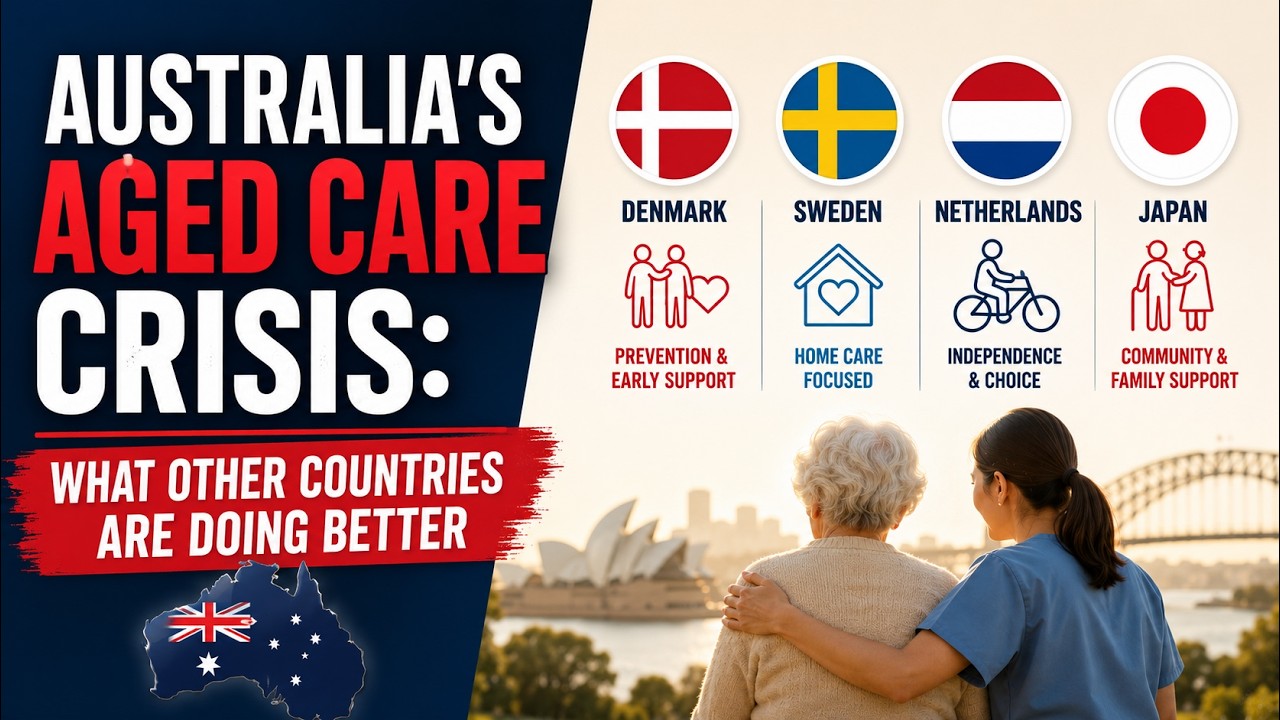
Australia's Aged Care Crisis: What Other Countries Are Doing Better
HomeCare Australia
Overview
This video explores Australia's aged care crisis by examining how Denmark, Sweden, the Netherlands, and Japan approach elder care differently. It highlights that countries successfully managing aging populations often invest earlier in preventative measures, reablement, and assistive technologies, focusing on maintaining independence rather than reacting to decline. The summary contrasts these international models with Australia's fragmented system, which often leads to long waits, high costs, and a focus on crisis management. It suggests practical reforms for Australia, emphasizing early intervention, integrated health and social care, affordable access, and a continuum of care options beyond the binary of home or residential living.
Save this permanently with flashcards, quizzes, and AI chat
Chapters
- Australia's aged care system is fragmented, with separate programs for basic and intensive home support, leading to inefficiencies.
- The 'Support at Home' initiative aims for a unified, person-centered system but is hampered by poor design, leading to a focus on crisis rather than prevention.
- Supporting someone at home is significantly cheaper than residential care, yet long waiting lists accelerate decline and increase future costs.
- Services like meals and transport are often treated as separate, costly 'everyday living' expenses, contributing to isolation and clinical problems.
- Complex assessment processes and rigid program boundaries, exemplified by long waits for simple items like crutches, hinder timely support.
- Denmark prioritizes 'reablement,' focusing on helping individuals regain or learn skills to increase their independence, rather than just completing tasks for them.
- Municipalities manage services, offering time-limited rehabilitation programs before committing to ongoing home help, aiming to avoid learned helplessness.
- Investment in rehabilitation, assistive technology, and home modifications has led to a decline in the proportion of older people needing residential care.
- The system aligns human outcomes (maintaining ability) with financial outcomes (delaying or reducing high-intensity care costs).
- Key lessons include dedicated funding and skilled staff for reablement, simplified assistive technology access, identifying reversible decline, and rewarding functional maintenance.
- Sweden's decentralized system, managed by municipalities, is based on universal social rights and funded by taxes and grants.
- The goal is to help older people live independently at home for as long as possible, with needs assessed individually.
- Essential supports like home-delivered meals, day activities, and subsidized transport are integrated and capped at a low monthly fee for users.
- Clear accountability rests with municipalities, which are responsible for both assessing needs and ensuring service provision, reducing blame-shifting.
- Lessons for Australia include viewing essential supports as an integrated package, considering capped charges for cumulative care costs, ensuring visible accountability, and recognizing community activities as preventative.
- The Netherlands uses a layered system: social support from municipalities, personal care/nursing via health insurance, and long-term care via a national insurance framework.
- This structure separates social participation, health needs, and enduring care requirements into distinct, logical streams.
- Personal budgets (PGB) offer consumer choice and control, similar to Australia's model, but require strong safeguards.
- The country emphasizes 'middle ground' living arrangements beyond traditional homes or large institutions, such as neighborhood-based care and age-friendly housing complexes.
- Integrating district nursing into the health system, rather than aged care, ensures clinical needs are met without competing with social support budgets.
- Japan's Long-Term Care Insurance system, funded by premiums from those aged 40+ and taxation, provides access to services based on assessed needs.
- The system integrates healthcare, long-term care, prevention, housing, and daily living support within local communities to enable aging in place.
- Preventative care and lower-level support are built into the system's architecture, not treated as waiting periods.
- Extensive use of day services provides rehabilitation, social connection, and respite for carers.
- Lessons include a stable, dedicated funding base (like social insurance), formalizing prevention, flexible service combinations, recognizing respite as core infrastructure, and strong local coordination.
- International models show that clear, adequate funding and local coordination are key to successful decentralization, avoiding postcode lotteries.
- Effective systems fund prevention and early intervention, ensuring support begins promptly rather than after decline.
- Connecting at-home nursing and health services seamlessly to the health system, not just aged care budgets, is crucial.
- Reablement requires dedicated service design and funding, not just policy language, to be effective.
- Affordable and predictable charges, especially for pensioners, are vital to prevent people from foregoing essential preventative services.
- Choice requires available workers and clear information; a continuum of care options is needed between home and residential settings.
- Practical reforms include a rapid response prevention budget, simplified assistive technology pathways, shared health responsibility post-hospital, protecting essential social supports, expanding middle-ground housing, and measuring independence outcomes.
Key takeaways
- Proactive investment in prevention, reablement, and assistive technology is more effective and cost-efficient than reactive crisis management in aged care.
- Fragmented funding and delivery systems, like Australia's, create inefficiencies and barriers to timely, appropriate care.
- Integrating health and social care services, particularly for at-home nursing, ensures clinical needs are met without competing against other support budgets.
- Affordable and predictable costs for essential services like meals, transport, and social connection are critical for older adults' well-being and independence.
- A continuum of care options, including diverse housing and community-based services, is necessary to bridge the gap between living at home and residential care.
- Measuring outcomes like maintained independence, reduced hospitalizations, and fewer falls is more valuable than simply tracking service hours or activity completion.
- Clear accountability and dedicated funding streams, such as social insurance models, can create more coherent and equitable aged care systems.
Key terms
Test your understanding
- How does Denmark's concept of 'reablement' differ from traditional task-based home care, and why is this distinction important for maintaining independence?
- What are the potential consequences of Australia's fragmented aged care system, particularly regarding the cost and effectiveness of support services?
- How do Sweden and the Netherlands structure their aged care systems to integrate health and social support, and what lessons can Australia learn from this integration?
- Why is it crucial for aged care systems to fund and prioritize preventative services and assistive technology, rather than waiting for a decline in function?
- What are the key differences in how Australia, Denmark, Sweden, the Netherlands, and Japan approach the affordability and accessibility of aged care services for older individuals?