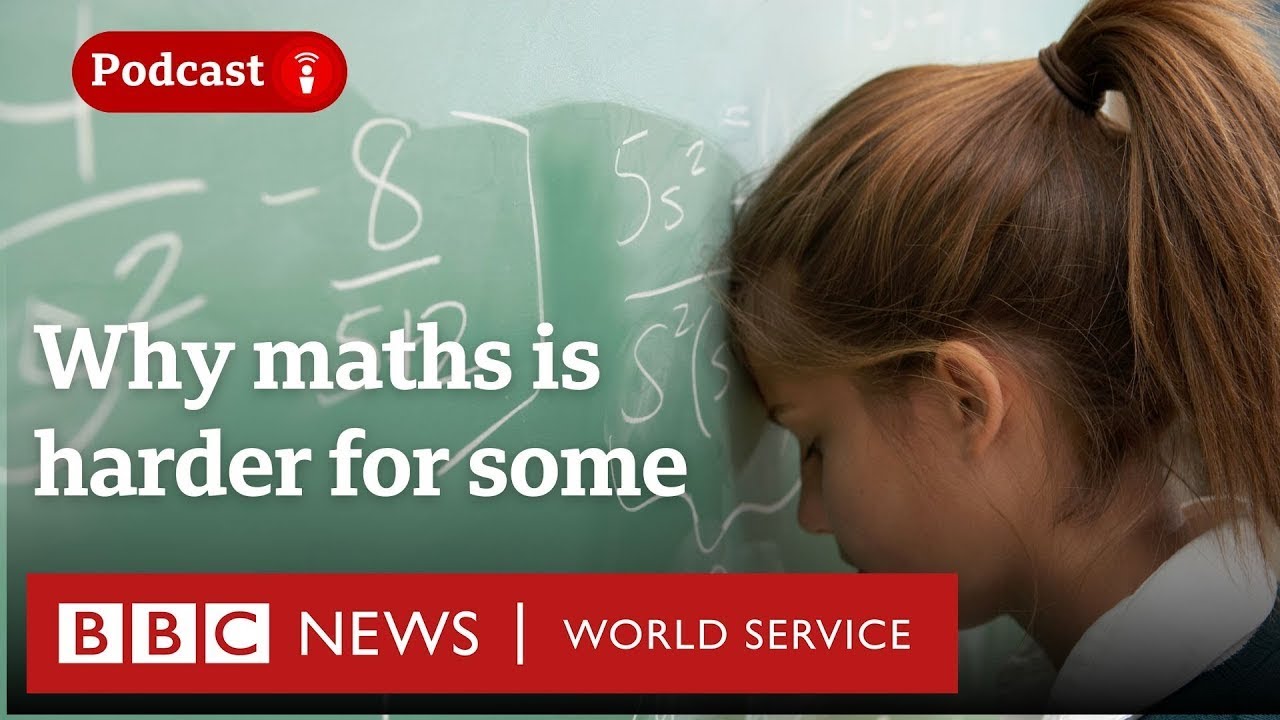
Why are some people bad at maths? - CrowdScience podcast, BBC World Service
BBC World Service
Overview
This video explores the reasons behind varying mathematical abilities, addressing listener Israel's question about why some people struggle with math while others excel. It delves into the interplay of genetics and environment, the impact of emotions like math anxiety, and the role of educational approaches. The discussion highlights that while genetics play a part, environmental factors, personal beliefs, and even innate numerical sense (or lack thereof, as in dyscalculia) significantly influence mathematical proficiency. Ultimately, the video emphasizes that improvement is possible for everyone through effort, belief, and appropriate support, regardless of perceived natural aptitude.
Save this permanently with flashcards, quizzes, and AI chat
Chapters
- Math abilities vary greatly among individuals, leading some to feel dread or difficulty while others find it easy.
- Listener Israel's experience of struggling with math since third grade and being told he was 'naturally slow' is a common sentiment.
- Despite effort, some individuals find math persistently challenging, leading to negative emotions and a dislike for the subject.
- The initial farmer's riddle serves as a lighthearted introduction to mathematical problem-solving and its potential to evoke different reactions.
- The idea of being 'naturally' good or bad at math is often misunderstood; it's not solely determined by birth.
- Twin studies show that identical twins are more similar in mathematical ability than non-identical twins, suggesting a genetic component.
- Heritability estimates for mathematical ability range from 50-60%, indicating that genes and environment play significant, roughly equal roles.
- The 'environment' is broadly defined as everything an individual experiences (the 'exposome'), including unpredictable, individual-specific factors, not just family or school.
- Beliefs, attitudes, and emotions significantly influence math learning and performance, with math anxiety being a major factor.
- Negative experiences, stereotypes, or falling behind can trigger anxious thoughts, creating a vicious cycle of avoidance and poor performance.
- Math anxiety overloads working memory, the mental space for thinking, leaving less capacity for problem-solving.
- It is possible for everyone to improve their math skills by believing in their ability, dedicating time and effort, and adopting a positive mindset.
- Educational systems vary in their effectiveness, with countries like China and Finland historically showing strong performance in international math assessments (like PISA).
- Effective systems often focus on ensuring basic skills for all students and providing strong support and respect for teachers.
- Finland's approach emphasizes foundational learning and offers significant investment in special support for struggling students.
- While rankings provide insights, they don't capture the full picture; the key is often in the consistent effort to support all learners, not just top performers.
- Humans possess an innate sense of quantity, even in cultures without formal number words.
- In some individuals, this innate numerical sense is less efficient, making learning arithmetic extremely difficult.
- This condition, known as dyscalculia, affects approximately 5% of the population and is distinct from other reasons for struggling with math.
- Interventions like educational games can help improve numerical understanding, particularly for those with dyscalculia, though long-term effects require further study.
- Mathematical ability is influenced by a complex interplay of genetics, environment, emotions, education, and innate numerical sense.
- Despite challenges, including dyscalculia, individuals can improve their math skills and numeracy.
- Belief in one's ability, consistent effort, and seeking appropriate support are crucial for overcoming math difficulties.
- Even individuals who struggle with basic arithmetic, like mental math, can excel in more advanced mathematical fields with motivation and hard work.
Key takeaways
- Mathematical ability is a complex trait influenced by both genetic predispositions and a lifetime of environmental exposures (the 'exposome').
- Math anxiety is a significant barrier that can impair cognitive functions like working memory, hindering learning and performance.
- A growth mindset, believing in one's capacity to improve, is fundamental for overcoming math difficulties.
- Dyscalculia is a specific learning disorder affecting innate number sense, impacting about 5% of people and making arithmetic learning particularly challenging.
- Effective math education often focuses on building strong foundational skills for all students and providing robust support systems for learners who struggle.
- While genetics and innate abilities play a role, personal effort, motivation, and a positive attitude are powerful drivers for improving mathematical skills.
- It is never too late to improve numeracy and mathematical skills, regardless of past struggles or perceived natural aptitude.
Key terms
Test your understanding
- How do genetics and environmental factors interact to influence an individual's mathematical ability?
- What is math anxiety, and how does it specifically impede mathematical learning and performance?
- What is dyscalculia, and how does it differ from general math difficulties caused by other factors?
- Why is a growth mindset considered crucial for improving mathematical skills, and what practical steps can one take to cultivate it?
- What are some key characteristics of educational systems that tend to foster strong mathematical skills across a population?