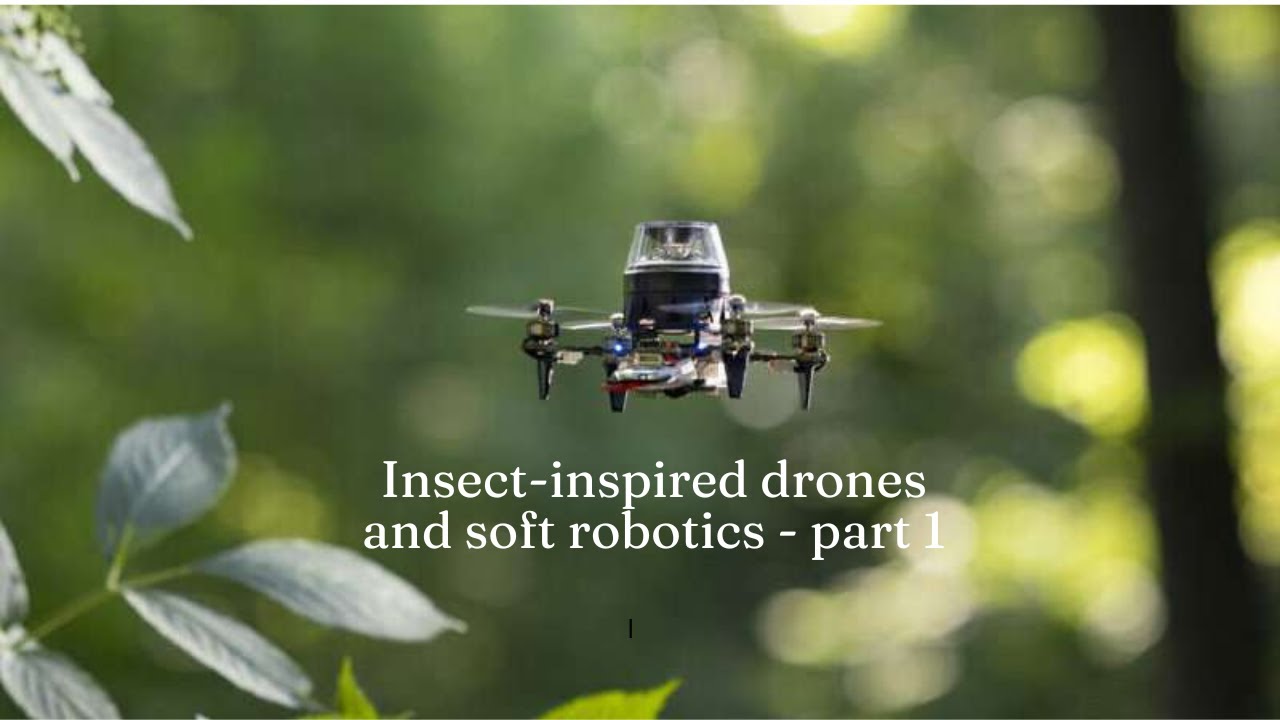
Insect-inspired drones and soft robotics - part 1
Courses VITOLS -VIT Chennai
Overview
This video explores the design principles of insect-inspired drones and soft robotics, focusing on how biological mechanisms of insects are mimicked to create advanced flying robots. It details the structural components of insects (head, thorax, abdomen) and their robotic counterparts, emphasizing how features like compound eyes, antennae, and flapping wings are translated into drone technology. The discussion covers the physics of insect flight, including wing flexibility, energy storage, and the use of smart materials like shape memory alloys. It also touches upon the fabrication processes, aerodynamic principles, performance metrics, and the advantages and challenges of developing these miniature, autonomous flying machines for applications like surveillance and disaster management.
Save this permanently with flashcards, quizzes, and AI chat
Chapters
- Insects have three main body parts: head (eyes, antennae), thorax (legs, muscles for locomotion), and abdomen (organs).
- Robotic insects mimic these parts: the head for sensing (cameras), thorax for movement mechanisms, and abdomen for power/electronics.
- Insect-inspired drones differ from conventional drones by replicating natural flight behaviors and instincts.
- Components like compound eyes are mimicked by FPV (First-Person View) cameras, and antennae's sensing capabilities are being integrated for environmental detection.
- Insect wings flap using specialized thoracic muscles, enabling complex movements (linear and rotary) across three degrees of freedom.
- Insects store energy in their wings through elastic deformation (like springs), allowing for efficient, sustained flight with minimal energy expenditure per flap.
- Mimicking this involves replicating wing flexibility, contraction/expansion cycles, and energy storage/release mechanisms.
- Flexible wing materials, such as those using shape memory alloys ('smart wings'), are key to achieving this energy-efficient flapping motion.
- Two primary mechanical designs for flapping mimicry are spring mechanisms (for linear motion) and rotary mechanisms (for rotational motion).
- The wing hinge's position relative to the leading edge affects pitching and flight control.
- Research often focuses on specific insects, like the ro shaffer beetle, to analyze and replicate precise wing kinematics and flapping cycles.
- Fabrication involves micro-scanning insect wings, CAD modeling, and 3D printing to create flexible, vein-like structures with attached membranes.
- Aerodynamic performance depends on factors like wing shape, leading-edge vortices, and the insect's weight, influencing wing-beating frequency.
- The Reynolds number characterizes the fluid dynamics, indicating the ratio of inertial to viscous forces, which is critical for flight at different scales.
- Insect-scale drones have low wing inertia, requiring fast flapping responses and passive wing control, unlike larger avian scales.
- Performance is measured by flapping frequency, lift generation, power consumption, and comparison to natural insect flight using high-speed cameras and force transducers.
- Advantages include miniaturization for confined spaces, swarm capabilities, and minimalistic designs that optimize performance with minimal resources.
- Key challenges are the complexity of small-scale electromechanical component design, achieving full autonomy (sensing, navigation, self-recharging), and integrating high computing power (GPUs, neuromorphic devices) within size and power constraints.
- Future development requires specialized components and advanced computing architectures to overcome limitations.
- The next steps involve exploring different types of insect-inspired drones and moving into soft robotics that mimic worm-like or other insect movements.
Key takeaways
- Insect flight mechanisms, particularly energy storage in flexible wings, offer a blueprint for creating more efficient and longer-lasting drones.
- Mimicking insect sensory organs like compound eyes and antennae can lead to drones with enhanced environmental awareness and specialized detection capabilities.
- Advanced fabrication techniques like 3D printing are essential for creating the complex, flexible structures required for insect-inspired drone wings.
- Understanding aerodynamic principles like the Reynolds number is critical for designing effective flight systems across different scales, from insects to drones.
- While insect-inspired drones offer significant advantages in size and maneuverability, achieving full autonomy and integrating advanced computing remain major developmental challenges.
- The minimalistic design philosophy of insects, maximizing performance with minimal resources, is a guiding principle for optimizing drone efficiency.
Key terms
Test your understanding
- How does the energy storage mechanism in insect wings contribute to their flight efficiency, and how can this be mimicked in drones?
- What are the primary challenges in designing and fabricating insect-inspired drones compared to conventional drones?
- Explain the role of the Reynolds number in understanding insect flight and how it applies to drone design.
- What are the key advantages of using insect-inspired designs for drones, particularly in terms of their potential applications?
- How do researchers attempt to replicate the sensory capabilities of insect antennae in robotic drones?