28:01
ANYONE can have insane willpower. It's easy.
SpoonFedStudy
Overview
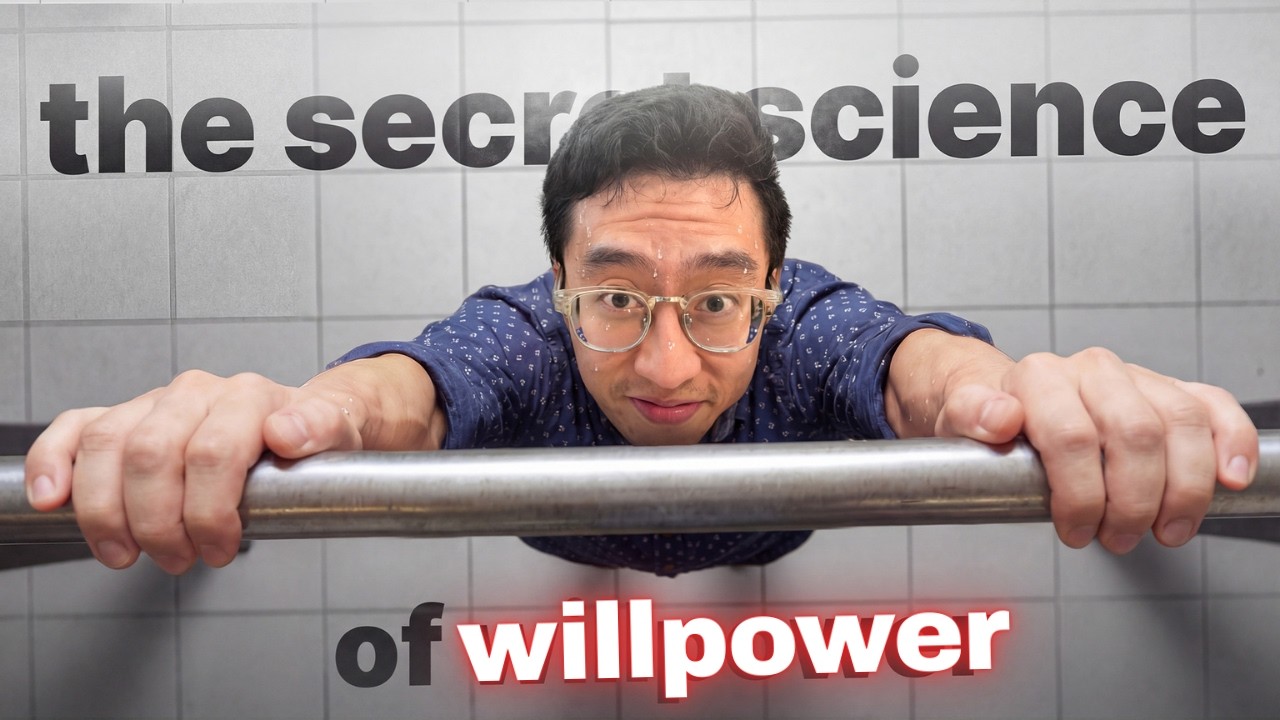
This video explores the science behind willpower, challenging the common belief that it's a limited, innate trait. It introduces the anterior cingulate cortex (AMCC) as a key brain region responsible for willpower and decision-making. The content explains that willpower isn't just about resisting temptation but involves a complex interplay of perceived costs, rewards, and the brain's ability to adapt and predict. The video suggests that willpower can be trained and improved by understanding its neurological basis and actively manipulating perceptions of effort and reward.
How was this?
Save this permanently with flashcards, quizzes, and AI chat
Chapters
- Habits are automatic behaviors that require little to no willpower, like well-paved roads.
- Willpower is like off-roading, requiring more energy and effort to overcome resistance.
- Most people default to 'off-roading' through life, making it inefficient.
- To improve, either build more 'roads' (habits) or strengthen your 'engine' (willpower).
Understanding the distinction between habits and willpower helps learners identify areas where they can automate behaviors to conserve mental energy for more challenging tasks.
Brushing your teeth is a habit (paved road), while forcing yourself to exercise when you don't feel like it requires willpower (off-roading).
- Early theories suggested willpower is a limited resource that depletes with use (ego depletion).
- Initial studies showed that resisting temptation (like cookies) led to poorer performance on subsequent tasks.
- Later research indicated that the effect of glucose on willpower was dependent on the belief that willpower is limited.
- If you believe willpower is unlimited, it behaves as such, regardless of glucose intake.
This challenges the common notion that willpower is a finite resource that runs out, suggesting that our beliefs about willpower significantly influence its actual availability.
Participants who believed willpower was limited showed improved performance after drinking a glucose beverage, while those who didn't believe it showed no change, regardless of the drink.
- The feeling of effort is a subjective signal created by the brain, not necessarily a direct reflection of physical exertion.
- Perception of pain and effort can be manipulated; thinking you can control a situation can reduce its perceived difficulty.
- A rare case study (RMBB) showed a woman who lost the sensation of mental strain despite performing effortful tasks, demonstrating the brain's role in generating this feeling.
Recognizing that the feeling of effort is a perception allows learners to understand that they can influence how difficult tasks feel, potentially making challenging activities more manageable.
A study where participants were told they could stop pain faster using a joystick (even though it was a lie) led to reduced pain perception because they believed they had control.
- The AMCC is a crucial brain region acting as a central hub for willpower, decision-making, and predicting future outcomes.
- It integrates sensory information, internal body states, memories, and emotions to assess costs and rewards.
- Damage or inactivation of the AMCC significantly reduces willpower and can lead to apathy or a lack of spontaneity.
- Stimulating the AMCC can induce feelings of impending challenge and a strong resolve to overcome it.
Identifying the AMCC as the neurological seat of willpower provides a concrete target for understanding and developing greater self-control and perseverance.
Rodents with an inactivated AMCC gave up more easily when faced with simple barriers to food, illustrating the region's role in perseverance.
- The AMCC performs real-time cost-benefit analyses to guide decisions, weighing the difficulty of a task against its potential reward.
- It monitors for prediction errors – discrepancies between expected and actual outcomes – to recalibrate future perceptions.
- Individuals with high grit often have a bias in their AMCC, overvaluing rewards, undervaluing costs, or overestimating their resources.
- The AMCC's predictions are subjective and can be manipulated to influence behavior and perceived effort.
Understanding the AMCC's function as a predictive simulator helps learners grasp why they sometimes give up and how to potentially adjust their internal calculations to foster greater persistence.
Deciding whether to go to the gym involves the AMCC assessing the perceived cost (pain of workout) versus the reward (health, appearance), which can vary based on individual biases and circumstances.
- The AMCC is highly neuroplastic, meaning it can be reshaped and strengthened through learning and experience.
- Perceived costs (effort, pain) can be reduced by repeatedly exposing yourself to challenging situations (desensitization).
- Perception of body's resources can be improved through optimizing physical health and adopting a growth mindset.
- The salience of rewards can be manipulated to reduce the tendency to discount future benefits (e.g., using the 'Delorean technique').
This chapter provides actionable strategies for learners to actively train and enhance their willpower by leveraging the brain's capacity for change.
Pushing through difficult experiences like medical school or cold showers trains the brain to perceive costs as lower, making future tough tasks feel less daunting.
- Willpower isn't depleted; rather, it's a misallocation of neuronal attention due to competing priorities flagged by the AMCC.
- When tired or hungry, the AMCC flags survival-related alarms (e.g., need for rest, food), diverting resources from conscious control.
- The subjective feeling of 'running out of willpower' occurs when the brain is overwhelmed by these competing alarms.
- When internal states are balanced, the AMCC finds fewer conflicts, making it easier to focus on difficult tasks.
This reframes willpower not as a fuel tank to be managed, but as a dynamic process of attention allocation, offering a more nuanced understanding of why self-control falters.
At the end of a long day, the AMCC might prioritize the 'alarm' for rest and immediate comfort over a long-term goal, leading to the feeling of having 'no willpower left' for that goal.
Key takeaways
- Willpower is not an innate, fixed trait but a dynamic brain function that can be trained and improved.
- Habits are essential for conserving mental energy, allowing willpower to be reserved for truly challenging situations.
- Our beliefs about willpower significantly influence its effectiveness; believing it's unlimited can make it so.
- The feeling of effort is a subjective perception generated by the brain, which can be manipulated to make tasks feel easier.
- The anterior cingulate cortex (AMCC) is the brain's central hub for willpower, integrating various signals to make cost-benefit decisions.
- Willpower challenges often stem from competing internal priorities flagged by the AMCC, not from a finite resource depletion.
- By understanding and actively training the AMCC's functions—perceiving costs, valuing rewards, and assessing resources—individuals can enhance their perseverance.
Key terms
WillpowerHabitsEgo DepletionAnterior Cingulate Cortex (AMCC)NeuroplasticityCost-Benefit AnalysisPerception of EffortCompeting Interests TheoryAlostostasisSubjective Signal
Test your understanding
- How does the video differentiate between habits and willpower, and why is this distinction important for managing one's energy?
- What was the key finding regarding the role of belief in the glucose and willpower studies, and what does this imply about our own willpower?
- Explain the concept of the AMCC and its primary functions related to willpower and decision-making.
- According to the 'Competing Interests Theory,' why do people often feel like they 'run out of willpower,' and how does this differ from the idea of a limited resource?
- What are the three main ways the AMCC's biases can be manipulated or trained to increase perseverance and grit?