53:37
Physics - Basic Introduction
The Organic Chemistry Tutor
Overview
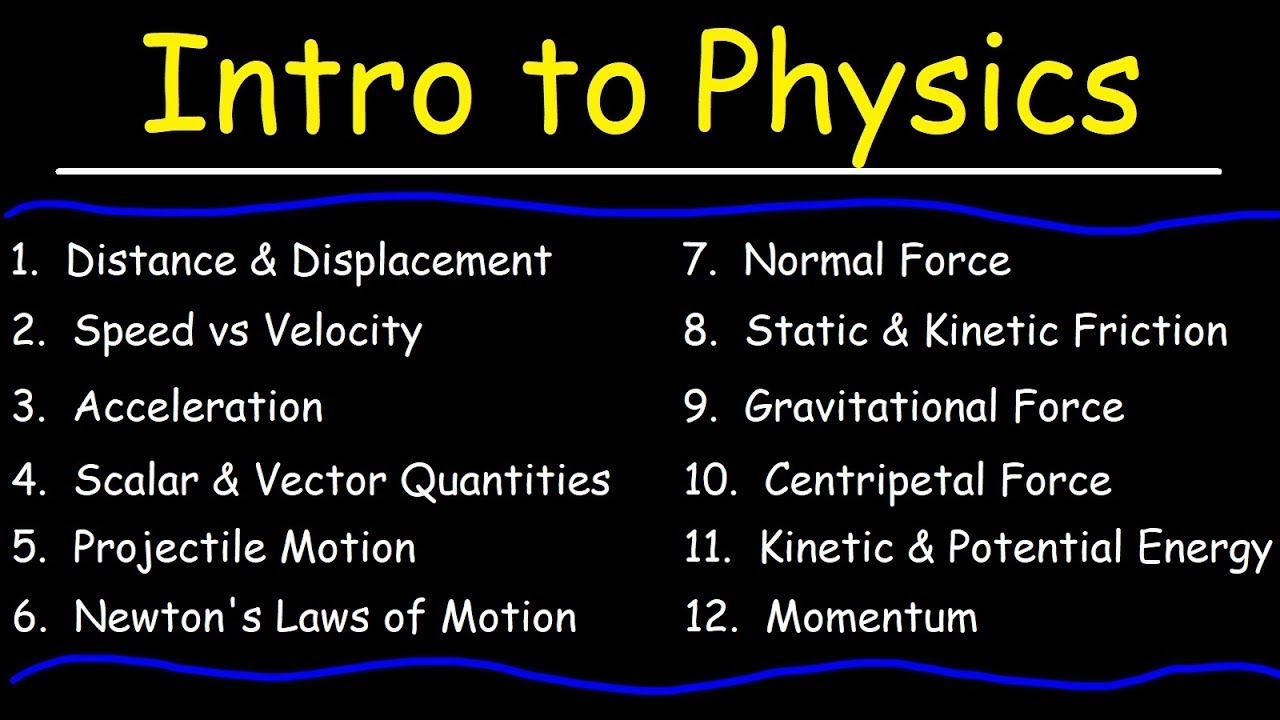
This video introduces fundamental physics concepts, starting with the distinction between distance and displacement, and speed and velocity. It then explains acceleration, including gravitational acceleration, and its effect on motion. The concepts of projectile motion in one and two dimensions are explored, followed by a detailed explanation of Newton's three laws of motion, focusing on the relationship between force, mass, and acceleration. The video uses examples to illustrate these principles, aiming to build a foundational understanding of classical mechanics.
How was this?
Save this permanently with flashcards, quizzes, and AI chat
Chapters
- Distance measures the total path length traveled, a scalar quantity (magnitude only).
- Displacement measures the change in position from start to end, a vector quantity (magnitude and direction).
- Displacement can be positive or negative depending on direction, while distance is always positive.
- Example: Walking 8 meters east then 3 meters west results in 11 meters of distance but 5 meters of displacement.
Understanding the difference between distance and displacement is crucial for accurately describing an object's motion and position changes, especially in more complex scenarios.
John walks 8 meters east and then 3 meters west. His total distance is 11 meters (8 + 3), but his displacement is 5 meters east (8 - 3).
- Speed is a scalar quantity indicating how fast an object is moving (magnitude only).
- Velocity is a vector quantity indicating how fast an object is moving and in what direction.
- Speed is the absolute value of velocity; speed is always positive, while velocity can be positive or negative.
- Average speed is total distance divided by total time.
- Average velocity is total displacement divided by total time.
Distinguishing between speed and velocity is essential because direction matters in many physics problems, affecting how we calculate motion and predict outcomes.
A train moving at 45 meters per second describes its speed. A train moving at 30 meters per second west describes its velocity.
- Acceleration is the rate at which velocity changes over time.
- It is calculated as the change in velocity divided by the change in time (Δv / Δt).
- If acceleration and velocity have the same sign (both positive or both negative), the object speeds up.
- If acceleration and velocity have opposite signs, the object slows down.
- Gravitational acceleration (g) on Earth is approximately -9.8 m/s², affecting only the vertical component of velocity.
Acceleration explains how objects change their state of motion, which is fundamental to understanding everything from a car's braking to a falling object's increasing speed.
A sports car reaching 60 mph in 5 seconds has a greater acceleration (12 mph/s) than a truck reaching 60 mph in 30 seconds (2 mph/s).
- A projectile is an object moving solely under the influence of gravity.
- In projectile motion, the horizontal velocity (vx) remains constant because there is no horizontal acceleration (ax = 0).
- The vertical velocity (vy) changes due to gravitational acceleration (ay = -9.8 m/s²).
- The path of a projectile is called its trajectory.
- When an object is launched at an angle, its initial velocity must be broken down into horizontal (vx = v * cos(theta)) and vertical (vy = v * sin(theta)) components.
Understanding projectile motion allows us to predict the path and behavior of objects in two dimensions, like a thrown ball or a cannonball, by analyzing their horizontal and vertical movements independently.
A ball kicked off a cliff with an initial horizontal velocity of 5 m/s will maintain that horizontal speed, while its vertical speed changes due to gravity.
- Newton's First Law (Inertia): An object at rest stays at rest, and an object in motion stays in motion with the same velocity, unless acted upon by a net external force.
- Newton's Second Law: The net force acting on an object is equal to its mass times its acceleration (F_net = ma).
- Newton's Third Law: For every action, there is an equal and opposite reaction.
- Forces are pushes or pulls that can cause changes in motion.
- Mass is a measure of an object's inertia; a larger mass requires more force to achieve the same acceleration.
Newton's laws are the bedrock of classical mechanics, explaining the relationship between forces and motion, and providing the framework to analyze how objects move and interact.
Applying an 80 Newton force to a 10 kg mass (with no friction) results in an acceleration of 8 m/s² (80 N / 10 kg).
Key takeaways
- Distinguish between scalar quantities (magnitude only, like distance and speed) and vector quantities (magnitude and direction, like displacement and velocity).
- Acceleration is the rate of change of velocity, not just speed, and its sign relative to velocity determines if an object is speeding up or slowing down.
- In projectile motion, horizontal and vertical components of motion can be analyzed independently: horizontal velocity is constant, while vertical velocity is affected by gravity.
- Newton's First Law explains inertia – the tendency of objects to resist changes in their motion.
- Newton's Second Law provides a quantitative relationship between force, mass, and acceleration (F=ma), allowing us to calculate how forces affect motion.
- Understanding these basic physics principles is essential for analyzing and predicting the behavior of objects in the physical world.
Key terms
DistanceDisplacementScalar QuantityVector QuantitySpeedVelocityAccelerationGravitational AccelerationProjectile MotionTrajectoryNewton's First LawNewton's Second LawNewton's Third LawForceMassNet ForceInertia
Test your understanding
- What is the fundamental difference between distance and displacement, and why is direction important for displacement?
- How does acceleration relate to velocity, and what happens to an object's speed when its acceleration and velocity have opposite signs?
- In projectile motion, why is the horizontal component of velocity typically considered constant, while the vertical component changes?
- According to Newton's First Law, what must happen for an object at rest to start moving or for an object in motion to change its velocity?
- How does Newton's Second Law (F=ma) quantitatively describe the relationship between force, mass, and the resulting acceleration of an object?