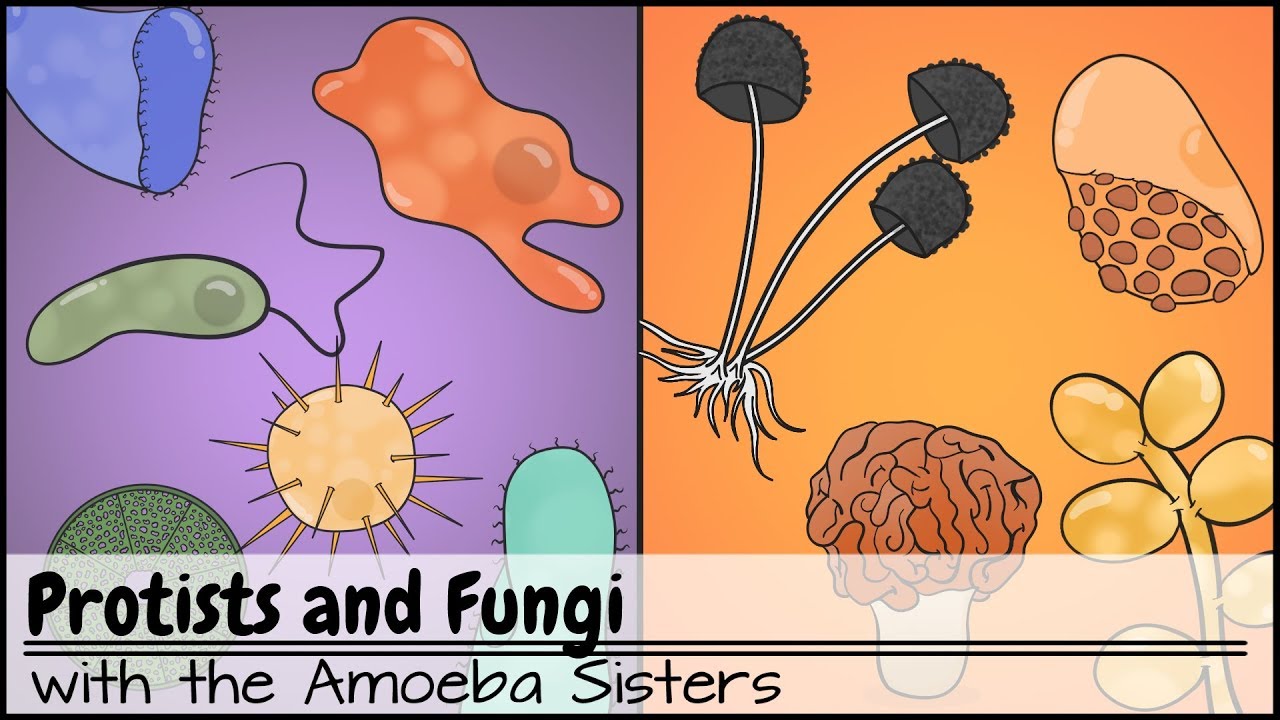
Protists and Fungi
Amoeba Sisters
Overview
This video explores the diverse and often overlooked kingdoms of Protists and Fungi. It explains that protists are eukaryotic organisms that don't fit into the plant, animal, or fungus categories, highlighting their varied habitats, modes of nutrition (autotrophic and heterotrophic), and methods of locomotion. The video also details the crucial ecological roles protists play, from oxygen production to causing diseases like malaria. It then transitions to fungi, emphasizing their eukaryotic nature, chitin cell walls, and heterotrophic lifestyle. The summary covers fungi's ecological importance as decomposers, their role in food and medicine, and their symbiotic relationships, while also acknowledging their potential to cause infections.
Save this permanently with flashcards, quizzes, and AI chat
Chapters
- Protists are eukaryotic microorganisms, meaning their cells have a nucleus and other membrane-bound organelles.
- They are a diverse group, often defined by what they are NOT (not plants, animals, or fungi).
- Protists can be unicellular or multicellular and inhabit various environments like water, soil, and other organisms.
- They exhibit different modes of nutrition, being either autotrophs (making their own food, often through photosynthesis) or heterotrophs (consuming other organisms).
- Locomotion in protists can occur through flagella, cilia, or pseudopods (as seen in amoebas).
- Some protists have cell walls (plant-like or fungus-like), while others do not (animal-like).
- Examples of heterotrophic protists include amoebas, paramecia, and slime molds.
- Reproduction in protists is complex, involving both asexual (like binary fission) and sexual methods, often with intricate life cycles.
- Photosynthetic protists are vital producers in aquatic environments, generating oxygen and forming the base of food chains.
- Many protists, like slime molds, act as decomposers, recycling nutrients.
- Symbiotic relationships exist where organisms depend on protists for digestion or carbon fixation (e.g., insects, corals).
- Problematic protists can cause diseases in humans and other organisms, such as malaria (caused by a protist carried by mosquitoes) and the Irish Potato Famine (caused by a protist-like organism).
- Fungi are also eukaryotes, but molecular genetics shows they are more closely related to animals than plants.
- Most fungi have cell walls made of chitin, a material also found in insect exoskeletons.
- Fungi are heterotrophs, obtaining nutrients by consuming organic matter, and they do not perform photosynthesis.
- They can be found in diverse environments, not just damp, dark places.
- Most fungi are multicellular, though unicellular forms like yeast exist.
- Reproduction often involves spores, which are easily dispersed by wind or animals.
- Fungi play a critical role as decomposers, essential for nutrient cycling in ecosystems.
- They are used in food production (bread, cheese, mushrooms) and are the source of important medicines, including antibiotics like penicillin.
- While beneficial, fungi can also cause infections in humans (e.g., athlete's foot, ringworm) and act as parasites on plants and animals.
- Many fungi form symbiotic relationships, such as mycorrhizae with plant roots to enhance nutrient and water uptake.
- Lichens are a classic example of symbiosis between fungi and algae.
- Emerging research explores fungi for biofuels, biocontrol agents, and roles in biotechnology.
Key takeaways
- Protists are a highly diverse group of eukaryotic organisms that defy simple classification, playing essential roles in ecosystems.
- While many protists are harmless or beneficial, some are significant pathogens causing diseases like malaria.
- Fungi, despite often being perceived negatively, are vital decomposers and have crucial symbiotic relationships with plants and other organisms.
- Fungi are more closely related to animals than plants, a fact revealed by molecular genetics.
- The cell walls of fungi are primarily made of chitin, a unique structural polysaccharide.
- Both protists and fungi have complex reproductive strategies that contribute to their diversity and survival.
- From producing oxygen and forming food webs to providing medicines and food, protists and fungi have profound impacts on life on Earth.
Key terms
Test your understanding
- What defines a protist, and why is it considered a diverse 'catch-all' category in biology?
- How do protists obtain energy and nutrients, and what are some examples of their feeding strategies?
- Explain the ecological significance of protists, considering both their beneficial roles and their impact as pathogens.
- What are the key characteristics that distinguish fungi from plants and animals, particularly regarding their cell walls and genetic relatedness?
- Describe the essential roles fungi play in ecosystems, focusing on decomposition and symbiotic relationships.
- How have fungi contributed to human society, both as food sources and in the development of medicine?