AWS Explained: The Most Important AWS Services To Know
Be A Better Dev
Overview
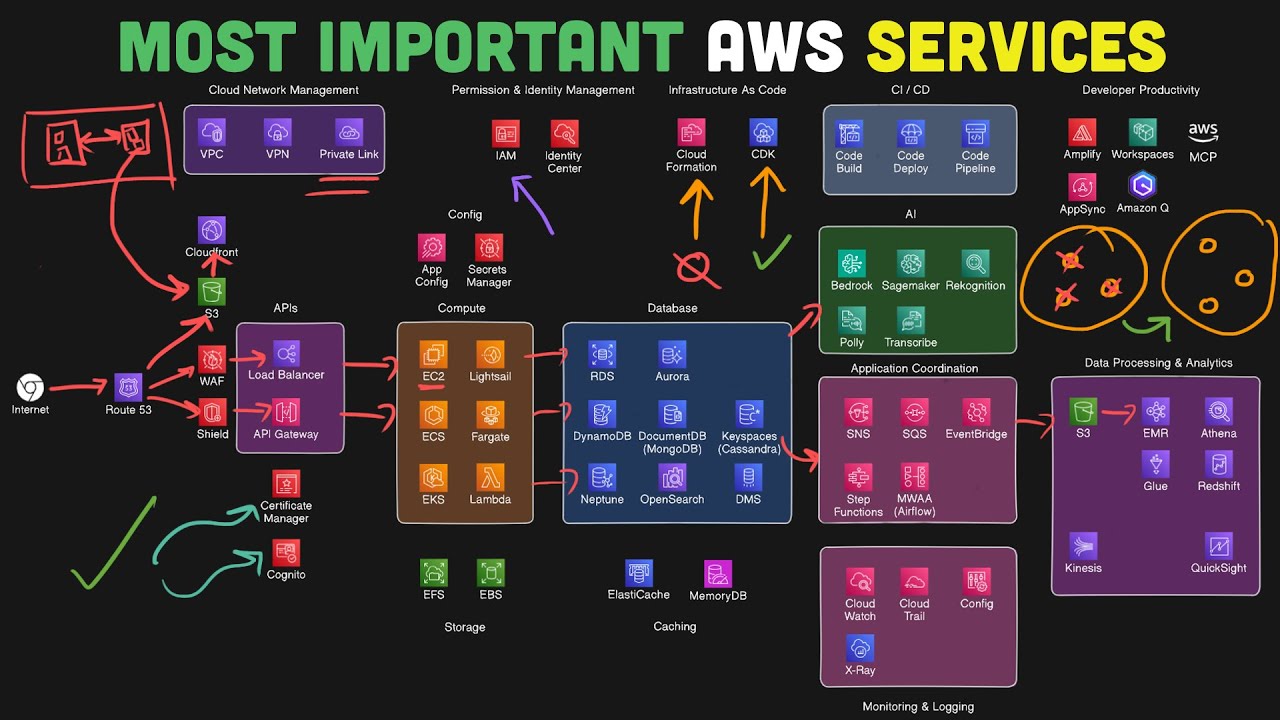
This video provides a practical overview of essential AWS services, focusing on those crucial for building and managing applications. It uses an e-commerce example to illustrate how services like Route 53 for DNS, S3 for storage, CloudFront for content delivery, Elastic Load Balancing and API Gateway for managing API traffic, and various compute services (EC2, Lambda, Containers) work together. The video also covers databases (RDS, DynamoDB), security (WAF, Shield, Cognito), configuration management, AI/ML services, application coordination (SNS, SQS, Step Functions), data processing (EMR, Athena, Redshift), monitoring (CloudWatch, CloudTrail), and infrastructure as code (CloudFormation, CDK). The goal is to demystify AWS by highlighting the core services needed for effective cloud practice.
Save this permanently with flashcards, quizzes, and AI chat
Chapters
- Route 53 manages DNS, domain registration, and traffic routing, including geographic and latency-based rules, and health checks for high availability.
- Amazon S3 provides scalable object storage for static assets like images and HTML files, serving as a flexible foundation for web content.
- CloudFront acts as a Content Delivery Network (CDN) to cache S3 content globally, reducing latency for users by serving content from edge locations closer to them.
- Elastic Load Balancing (ELB) distributes incoming API traffic across multiple compute instances, enabling horizontal scaling and improving application availability.
- API Gateway offers a managed service for creating, publishing, and securing APIs, providing features like rate limiting, throttling, and direct integration with other AWS services without needing compute in between.
- AWS WAF (Web Application Firewall) protects applications from common web exploits like SQL injection and bot attacks, while AWS Shield defends against Distributed Denial of Service (DDoS) attacks.
- AWS Certificate Manager (ACM) provides and manages SSL/TLS certificates to enable encrypted HTTPS connections, and Amazon Cognito handles user authentication and authorization, managing user sign-ups and permissions.
- EC2 (Elastic Compute Cloud) provides virtual servers (instances) that offer flexibility but require manual management of operating systems, patching, and scaling.
- AWS Lightsail offers a simplified, all-in-one platform for launching virtual private servers, databases, and more, ideal for simpler applications and beginners.
- ECS (Elastic Container Service) and EKS (Elastic Kubernetes Service) manage the deployment and lifecycle of containerized applications, with Fargate offering a serverless option for running containers without managing underlying infrastructure.
- AWS Lambda is a serverless compute service that runs code in response to events, automatically scaling and requiring minimal management, suitable for event-driven architectures and APIs.
- EBS (Elastic Block Store) provides persistent block storage volumes for EC2 instances, acting like a virtual hard drive, while EFS (Elastic File System) offers a scalable file system that can be shared across multiple EC2 instances.
- RDS (Relational Database Service) manages relational databases (like MySQL, PostgreSQL) with features for automated backups, patching, and multi-AZ deployments, while AWS Aurora is a high-performance, MySQL/PostgreSQL-compatible database with a serverless option.
- DynamoDB is a fully managed NoSQL key-value and document database known for its speed and scalability, used by many internal Amazon applications.
- DocumentDB and Amazon Keyspaces provide managed NoSQL options for MongoDB and Cassandra workloads, respectively.
- AWS Neptune is a graph database service for managing highly connected data, and Amazon OpenSearch (a fork of Elasticsearch) is used for search and log analytics.
- AWS Secrets Manager securely stores and manages sensitive credentials like API keys and database passwords.
- AWS AppConfig helps manage application configurations and feature flags, allowing dynamic updates to application behavior without redeploying code.
- ElastiCache provides in-memory caching for high-speed data retrieval, supporting Redis and Memcached, while MemoryDB for Redis offers a durable, Redis-compatible in-memory database that persists data.
- Amazon Bedrock offers access to various foundational AI models for building generative AI applications, while Amazon SageMaker is a comprehensive platform for data scientists to build, train, and deploy machine learning models.
- AWS Rekognition analyzes images and videos, Amazon Polly converts text to speech, and AWS Transcribe converts speech to text.
- SNS (Simple Notification Service) enables a publish/subscribe model for sending messages to multiple subscribers asynchronously.
- SQS (Simple Queue Service) provides managed message queues for decoupling application components and ensuring reliable message processing.
- Amazon EventBridge offers a serverless event bus that connects applications with AWS services and custom applications, supporting event routing, schema discovery, and scheduled events.
- AWS Step Functions orchestrates distributed applications and microservices into serverless workflows with visual monitoring and error handling.
- EMR (Elastic MapReduce) provides a managed Hadoop framework for big data processing, while AWS Athena allows interactive SQL queries directly on data in S3.
- AWS Glue is a serverless data integration service for data discovery, preparation, and transformation, and Amazon Redshift is a petabyte-scale data warehouse for analytics.
- CloudWatch collects logs, metrics, and events, providing dashboards and alarms for monitoring application and infrastructure health.
- CloudTrail records API calls made within your AWS account, providing an audit trail for governance and security analysis.
- AWS Config tracks resource configurations and compliance, alerting on deviations from defined policies.
- AWS X-Ray provides distributed tracing to analyze and debug distributed applications, identifying performance bottlenecks.
- AWS CodeBuild compiles source code, runs tests, and produces software packages; CodeDeploy automates code deployments to various compute services; and CodePipeline orchestrates continuous integration and continuous delivery (CI/CD) workflows.
- CloudFormation allows you to model and provision AWS infrastructure resources using declarative JSON or YAML templates.
- AWS CDK (Cloud Development Kit) enables you to define cloud infrastructure using familiar programming languages (like Python, TypeScript), which then synthesizes into CloudFormation templates.
- These tools ensure infrastructure is version-controlled, repeatable, and consistent across different environments and regions.
Key takeaways
- AWS offers a vast array of services, but mastering a core set is sufficient for most practical applications.
- Understanding the interplay between networking, storage, compute, and database services is fundamental to building scalable applications.
- Security services like WAF, Shield, and Cognito are crucial for protecting your application and its users.
- Serverless options like Lambda and Fargate reduce operational overhead and can offer cost efficiencies.
- Managed database services (RDS, DynamoDB) abstract away much of the complexity of database administration.
- Infrastructure as Code (CloudFormation, CDK) is essential for repeatable, version-controlled, and automated infrastructure deployments.
- Monitoring and logging services (CloudWatch, CloudTrail) are vital for maintaining application health and security.
Key terms
Test your understanding
- How does Route 53 help improve user experience for a global application?
- What is the primary difference in purpose between Amazon S3 and CloudFront?
- When would you choose to use AWS Lambda over EC2 for running application code?
- Explain the role of API Gateway in managing access to backend services.
- How do Infrastructure as Code tools like CloudFormation contribute to application reliability and consistency?
- What is the main benefit of using a managed database service like RDS compared to running a database on an EC2 instance?