11:48
Simplifying Exponents With Fractions, Variables, Negative Exponents, Multiplication & Division, Math
The Organic Chemistry Tutor
Overview
This video explains the fundamental properties of exponents, focusing on how to simplify expressions involving multiplication, division, powers of powers, zero exponents, and negative exponents. It covers rules for combining terms with common bases by adding or subtracting exponents, and how to handle exponents when raising a power to another power by multiplying. The video also clarifies the distinction between negative exponents applied to a base versus a negative sign outside the base, and demonstrates how to simplify complex expressions with multiple variables and coefficients.
How was this?
Save this permanently with flashcards, quizzes, and AI chat
Chapters
- When multiplying terms with the same base, add the exponents (e.g., x^4 * x^5 = x^(4+5) = x^9).
- When dividing terms with the same base, subtract the exponents (e.g., x^7 / x^3 = x^(7-3) = x^4).
- These rules stem from the definition of exponents as repeated multiplication.
Understanding these core rules is essential for simplifying algebraic expressions and solving equations, forming the foundation for more complex exponent manipulations.
x^7 / x^3 simplifies to x^4 because seven x's divided by three x's allows for cancellation of three pairs, leaving four x's.
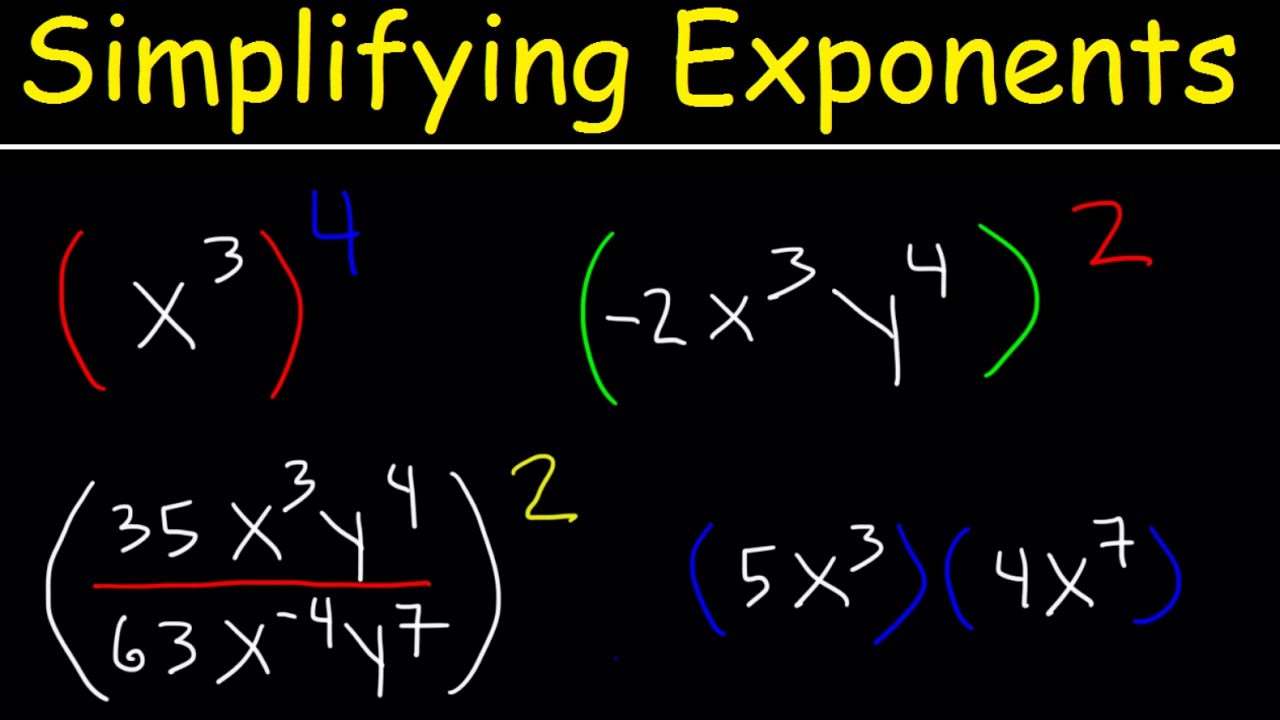
- When raising an exponent to another power, multiply the exponents (e.g., (x^3)^4 = x^(3*4) = x^12).
- Any non-zero number or variable raised to the power of zero equals one (e.g., x^0 = 1, 4^0 = 1).
- This rule applies only to the base directly affected by the zero exponent; coefficients outside parentheses remain unchanged (e.g., -4x^0 = -4 * 1 = -4).
These rules provide shortcuts for simplifying expressions and are crucial for understanding polynomial operations and advanced algebraic concepts.
(x^3)^4 means multiplying x^3 by itself four times, resulting in a total of 3 * 4 = 12 x's being multiplied together.
- A negative exponent indicates a reciprocal; move the term to the opposite side of the fraction bar and change the exponent's sign (e.g., x^-3 = 1/x^3).
- Conversely, a negative exponent in the denominator can be moved to the numerator to become positive (e.g., 1/x^-4 = x^4).
- The sign of the base is distinct from the sign of the exponent; negative exponents are handled by reciprocation, not by changing the base's sign.
Negative exponents are a concise way to represent fractions and are vital for simplifying expressions in calculus, physics, and engineering.
To simplify x^-3, you move x to the denominator and change the exponent to positive, resulting in 1/x^3.
- When a product or quotient is raised to a power, the exponent must be distributed to each factor within the parentheses (e.g., (3x^2)^3 = 3^3 * (x^2)^3).
- Remember to apply the exponent to both the numerical coefficient and each variable.
- Simplify coefficients by calculating their powers (e.g., 3^3 = 27) and simplify variable powers by multiplying exponents (e.g., (x^2)^3 = x^6).
This rule allows for the simplification of complex expressions involving multiple terms raised to a power, preparing learners for polynomial expansion.
For (3x^2)^3, distribute the 3: 3^3 * (x^2)^3 = 27 * x^(2*3) = 27x^6.
- Combine coefficients by multiplying or dividing as indicated.
- Combine variables with the same base by adding exponents for multiplication or subtracting for division.
- Distribute exponents to all parts of a term before combining.
- Ensure all negative exponents are converted to positive exponents in the final answer.
Mastering the simplification of complex expressions is a key skill in algebra, enabling efficient problem-solving and reducing the chance of errors in subsequent calculations.
To simplify 24x^7y^3 / 8x^4y^-2, first divide coefficients (24/8=3), then subtract exponents for x (7-4=3), and add exponents for y (3 - (-2) = 5), resulting in 3x^3y^5.
- Clarify the difference between expressions like -3^2 and (-3)^2.
- In -3^2, only the 3 is squared, resulting in -(3*3) = -9.
- In (-3)^2, the entire base (-3) is squared, resulting in (-3)*(-3) = 9.
- When simplifying fractions with exponents, simplify the numerator and denominator separately before applying division or distributing exponents.
Understanding the order of operations, especially with negative bases and exponents, prevents common mistakes and ensures accurate results in algebraic manipulations.
The expression -3^2 evaluates to -9 because the exponent applies only to the 3, while (-3)^2 evaluates to 9 because the negative sign is part of the base being squared.
Key takeaways
- Multiplying terms with the same base involves adding their exponents.
- Dividing terms with the same base involves subtracting their exponents.
- Raising a power to another power requires multiplying the exponents.
- Any non-zero base raised to the power of zero equals one.
- Negative exponents signify reciprocals and are resolved by moving the base to the opposite side of the fraction bar and changing the exponent's sign.
- Exponents must be distributed to every factor within a base that is raised to a power.
- Carefully distinguish between the base and its sign when dealing with negative exponents and powers.
Key terms
ExponentBaseMultiplication Property of ExponentsDivision Property of ExponentsPower of a Power RuleZero ExponentNegative ExponentCoefficientReciprocal
Test your understanding
- How do you simplify expressions when multiplying terms with the same base?
- What is the rule for simplifying expressions when dividing terms with the same base?
- Explain how to handle a negative exponent in an algebraic expression.
- What is the difference between x^0 and -x^0?
- How do you simplify an expression like (ab^2)^3?