22:35
Mod 5 1
The Mindful Professor
Overview
This video explores the relationship between focused work and mind-wandering in fostering creativity. It revisits foundational concepts like creativity as an everyday practice and the importance of growth and intrinsic motivation. The core idea is that creativity thrives not from constant focus, but from a dynamic interplay between intense concentration and periods of rest and exploration. This balance allows the brain to unconsciously process problems, make novel connections, and generate breakthrough ideas, ultimately enhancing creative output.
How was this?
Save this permanently with flashcards, quizzes, and AI chat
Chapters
- Creativity is an everyday practice that requires skill development and time for exploration.
- A growth mindset, where challenges are seen as learning opportunities, is crucial for creativity.
- Intrinsic motivation, driven by personal interest and enjoyment, fuels creative endeavors.
- Complexity in creativity involves balancing opposing impulses, such as learning broadly versus deeply.
Understanding these foundational elements helps learners appreciate that creativity is accessible and can be cultivated through specific mindsets and approaches.
Learning deeply in one area (depth) is important for mastery, while learning widely across different fields (breadth) fosters adaptability and novel thinking.
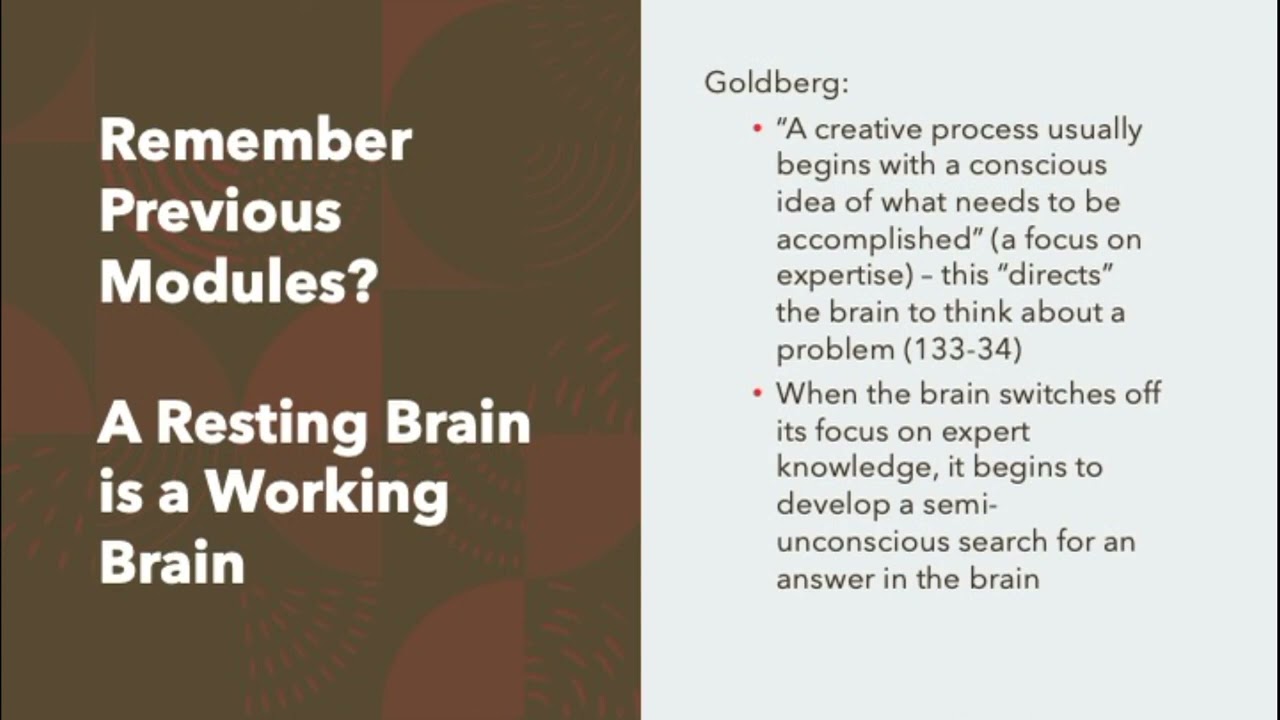
- Creative ideas often emerge from a multi-step process involving conscious framing and unconscious searching.
- Conscious framing involves clearly defining and understanding a problem or idea.
- During periods of rest (sleep, meditation, distraction), the brain unconsciously searches for solutions by making wide-ranging connections.
- This unconscious search is like a dog released from a cage, exploring a vast network of memories and information.
Recognizing this two-step process highlights the critical role of downtime and rest in problem-solving and idea generation, challenging the notion that constant work leads to the best results.
A poet like John Newlove would step away from writing a poem, engage in other activities, and then have a line or idea surface, seemingly from nowhere, which then guided their writing.
- Breakthrough ideas, or 'aha' moments, occur when the brain brings solutions from its unconscious search into conscious awareness.
- These moments are often unexpected and arise during activities like showering, driving, or waking up.
- Once an idea surfaces, conscious implementation begins: evaluating, planning, and acting on the solution.
- Creative individuals listen to these emergent ideas without immediate judgment and begin asking 'how' questions to explore their feasibility.
This stage emphasizes the importance of recognizing and acting upon sudden insights, transforming them from fleeting thoughts into tangible creative outputs.
The speaker's own experience of an idea for a book title ('Process, a Love Story') popping into their head while making breakfast, leading them to immediately write it down for later development.
- Creativity is enhanced by moving between states of intense focus and periods of rest and mind-wandering.
- Prioritizing one state exclusively, like extreme focus, can limit creative potential.
- Practicing this movement between states prepares individuals to handle creative challenges more effectively.
- This balance is essential for accessing the brain's ability to find and fuse disconnected information.
This principle encourages a more holistic approach to work and creativity, advocating for intentional breaks and diverse mental states to optimize idea generation.
The speaker's personal practice of taking a 25-minute nap daily to refresh and improve afternoon work performance, demonstrating a deliberate use of rest.
- Three key mental states influence creativity: flow, intentional wandering, and free wandering.
- Flow is a state of deep engagement and productivity, often described as being 'in the zone'.
- Intentional wandering involves deliberately taking breaks to daydream, rest, or focus on positive thoughts to refresh the mind.
- Free wandering occurs when the brain rests without specific provocation, allowing thoughts to drift spontaneously.
Understanding these distinct mental states provides a framework for intentionally managing one's cognitive processes to enhance creative outcomes.
Intentional wandering might involve setting aside a specific time to think about anxieties, not to solve them, but to acknowledge them and then release them for the rest of the day.
Key takeaways
- Creativity is not solely about intense focus, but about the dynamic interplay between focused effort and periods of rest and mind-wandering.
- The brain's unconscious processing during rest is vital for making novel connections and generating breakthrough ideas.
- Recognizing and capturing 'aha' moments is crucial for moving creative ideas from conception to implementation.
- Adopting a growth mindset and cultivating intrinsic motivation are essential for sustained creative development.
- Complexity in creativity arises from balancing different cognitive impulses, such as deep specialization and broad exploration.
- Deliberately switching between states of flow, intentional wandering, and free wandering can significantly enhance creative output.
- Rest and breaks are not unproductive downtime but active components of the creative process.
Key terms
CreativityGrowth MindsetIntrinsic MotivationComplexityBreadth vs. DepthConscious FramingUnconscious SearchAha! MomentMind WanderingFlow StateIntentional WanderingFree Wandering
Test your understanding
- How does the concept of a 'growth mindset' contribute to a more creative individual?
- Explain the relationship between conscious framing and unconscious searching in generating creative ideas.
- What is the significance of the 'aha!' moment in the creative process, and how does it relate to the unconscious search phase?
- Why is it important to move between states of intense focus and mind-wandering for creativity?
- Describe the differences between flow, intentional wandering, and free wandering, and how each state impacts creativity.