1:05:53
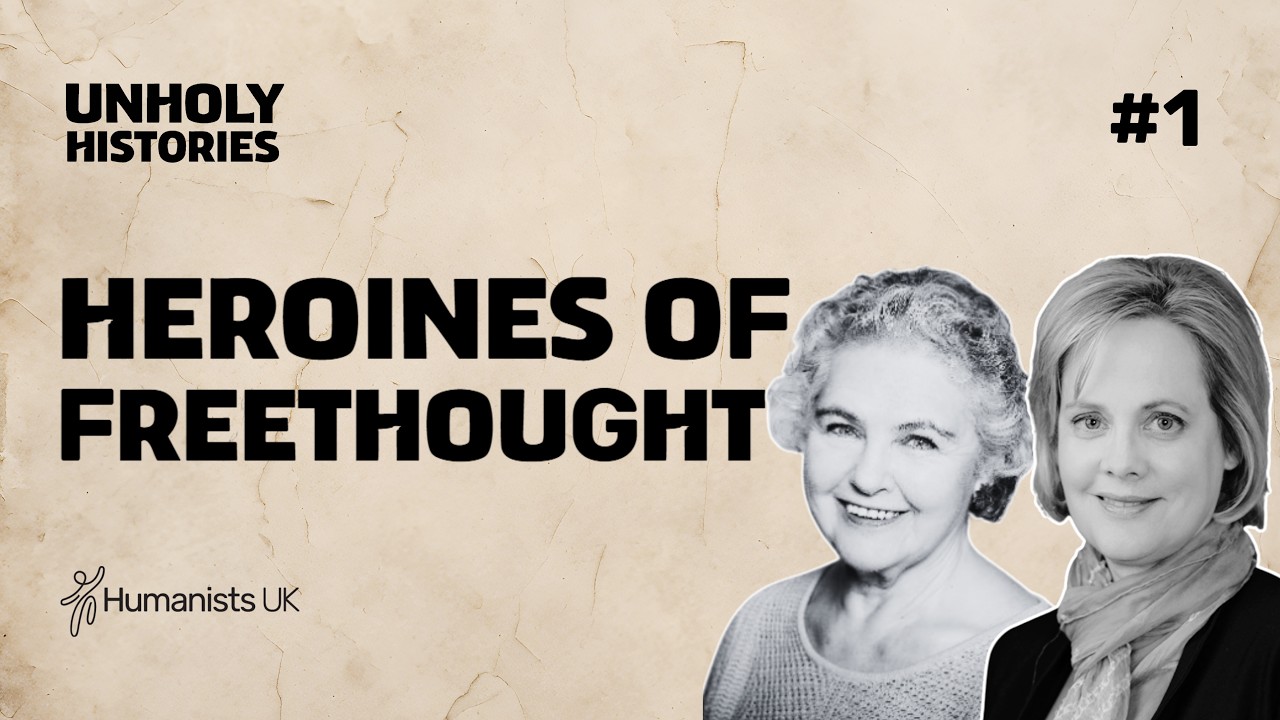
Why Was It Scandalous to Be a Woman Freethinker? | Unholy Histories Podcast
Humanists UK
Overview
This episode of "Unholy Histories" explores the often-overlooked contributions of women freethinkers throughout history. It highlights how these women challenged religious and social conventions, advocating for reason, equality, and human progress, often facing significant backlash. The discussion features historians Nan Sloane and Annie Laurie Gaylor, who share insights into the motivations behind their research and writing on these "heroines of freethought." They delve into the specific struggles and achievements of various women, emphasizing their fight against patriarchal structures and religious dogma, and their impact on modern freedoms and the humanist movement.
How was this?
Save this permanently with flashcards, quizzes, and AI chat
Chapters
- Many influential figures in history are men, but women have also been leading voices for reason and progress, though their stories are often ignored.
- The term 'freethinker' historically carried a stigma, especially for women who dared to question religious and social norms.
- This episode aims to uncover the lives, struggles, and legacies of these women and their impact on the humanist movement.
- Guests Nan Sloane and Annie Laurie Gaylor are introduced as experts on women's history and freethought.
Understanding the historical context of women freethinkers reveals the deep-seated societal barriers they faced and the courage required to challenge them, providing a richer understanding of both feminist and humanist histories.
Sarah Underwood's 1876 collection 'Heroines of Freethought,' which celebrated 11 women who defied convention, is mentioned as an early attempt to highlight these figures.
- Nan Sloane was motivated to research women's political activism beyond the suffrage movement, discovering their involvement in various social and reform movements.
- Annie Laurie Gaylor created her anthology 'Women Without Superstition' because no comprehensive collection of women freethinkers' writings existed.
- Both authors found that women freethinkers were often footnotes in broader historical accounts, necessitating dedicated research to bring their contributions to light.
- The research involved extensive archival work, sometimes struggling to find even basic biographical information or photographs of these women.
The personal motivations of historians in seeking out marginalized voices demonstrate the importance of actively reconstructing history to ensure a more complete and accurate representation of past contributions.
Annie Laurie Gaylor's difficulty in finding a photograph of the 19th-century pamphleteer Emma Martin for her book illustrates the challenges in recovering these women's stories.
- Women freethinkers often wrote about the treatment of women by religion and advocated for women's rights, directly challenging biblical strictures on female subservience.
- Their writings encompassed a diversity of philosophical ideas, but a common thread was the critique of religious dogma and its impact on women.
- These women fought for broader societal improvements, not just gender equality, striving to create better lives for everyone.
- A key element of their rebellion was not just their opinions, but the very method by which they arrived at those opinions – independent thought.
Identifying common themes reveals the interconnectedness of religious critique, feminist advocacy, and broader social reform, showing how challenging one norm often led to challenging others.
Emma Martin's lecture 'God's Gifts and Man's Duties' argued for people to take action against oppression and inequality, questioning religious strictures and advocating for self-determination.
- Frances Wright was an early female lecturer who addressed mixed audiences, criticizing religious manipulation of women and advocating for 'halls of science' instead of churches.
- Ernestine Rose, daughter of a rabbi, became a prominent freethinker and lobbyist for women's property rights, facing significant opposition.
- Elizabeth Cady Stanton was a key figure in the US suffrage movement and fiercely critical of religion, even editing the 'Woman's Bible,' which led to her being repudiated by some in the movement.
- These women often faced public vilification, with harsh names and criticism directed at their perceived 'betrayal of femininity'.
The stories of these individual pioneers illustrate the immense personal courage and resilience required to break new ground in social and intellectual reform, often at great personal cost.
Ernestine Rose's five-month campaign to gather signatures for the first married women's property rights bill in the US, ultimately achieving success in 1848, demonstrates her persistence.
- Jane and Mary Ann Carlile, along with Jane's husband Richard, ran a radical bookshop that challenged state and religious authorities.
- They were repeatedly arrested, prosecuted, and imprisoned for blasphemy and selling seditious literature.
- Jane Carlile took over the bookshop and continued the work while pregnant and raising children in prison, demonstrating extraordinary resilience.
- Jane eventually established her own competing bookshop after her husband abandoned her, becoming an independent freethinker through her experiences.
The Carlile family's story highlights how ordinary women, through circumstance and defiance, became radical figures, showing that freethought could be forged through lived experience and persecution, not just intellectual pursuit.
Jane Carlile and her sister-in-law Mary Ann Carlile were imprisoned together in the same cell, with Jane pregnant, due to their involvement in Richard Carlile's radical publishing activities.
- Many freethinking women were involved in multiple progressive causes, including abolitionism, which often exposed them to discrimination as female activists.
- The experience of being silenced or marginalized in movements like abolition directly fueled the push for women's suffrage.
- Historically, women's voices were restricted to certain genres like domestic or gothic novels; straying beyond these boundaries invited scandal and criticism.
- Even in death, obituaries of women freethinkers often downplayed or omitted their radical views, focusing instead on their religious upbringing.
This chapter underscores that the fight for freethought was intertwined with other social justice movements, and that societal constraints on women's expression were pervasive, even in death.
Elizabeth Cady Stanton's co-convening of the Seneca Falls Convention was partly inspired by her experience at an abolition meeting in London where women were forced to sit behind a curtain.
- In the 19th century, women in the US and UK had severely limited legal rights, often classed with children, lacking rights to custody, property, or even to sue.
- Freethinking women were at the forefront of advocating for reforms like divorce law, reproductive rights (contraception), and personal autonomy.
- In Britain, the 1832 Reform Act actually rolled back women's voting rights, making the suffrage movement a necessity.
- Women's activism extended to areas like dress reform, challenging biblical injunctions against wearing trousers.
Understanding the severe legal and social limitations women faced provides crucial context for the radical nature of their demands and the profound impact of their advocacy on modern freedoms.
The early contraceptive movement was largely driven by the freethought movement, advocating for women's control over their bodies.
- Women freethinkers are often forgotten due to a combination of sexism, the erasure of freethought movements from mainstream history, and difficulty in accessing their writings.
- Societies remain officially religious, marginalizing non-religious histories and perspectives, even as religious adherence declines.
- The battles fought by these women, such as for the right to vote and reproductive freedom, are still being contested today, highlighting the ongoing relevance of their struggles.
- Remembering these women inspires continued advocacy for secular governance and individual liberties, especially for women.
Their legacy is crucial for understanding the ongoing fight for secularism and individual rights, serving as a reminder that progress is not guaranteed and requires continuous effort.
The current political climate in the US, with challenges to abortion rights, contraception, and marriage equality, demonstrates that the battles for women's rights and secular governance are far from over.
Key takeaways
- Women have historically been central to freethought and social reform, often facing double discrimination as women and non-conformists.
- Challenging religious dogma was intrinsically linked to advocating for women's rights and broader social justice.
- The courage of women freethinkers in the face of severe social and legal constraints laid the groundwork for many modern freedoms.
- Independent thought, rather than adherence to prescribed roles, was the core of their rebellion and a key target of societal backlash.
- The historical marginalization of women's contributions necessitates active efforts to recover and celebrate their stories.
- The fight for secular governance and individual liberties is ongoing, with current challenges echoing historical struggles.
- Remembering these women provides inspiration and a framework for continuing the pursuit of equality and autonomy.
Key terms
FreethinkerHumanismSecularismSuffrage MovementAbolitionismPatriarchyReligious DogmaPersonal AutonomyRational Dress SocietyVice Society
Test your understanding
- Why was it considered particularly scandalous for women to be freethinkers in historical contexts?
- What were the common themes and motivations behind the writings and activism of women freethinkers?
- How did the legal and social limitations of the 19th century shape the activism of women like Elizabeth Cady Stanton and Ernestine Rose?
- What examples illustrate the resilience and courage of women who faced persecution for their freethinking views?
- Why are the stories of these women often overlooked in historical narratives, and why is it important to remember them today?