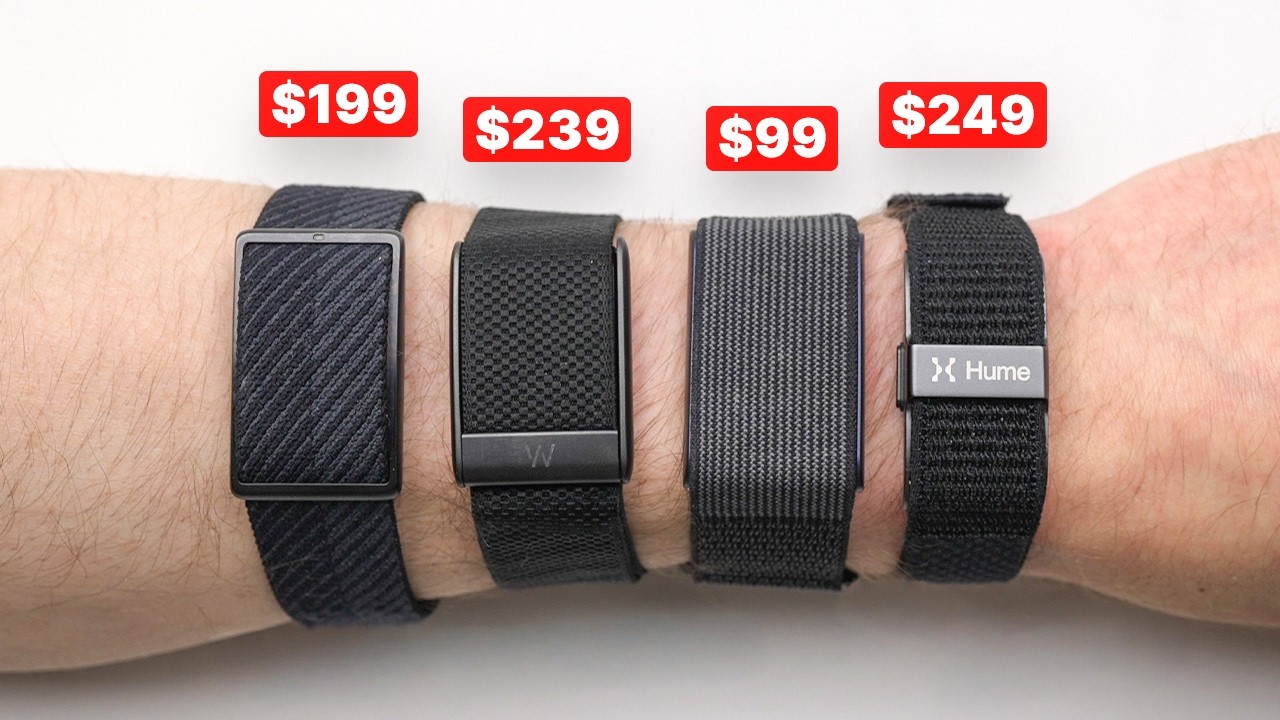
I Tested 4 Fitness Trackers (Don't Make This Mistake)
Mike Hanna
Overview
This video reviews four fitness trackers: Amazfit Helio Strap, Polar Loop, Human Band, and Whoop 5.0, comparing them on accuracy, app experience, and features. The reviewer highlights the importance of accurate data for understanding sleep, activity, and recovery. Key findings include the surprising accuracy of the budget-friendly Amazfit Helio Strap when worn on the bicep for heart rate tracking, the dated app experience of the Polar Loop, the significant drawbacks of the Human Band's app and data accuracy, and the premium, data-rich experience of the subscription-based Whoop 5.0. The video concludes by recommending the Amazfit Helio Strap as the best value for its price and data quality.
Save this permanently with flashcards, quizzes, and AI chat
Chapters
- Four fitness trackers are tested for accuracy and features, ranging from budget to premium.
- The Amazfit Helio Strap ($99) offers a comfortable design, long battery life (up to 10 days), and 50 ATM water resistance.
- Its app, Zepp, has improved with frequent updates, offering customizable metrics, notifications, and health monitoring (heart rate, stress, SpO2).
- Unique features include a 'pie score' for gamified activity and detailed sleep tracking with weekly/monthly reports.
- Activity metrics include exertion, fatigue, fitness level, and training status, which feed into a 'bio charge' recovery score.
- The Polar Loop ($199) is the thinnest tracker tested and comes with two band sizes for a better fit.
- It offers 30m water resistance and an 8-day battery life, charging via a magnetic cable.
- The Polar Flow app is described as dated, with data presented chronologically rather than prioritizing key scores.
- Sleep tracking provides stages, duration, and scores based on amount, solidity, continuity, efficiency, and regeneration.
- Recovery is measured by 'ANS charge,' a score based on heart rate, HRV, and breathing during the first 4 hours of sleep.
- The Human Band ($249) is thicker than other trackers and has a less convenient charging system.
- It boasts IP68 water resistance but has the shortest battery life (4-5 days).
- The app features a prominent, permanent upsell for a premium version, which is a significant drawback for a high-priced device.
- Key metrics include a health score, metabolic momentum, metabolic capacity, strain, and recovery, though their calculation is unclear.
- Sleep tracking is inconsistent, with the device sometimes missing large portions of sleep, requiring specific wrist placement for better accuracy.
- The Whoop 5.0 ($239/year subscription) has the smallest brain profile and premium band materials for 24/7 comfort.
- It offers a unique bicep charging solution with a power pack, extending battery life up to 14 days.
- The app is considered the most premium, displaying sleep, recovery, and strain scores prominently.
- It features a smart alarm, a recovery journal for pattern analysis, and AI-powered insights and Q&A.
- Advanced metrics include sleep consistency, efficiency, sleep stress, and a 'Whoop age' for healthspan comparison.
- Sleep duration, bedtime, and wake-up times were consistent across Amazfit, Polar, and Whoop, with Human Band showing significant inaccuracies.
- HRV (Heart Rate Variability) data was close for Amazfit, Polar, and Whoop, but wildly inaccurate for the Human Band.
- Wrist-based heart rate tracking showed some underestimation and delays for Amazfit, Polar, and Whoop, with Whoop being more aligned overall.
- Bicep-based heart rate tracking significantly improved accuracy for Amazfit and Polar, while Whoop's accuracy decreased.
- The Human Band failed to provide accurate workout heart rate data or broadcast it to an app.
- The Amazfit Helio Strap is recommended as the best value at $99, offering excellent data quality and app experience for its price.
- The Polar Loop has good hardware but needs app improvements.
- The Human Band suffers from accuracy issues, a frustrating app, and a pushy subscription model.
- The Whoop 5.0 provides a premium, data-intensive experience but comes with a recurring annual cost.
- Increased competition in the fitness tracker market is driving innovation and better value for consumers.
Key takeaways
- Fitness tracker accuracy can vary significantly between devices, especially for metrics like HRV and workout heart rate.
- The placement of a fitness tracker (wrist vs. bicep) can dramatically impact the accuracy of heart rate data.
- App experience and data presentation are as important as the raw data itself for understanding fitness metrics.
- Subscription models for fitness trackers (like Whoop) offer deep insights but require ongoing payment, while one-time purchases (like Amazfit) may offer less advanced features.
- Budget-friendly trackers can offer surprisingly good value and accuracy, challenging more expensive options.
- Features like sleep stage tracking, recovery scores, and heart rate variability are key indicators of overall health and training readiness.
- Be wary of devices with unclear data calculations, persistent upsells, or instructions that significantly complicate usage (e.g., specific band placement).
Key terms
Test your understanding
- How does wearing a fitness tracker on the bicep versus the wrist affect heart rate accuracy, according to the video?
- What are the main drawbacks of the Human Band that make it a less desirable option compared to others?
- Compare and contrast the app experiences of the Polar Loop and the Whoop 5.0.
- Why is Heart Rate Variability (HRV) an important metric, and how did the tested devices perform in measuring it?
- What factors should a user consider when deciding between a subscription-based fitness tracker like Whoop and a one-time purchase like the Amazfit Helio Strap?