15:10
How Do Animals Know What To Do? | Innate vs. Learned Behaviors for Students
Lumina Learning
Overview
This video explores the fascinating world of animal behavior, distinguishing between behaviors animals are born with (innate) and those they acquire through experience (learned). It delves into innate behaviors like reflexes and instincts, and learned behaviors such as imprinting and conditioning. The summary also touches upon social behaviors like aggression and courtship, and cyclic behaviors like hibernation and migration, highlighting how these actions are crucial for animal survival and species continuation.
How was this?
Save this permanently with flashcards, quizzes, and AI chat
Chapters
- Animal behavior encompasses all the ways organisms respond to their environment, and is essential for survival.
- Behaviors can be broadly categorized into two main types: innate (born with) and learned (acquired through experience).
- Ethology is the scientific study of animal behavior.
Understanding the fundamental types of animal behavior provides a framework for analyzing why animals act in specific ways to survive and thrive.
Geese flying in a triangular pattern or chameleons camouflaging are examples of behaviors that prompt the question of 'how animals know what to do'.
- Innate behaviors are genetically programmed and passed down through generations, requiring no prior learning.
- Reflexes are simple, automatic responses to stimuli, like blinking or pulling away from a hot surface, often bypassing the brain.
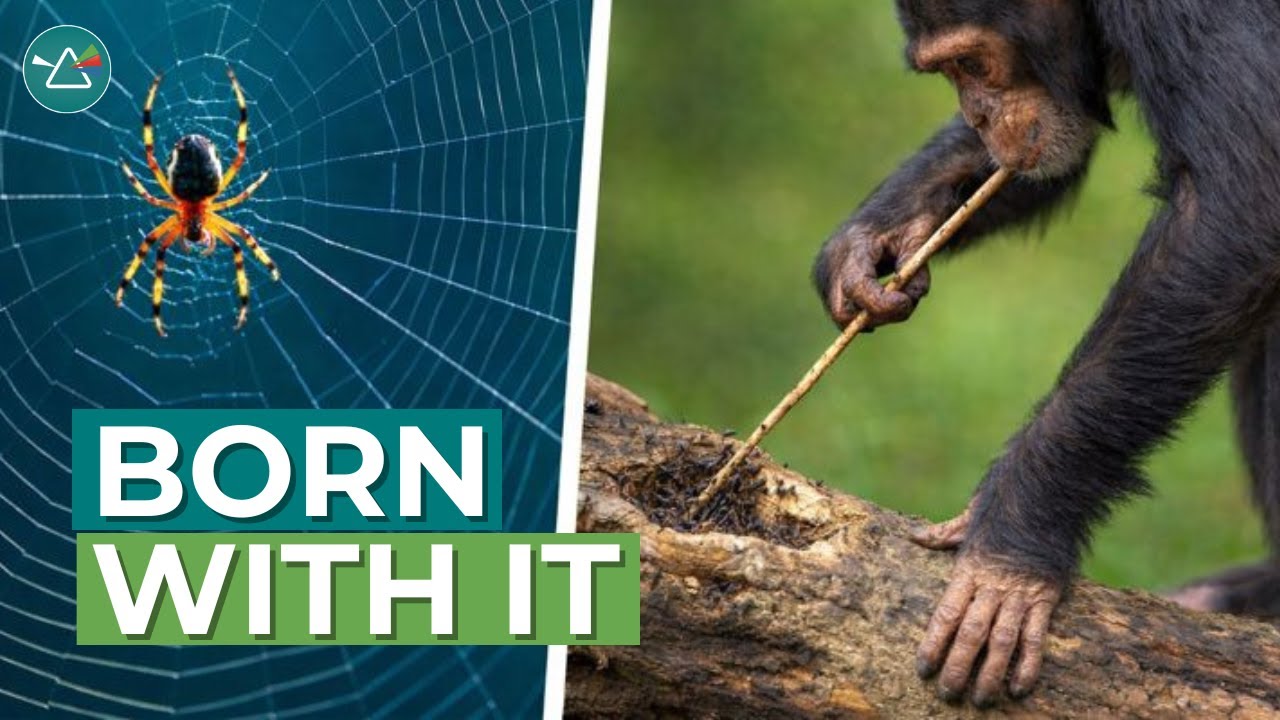
- Instincts are more complex, innate behavioral patterns, such as a spider spinning a web or birds migrating, which can take time to complete.
These hardwired behaviors ensure basic survival functions are met from birth, providing immediate responses to critical environmental cues.
A baby monkey instinctively grasping with its hands and feet without being taught is an example of an innate behavior.
- Learned behaviors are acquired through experience and interaction with the environment.
- Imprinting is a type of learned behavior where an animal forms a strong social attachment to another organism or object during a critical early period, such as recognizing a parent.
- Conditioning involves associating a stimulus with a response, often through rewards or punishments, like training a dog to sit for a treat.
Learned behaviors allow animals to adapt to changing environments and develop complex skills necessary for survival and social interaction.
A puppy learning to associate the command 'sit' with receiving a treat is an example of conditioning.
- Aggression is a forceful behavior used to protect young, territory, or food resources, crucial for survival.
- Courtship behaviors are specific actions, sounds, or displays used by animals to attract mates and ensure species continuation.
- Social behavior encompasses all interactions between members of the same species, including cooperation, communication, and maintaining social structures.
- Societies, like those of bees or chickens, involve organized groups with specific roles for members.
These behaviors are vital for reproduction, resource acquisition, and maintaining order within animal groups, contributing to both individual and species survival.
Male peacocks displaying their colorful feathers to attract a mate is an example of courtship behavior.
- Pheromones are chemical signals released by animals to influence the behavior of others of the same species, often for mating or warning of danger.
- Cyclic behaviors occur in repeated patterns, often seasonally, and are passed down through generations.
- Hibernation is a cyclic adaptation where animals drastically reduce activity and slow bodily processes to survive winter.
- Migration is an instinctive seasonal movement to find better conditions for food or reproduction.
These behaviors demonstrate how animals synchronize with environmental cycles and communicate effectively to ensure survival and successful reproduction.
Ants releasing pheromones to guide others to a food source illustrates chemical communication within a species.
Key takeaways
- Animal survival hinges on a combination of innate, genetically programmed behaviors and learned behaviors acquired through experience.
- Reflexes provide immediate, automatic responses, while instincts are more complex, innate behavioral patterns.
- Learned behaviors like imprinting and conditioning allow animals to adapt and develop crucial life skills.
- Social behaviors, including aggression and courtship, are essential for reproduction, resource management, and group cohesion.
- Effective communication, such as through pheromones, and cyclic adaptations like hibernation and migration are key to navigating environmental challenges.
- Understanding animal behavior requires recognizing the interplay between an animal's biology, its environment, and its experiences.
Key terms
BehaviorInnate BehaviorLearned BehaviorEthologistReflexInstinctImprintingConditioningAggressionCourtship BehaviorSocial BehaviorPheromoneCyclic BehaviorHibernationMigration
Test your understanding
- What is the fundamental difference between innate and learned behaviors in animals?
- How do reflexes and instincts differ as types of innate behaviors?
- Explain how imprinting and conditioning contribute to an animal's learned behaviors.
- Why are social behaviors like aggression and courtship crucial for the survival of a species?
- How do cyclic behaviors such as hibernation and migration help animals adapt to seasonal changes?