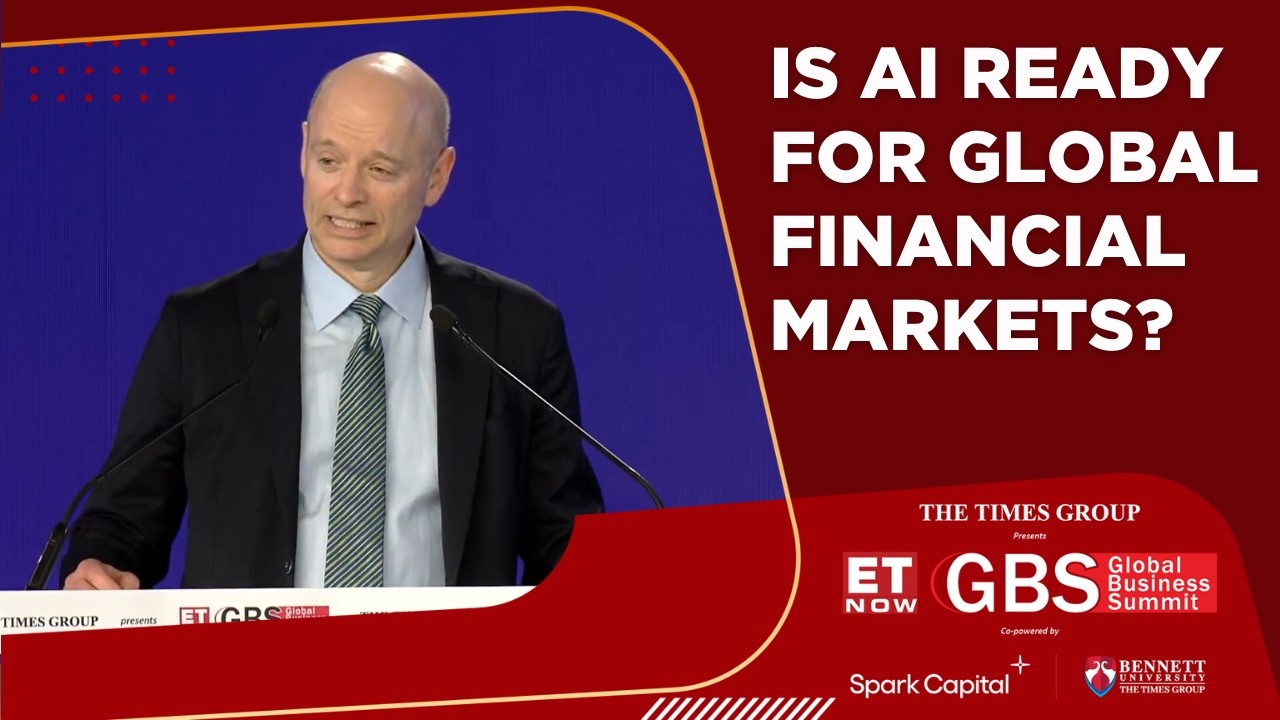
Shaping Tomorrow’s Markets | LSEG CEO On AI & Digital Capital | David Schwimmer | GBS 2026 | ET Now
ET Now
Overview
This video discusses the transformative impact of Artificial Intelligence (AI) and digital technologies on global financial markets, as explained by David Schwimmer, CEO of the London Stock Exchange Group (LSEG). LSEG has evolved from a traditional exchange to a global data and infrastructure provider, significantly enhanced by its acquisition of Refinitiv. The discussion highlights India's pivotal role in this transformation, drawing parallels between its historical contributions to mathematics and its current leadership in digital innovation like UPI and AI. Schwimmer emphasizes the critical importance of trusted, high-quality data for AI in finance and explores the rise of digital assets and distributed ledger technology (DLT) in reshaping market infrastructure, alongside the growth of private markets.
Save this permanently with flashcards, quizzes, and AI chat
Chapters
- LSEG has transformed from a regional stock exchange into a global leader in financial market infrastructure and data.
- The acquisition of Refinitiv was pivotal, establishing data and its delivery as core components of market infrastructure.
- LSEG now manages global indices, operates a major clearing house, and provides data services to hundreds of billions of market-moving messages daily.
- The company's strategy centers on providing essential data and infrastructure that power the world's increasingly fast-paced and digital financial ecosystem.
- India is a key player in the financial industry's transformation, recognized for its innovation, technological talent, and projected economic growth.
- Historically, India laid the groundwork for global commerce and finance by developing the decimal system and the concept of zero.
- India's Unified Payments Interface (UPI) is a leading example of successful, scalable digital infrastructure, now adopted internationally.
- The country is actively embracing AI, evidenced by tax incentives for data centers and hosting global AI discussions.
- AI, particularly LLMs and agents, offers significant opportunities for efficiency and improved decision-making in finance.
- The successful deployment of AI at scale hinges on trusting its outcomes, which directly depends on the quality and integrity of the input data.
- LSEG possesses a vast repository of high-quality, accurate financial data (33 petabytes), significantly larger than common internet datasets.
- Using low-quality data with AI models can lead to inaccuracies, AI hallucinations, model drift, and unintended biases, posing real risks in financial decision-making.
- Distributed Ledger Technology (DLT) and digital assets are increasingly integrated into the financial sector, with significant projected growth in digital fixed income instruments.
- Various regions are developing regulated environments for issuing, trading, and settling digital securities, including sandboxes in the EU and UK.
- DLT is seen as a near-term solution to replace legacy infrastructure, improve post-trade processes, and reduce risk.
- LSEG is actively participating in this transformation with its Digital Market Infrastructure (DMI) platform, offering blockchain-powered efficiencies.
- Beyond AI and DLT, the growth of private markets and the blurring lines between public and private markets represent another significant transformation.
- These combined changes across AI, tokenization, and market structures are driving dramatic innovation in capital markets.
- Adapting to these changes will require new practices, evolving roles for professionals, and updated regulatory frameworks.
Key takeaways
- Financial market infrastructure is rapidly evolving beyond traditional exchanges to encompass data provision and digital technology integration.
- Trusted, high-quality data is the foundational requirement for the safe and effective adoption of AI in the financial sector.
- India is emerging as a global leader in financial innovation, driven by its technological talent and progressive digital initiatives.
- Distributed Ledger Technology (DLT) and digital assets are poised to revolutionize market operations by enhancing efficiency and reducing risk.
- The future of finance will be shaped by the convergence of AI, digital assets, and evolving market structures, including the growth of private markets.
- LSEG's strategic focus on data and technology positions it at the forefront of these market transformations.
- Understanding historical innovations, like India's contribution to mathematics, provides context for current technological advancements.
Key terms
Test your understanding
- How has LSEG's acquisition of Refinitiv fundamentally changed its role in global financial markets?
- Why is high-quality, trusted data considered the most critical element for deploying AI in the financial industry?
- What historical contribution from India is highlighted as foundational to modern economic infrastructure, and how does it relate to current innovation?
- What are the primary benefits of Distributed Ledger Technology (DLT) for market infrastructure, according to the speaker?
- Beyond AI and digital assets, what other significant market trend is discussed as a driver of change in capital markets?