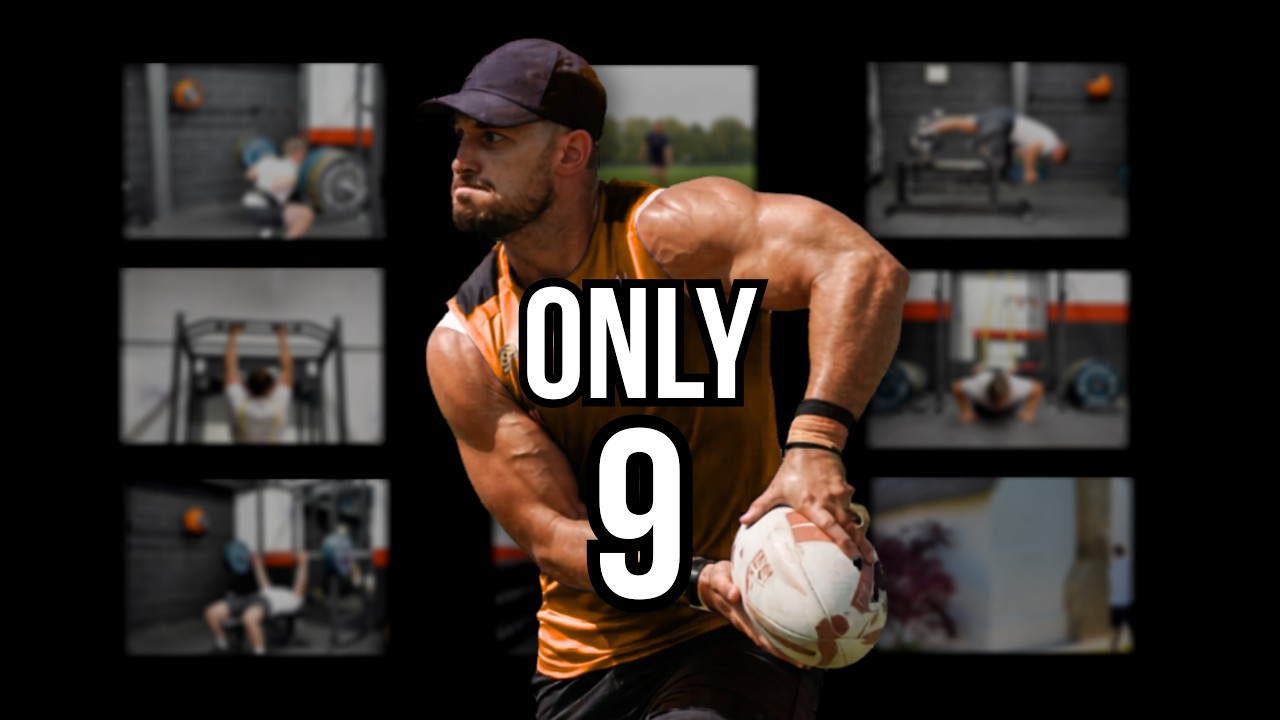
9 Exercises is All You Need To Get Big, Strong & Athletic?
JT Performance
Overview
This video argues that true athleticism, encompassing size, strength, speed, and power, can be developed through nine fundamental training "buckets" rather than a rigid set of specific exercises. The presenter emphasizes that the goal is to achieve specific adaptations, not just to lift heavy weights. Key areas include foundational strength (squats), speed and power development (sprinting, plyometrics), upper body strength and power (pulling, pushing, explosive movements), and crucial conditioning. The final, often overlooked, element is skill development through play, which integrates physical capacities into athletic performance. The video advocates for a balanced approach that prioritizes sport-specific needs and recovery for skill acquisition.
Save this permanently with flashcards, quizzes, and AI chat
Chapters
- True athletic development focuses on achieving specific physical adaptations (size, strength, speed, power, conditioning) rather than performing a fixed list of exercises.
- Many traditional strength-focused programs build strong lifters but not necessarily better athletes, leading to decreased speed and increased injury risk.
- Understanding the 'why' behind training choices is crucial for maximizing athletic potential.
- Squats (various forms) are fundamental for building leg strength, power, and size, correlating with improved sprint times and jump height.
- Strength gains have diminishing returns; focusing solely on maximal strength beyond a certain point (e.g., 1.5-2x bodyweight squat) may not significantly enhance speed or power and can increase fatigue.
- Prioritizing other qualities like speed becomes more beneficial once a solid strength base is established.
- Sprinting is paramount for developing speed, the most critical quality in many sports.
- Sprinting acts as a potent plyometric exercise, demanding high force production in short bursts and potentially reducing hamstring injury risk when performed correctly.
- Sprint training enhances collision power (momentum = bodyweight x speed), making athletes hit harder.
- Quality over quantity is key: short, intense sprints with ample rest are more effective and safer than treating sprints like endurance cardio.
- Hinging movements, particularly Romanian Deadlifts (RDLs) and back extensions, are vital for hamstring strength and injury prevention.
- RDLs can be more effective than Nordic curls for targeting the biceps femoris, a muscle frequently affected by hamstring injuries.
- Pull-ups are essential for upper body pulling strength and relative strength assessment, with heavy loading beneficial for advanced athletes.
- Horizontal rows (like chest-supported rows) are necessary to complement vertical pulling and build a comprehensive upper back.
- True plyometrics, like hops, train the body to produce maximal force in minimal time, developing 'springy' legs essential for sport.
- Distinguish between jumps (which train power) and plyometrics (which build elastic qualities).
- Upper body power requires exercises involving a 'throw' or 'release' component, focusing on absorbing and redirecting force, not just producing it.
- Exercises like Smith machine bench rows, partner drops, and banded push-ups are effective for developing upper body power and resilience.
- Bench pressing is a foundational exercise for upper body pushing strength (chest, shoulders, triceps).
- Push presses are crucial for developing full-body power, demonstrating how force transfers from the legs through the torso to the upper body.
- Proper technique in explosive lifts like the push press, involving a controlled dip and aggressive drive, is vital for maximizing power output.
- Aiming for higher loads (e.g., 1.25x bodyweight for bench press, 20-30% more than strict press for push press) is important for significant strength and power gains.
- Sustained energy production (conditioning) is vital; elite strength and speed are useless if they can only be maintained for short bursts.
- Off-feet conditioning methods, like the ESD (Effort, Steady, Duration) method, are effective for improving cardiovascular fitness without adding excessive stress to already taxed legs.
- The ESD method involves intervals of high-intensity work (80-85% max heart rate) followed by short rest periods, repeated for multiple rounds.
- Consistent conditioning sessions (2-3 times per week) are necessary to build a robust 'engine'.
- True athleticism integrates physical capacities (strength, speed, power, conditioning) with skill through practice and play.
- Skill development requires being fresh; intense training sessions (heavy lifting, hard conditioning, sprints) should be avoided the day before sport-specific practice or competition.
- Structuring the training week around sport participation, rather than arbitrary lifting days, optimizes skill acquisition and performance.
- Engaging in sport and team activities offers significant physical and mental health benefits that numbers alone cannot capture.
Key takeaways
- Focus on achieving specific physical adaptations (speed, power, strength, conditioning) rather than adhering to a fixed set of exercises.
- Balance strength training with speed and power development, recognizing that excessive focus on maximal strength can diminish athletic performance.
- Sprinting is a highly effective exercise for building speed, power, and injury resilience, but requires quality execution and adequate recovery.
- Targeted exercises for hamstring health (like RDLs) and comprehensive upper body development (pulling and pushing) are crucial for injury prevention and balanced physique.
- Plyometrics and explosive upper body movements train the body's ability to produce force rapidly, a key component of athleticism.
- Sufficient conditioning is essential to sustain physical efforts throughout a game or competition; off-feet methods can be highly effective.
- Skill development through play and practice is paramount, requiring athletes to manage fatigue and prioritize sport-specific training.
Key terms
Test your understanding
- How does focusing on 'specific adaptations' differ from focusing on 'specific exercises' in athletic training?
- What are the potential downsides of prioritizing maximal strength gains beyond a certain point, and how does this relate to athletic performance?
- Why are sprints considered a superior exercise for developing both speed and power compared to traditional cardio?
- How can athletes effectively train for upper body power while minimizing the risk of injury and maximizing force transfer?
- What is the role of 'play' in athletic development, and how should training schedules be structured to support skill acquisition?