18:01
Matematika kelas 9 : Transformasi Geometri (part 3 : Rotasi I)
Rumah Belajar Kamil
Overview
This video introduces geometric rotation as a transformation in a 2D Cartesian plane. It explains rotation as a turning of a point around a fixed center by a specific angle and direction. The video focuses on rotations with the origin (0,0) as the center, detailing the coordinate changes for 90°, 180°, and 270° rotations, both clockwise and counter-clockwise. It also provides formulas for calculating the coordinates of rotated points and demonstrates how to solve problems involving these rotations, including inverse problems and combined transformations (rotation followed by translation).
How was this?
Save this permanently with flashcards, quizzes, and AI chat
Chapters
- Rotation is a geometric transformation that involves turning a point or shape around a fixed center point.
- The rotation is defined by an angle of rotation and a direction (clockwise or counter-clockwise).
- A counter-clockwise rotation uses a positive angle (theta), while a clockwise rotation uses a negative angle (theta).
- Rotations can have a center at the origin (0,0) or any other point (a,b).
Understanding rotation is crucial for comprehending how shapes change position and orientation in space, forming a fundamental concept in geometry and its applications.
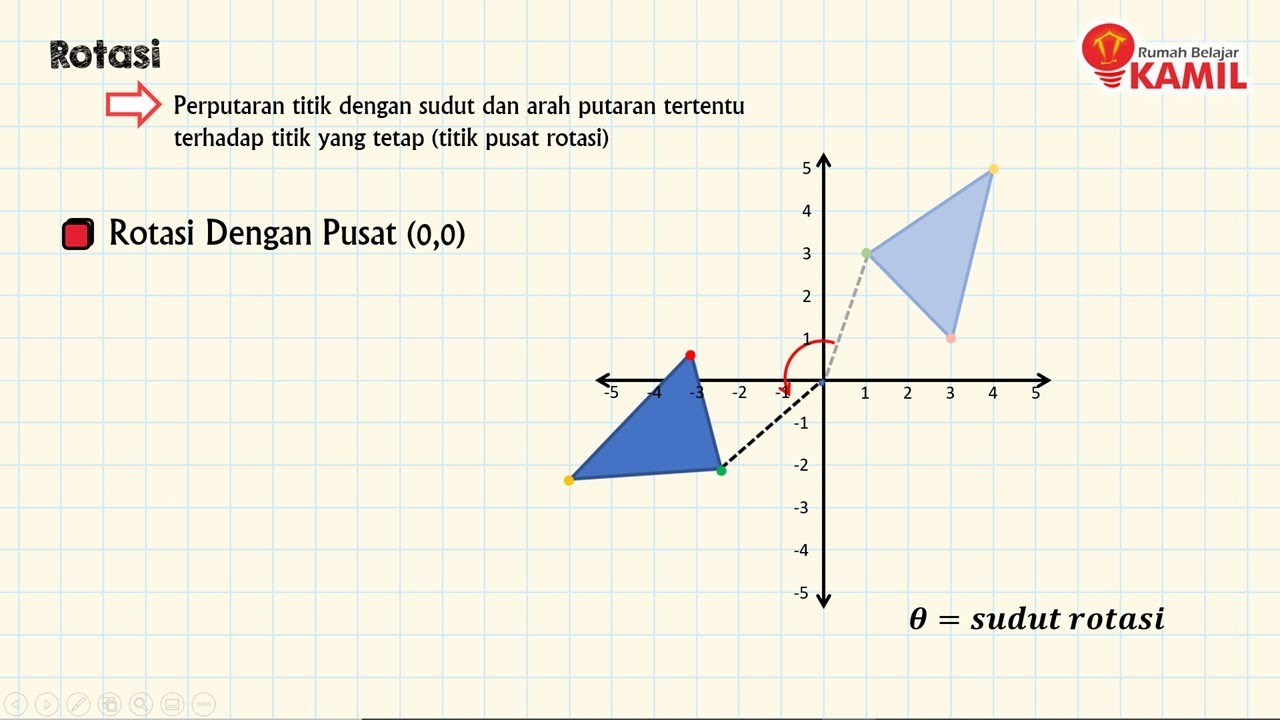
A triangle on a Cartesian plane is shown being rotated around the origin (0,0) by an angle theta, illustrating the initial and final positions of the triangle.
- Rotating a point (x,y) by 90 degrees counter-clockwise around the origin (0,0) results in a new point (-y, x).
- Rotating a point (x,y) by 90 degrees clockwise around the origin (0,0) results in a new point (y, -x).
- A 90-degree counter-clockwise rotation is equivalent to a 270-degree clockwise rotation (or -270 degrees).
- A 90-degree clockwise rotation is equivalent to a 270-degree counter-clockwise rotation (or -90 degrees).
This specific rotation rule provides a direct formula to find the new coordinates, simplifying calculations without needing to draw the rotation on a graph.
A triangle with vertices A(3,1), B(4,5), and C(1,3) is rotated 90 degrees counter-clockwise around (0,0), resulting in new vertices A'(-1,3), B'(-5,4), and C'(-3,1).
- Rotating a point (x,y) by 180 degrees around the origin (0,0) results in a new point (-x, -y).
- The direction of rotation (clockwise or counter-clockwise) does not change the resulting image for a 180-degree rotation.
- A 180-degree rotation is equivalent to two consecutive 90-degree rotations in the same direction.
The 180-degree rotation rule is straightforward, effectively inverting the signs of both coordinates, which is useful for symmetry and pattern recognition.
A triangle with vertices A(3,1), B(4,5), and C(1,3) is rotated 180 degrees around (0,0), resulting in new vertices A'(-3,-1), B'(-4,-5), and C'(-1,-3).
- Rotating a point (x,y) by 270 degrees counter-clockwise around the origin (0,0) results in a new point (y, -x).
- Rotating a point (x,y) by 270 degrees clockwise around the origin (0,0) results in a new point (-y, x).
- A 270-degree counter-clockwise rotation is equivalent to a 90-degree clockwise rotation (or -90 degrees).
- A 270-degree clockwise rotation is equivalent to a 90-degree counter-clockwise rotation (or -270 degrees).
This rule, like the 90-degree rotation, offers a direct formula for calculating coordinates, complementing the 90-degree rule and completing the set of standard orthogonal rotations.
A triangle with vertices A(3,1), B(4,5), and C(1,3) is rotated 270 degrees counter-clockwise around (0,0), resulting in new vertices A'(1,-3), B'(5,-4), and C'(3,-1).
- To find the image of a point after rotation, substitute its coordinates into the appropriate formula based on the angle and direction.
- When the direction is clockwise, use the negative of the angle value in the counter-clockwise formulas.
- To find the original point when the image and rotation are known, use the inverse rotation or rearrange the formula.
- Combined transformations involve applying each transformation sequentially, often starting with rotation and then translation.
Mastering these problem-solving techniques allows learners to accurately determine the final position of objects after various rotations and combined transformations.
Finding the image of point A(-3,5) after a 90-degree counter-clockwise rotation (A'(-5,-3)), a 90-degree clockwise rotation (A'(5,-3)), and a 180-degree rotation (A'(3,-5)).
Key takeaways
- Rotation is a rigid transformation that preserves size and shape, only changing orientation and position.
- The direction of rotation (clockwise vs. counter-clockwise) is indicated by the sign of the angle.
- Rotations by 90°, 180°, and 270° around the origin have specific, easily applicable coordinate transformation rules.
- A 90° counter-clockwise rotation maps (x,y) to (-y,x), and a 180° rotation maps (x,y) to (-x,-y).
- Understanding the relationship between clockwise and counter-clockwise rotations (e.g., 90° CCW = -270° CW) simplifies problem-solving.
- When solving for the original point, applying the inverse rotation is necessary.
- Combined transformations require performing each step in the specified order.
Key terms
RotationTransformationCenter of RotationAngle of RotationClockwiseCounter-clockwiseOriginImage PointCoordinateTranslation
Test your understanding
- What is the primary difference between rotation and translation as geometric transformations?
- How does the direction of rotation affect the resulting coordinates of a point?
- What is the formula for rotating a point (x,y) by 180 degrees around the origin?
- How can you determine the original coordinates of a point if you know its rotated image and the rotation applied?
- Explain the relationship between a 270-degree counter-clockwise rotation and a 90-degree clockwise rotation around the origin.