27:27
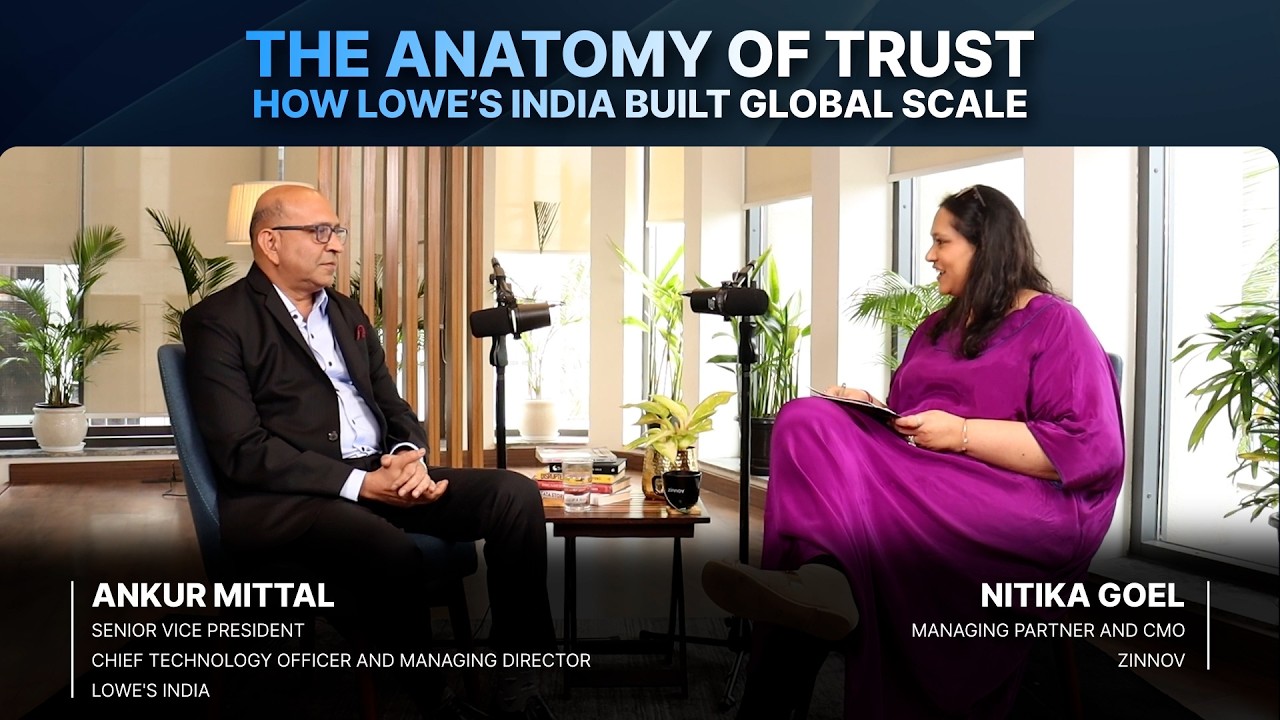
The Anatomy of Trust: How Lowe’s India Built Global Scale Ft. Ankur Mittal, Lowe's India
Zinnov
Overview
This video features an interview with Ankur Mittal, CTO and MD of Lowe's India, discussing the strategic importance and operational nuances of Global Capability Centers (GCCs). Mittal emphasizes the critical role of building trust, achieving functional alignment, and continuously earning wins to drive success. He shares insights on developing business acumen, articulating value to stakeholders, and fostering a culture of continuous learning and psychological safety within GCCs. The conversation also touches upon the evolving landscape of AI in retail, leadership challenges in Indian GCCs, and personal career reflections.
How was this?
Save this permanently with flashcards, quizzes, and AI chat
Chapters
- Lowe's is a 104-year-old home improvement retail giant offering a comprehensive range of products for home construction, decoration, and gardening.
- The scale of Lowe's stores is immense, averaging 120,000 sq ft with additional parking space, comparable to multiple football fields.
- The India GCC plays a crucial role in enabling Lowe's global operations, though the home improvement retail concept is less familiar in India.
Understanding the core business of Lowe's provides context for the strategic initiatives and challenges faced by its India-based Global Capability Center (GCC).
Lowe's offers everything from lumber and appliances to paint and outdoor furniture, all under one roof, illustrating the breadth of their home improvement offerings.
- Effective GCCs require clear functional roles with defined Key Performance Indicators (KPIs) for specific teams (e.g., AI, .com).
- A Center Head often acts as a 'tea junction,' stitching together various functions, but a strong functional role is crucial for empowerment and influence.
- While organizational structure varies, Mittal advocates for a model where functional roles drive compensation and responsibility, leading to greater empowerment and a stronger 'seat at the table'.
This distinction clarifies how responsibilities should be structured within a GCC to ensure accountability, drive performance, and foster a strategic partnership with the headquarters.
An accounting team or an AI engineering team should have clear, measurable KPIs that define their success, separate from the broader coordination role of a Center Head.
- Functional alignment and responsibility are built upon a foundation of trust, which is earned through consistent delivery of critical projects.
- GCCs must continuously 'earn their win every single day,' as past successes do not guarantee future opportunities or sustained credibility.
- Proactive initiatives, like developing a business case for an improved self-checkout system without being asked, demonstrate value and build trust.
This highlights the dynamic nature of GCC operations, emphasizing that sustained success requires ongoing performance and proactive value creation, not just fulfilling existing mandates.
Lowe's India proactively improved its self-checkout system, demonstrating capability and earning further trust and opportunities from leadership.
- GCCs need to move beyond efficiency plays to demonstrate strategic value, which has a higher ceiling than mere cost optimization.
- Articulating value requires understanding the specific KPIs and goals of different stakeholders (e.g., CFO, store operations SVP) and speaking their language.
- Building the 'articulation muscle' involves starting with small business cases, understanding stakeholder needs, and focusing on the 'what's in it for me?' question.
This addresses a common challenge for GCCs: proving their strategic worth beyond cost savings by effectively communicating the business impact of their work.
A business case for a CFO will focus heavily on numbers and ROI, while one for a store operations SVP might focus on customer experience or operational efficiency within stores.
- A culture of continuous learning, curiosity, and calculated risk-taking is essential for daily improvement and innovation.
- Leaders must demonstrate desired behaviors and equip frontline managers to guide new employees, including Gen Z, in understanding corporate culture and values.
- Psychological safety is crucial; employees should not fear failure when proposing new ideas, encouraging open communication and experimentation.
These cultural elements are vital for retaining talent, driving innovation, and ensuring that the GCC remains adaptable and high-performing in a competitive global market.
Encouraging associates to ask questions and guiding them to find answers, rather than providing all solutions, fosters independent problem-solving and learning.
- Effective leaders are possessive of their time, prioritizing meetings with clear agendas and short durations (3-10 minutes) where possible.
- Regular, informal check-ins can replace scheduled one-on-ones, allowing for more fluid communication and immediate addressing of issues.
- Initiatives like 'break rooms' foster open, free-flowing conversations between leaders and associates, promoting transparency and addressing diverse questions.
Efficient time management and open communication channels are critical for leadership effectiveness, enabling focus on strategic priorities and fostering a connected organizational culture.
Mittal prefers brief, agenda-driven meetings and informal check-ins over lengthy, scheduled status updates to maximize productivity.
- AI, including analytical, Gen AI, and computer vision, is poised to significantly enhance associate efficiency and open new work avenues, though human roles remain essential.
- The gap between Indian delivery leaders and global product owners often lies in risk-taking, proactive questioning, and stepping outside comfort zones.
- Setting up a new GCC requires hiring for domain expertise, strong technology leadership, talent attraction ('talent magnet'), and a 'culture champion' to bridge HQ and local operations.
This section addresses future trends, critical skill gaps, and foundational elements for establishing and scaling a successful GCC.
When hiring for a new GCC, one would prioritize a domain expert, a CTO from a startup, a talent magnet, and a culture champion.
Key takeaways
- Trust is the bedrock of functional alignment and expanded responsibilities within a GCC, earned through consistent, high-quality delivery.
- Continuous daily wins are essential; GCCs must constantly prove their value rather than relying on past achievements.
- Moving beyond efficiency to strategic value creation requires understanding stakeholder needs and effectively articulating business cases in their language.
- A culture that champions curiosity, continuous learning, and psychological safety is paramount for innovation and talent retention.
- Leaders must be masters of their time and foster open communication channels to maintain focus and build strong team cohesion.
- Developing proactive problem-solving skills and a willingness to take calculated risks are key differentiators for Indian GCC leaders aiming for global product ownership.
- Building a successful GCC requires a strategic mix of talent: domain experts, tech leaders, talent magnets, and culture champions.
Key terms
Global Capability Center (GCC)Functional AlignmentKey Performance Indicators (KPIs)Center HeadTrust BuildingStrategic ValueBusiness CasePsychological SafetyContinuous LearningTalent MagnetCulture ChampionAgentic AI
Test your understanding
- How does building trust enable functional alignment and greater empowerment within a GCC?
- Why is it crucial for GCCs to focus on 'earning wins every single day' rather than relying on past successes?
- What strategies can GCCs employ to develop the 'articulation muscle' and effectively communicate their strategic value to stakeholders?
- How can fostering psychological safety contribute to innovation and problem-solving within a GCC team?
- What are the essential roles to hire when establishing a new GCC from the ground up, and why is each critical?