14:12
Advanced Liquidity Concepts Explained | Smart Money Trading
Smart Risk
Overview
This video explains advanced concepts of market liquidity, focusing on how professional traders use it to their advantage. It introduces four key "hacks" for understanding and trading liquidity: identifying the trading range, understanding external and internal liquidity, grasping the concept of dynamic liquidity, and recognizing liquidity sweeps. The core idea is to trade with "smart money" by anticipating where liquidity is being targeted and used, rather than getting caught in market traps.
How was this?
Save this permanently with flashcards, quizzes, and AI chat
Chapters
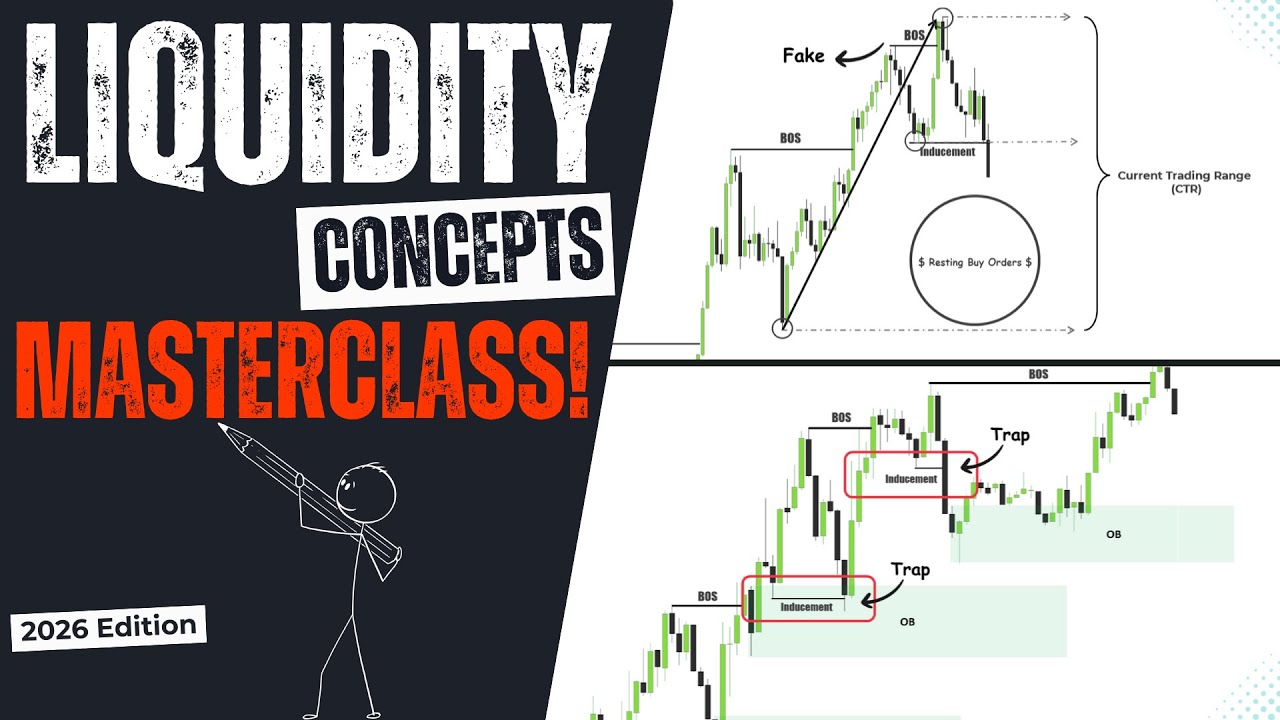
- A trading range is the area where price is currently operating and building liquidity, providing insight into future direction.
- To identify a valid trading range, zoom out to a higher time frame (e.g., 15-min for 1-min entries).
- A valid range requires a confirmed break of structure (BOS) that retraced into a discount area, triggering buy orders.
- The range is confirmed when price breaks below the most recent internal low (inducement) after the impulse leg, marking the swing high as the upper boundary.
Properly identifying the trading range prevents traders from chasing false breakouts and helps them focus on high-probability trading setups by waiting for confirmations like liquidity sweeps.
A valid break of structure (BOS) occurs when price retraces to a discount area, then makes an impulse move higher. The range is confirmed when price later breaks below the internal low of that impulse move.
- External liquidity resides outside the trading range, typically above swing highs or below swing lows where stop-losses are placed.
- The trading range high and low are critical external liquidity levels because they are closest to current price.
- Internal liquidity exists inside the trading range, often in the form of fair value gaps, consolidations, or internal swing points.
- Internal liquidity is used by smart money to fuel moves towards external liquidity; it's a stepping stone, not the final target.
Distinguishing between external and internal liquidity shifts the focus from predicting direction to understanding which liquidity pool price is targeting first, a crucial insight for professional trading.
Major swing highs and lows outside the defined trading range represent external liquidity, while areas like fair value gaps or small consolidations within the range represent internal liquidity.
- Dynamic liquidity describes the continuous flow and rotation of price between internal and external liquidity pools.
- Price typically moves from internal liquidity (like fair value gaps) towards external liquidity, or vice-versa, in a cyclical manner.
- Understanding this rotation helps traders avoid providing liquidity (getting trapped) and instead focus on taking liquidity.
- When internal liquidity is depleted, price moves directly between external liquidity levels until new inefficiencies form.
Dynamic liquidity explains the core rhythm of market movement, allowing traders to anticipate price direction and timing by understanding how liquidity is used to drive price towards its next target.
Price might move from an internal fair value gap towards an external swing high, sweep that liquidity, and then reverse to target an external swing low.
- How price interacts with fair value gaps (FVGs) inside a trading range can signal future direction.
- If price respects an FVG and its midpoint, showing rejection to the upside, it suggests a move higher towards upper external liquidity.
- If price breaks through an FVG without reaction, it becomes an 'inverse FVG' acting as resistance.
- Rejection from an inverse FVG signals a likely move lower towards sell-side external liquidity.
Analyzing price behavior within fair value gaps provides clear signals for anticipating whether price will target higher external liquidity or lower external liquidity.
Price entering a fair value gap, bouncing off its midpoint, and moving up indicates a bullish bias towards the next buy-side liquidity pool.
- A liquidity sweep occurs when price briefly moves above or below a key level (taking liquidity) and then quickly reverses, closing back inside the range.
- High-probability sweeps target key external liquidity levels, often occurring around major session opens.
- Sweeps of internal liquidity levels are lower probability and can act as inducements or traps.
- A high-quality sweep involves taking external liquidity, reversing, and then targeting the opposite external liquidity pool.
Identifying genuine liquidity sweeps, especially those at external levels during high-volume periods, offers high-probability trading opportunities aligned with institutional money flow.
Price spikes above the Asia session high (sweeping buy-side liquidity) and then immediately reverses to take out the Asia session low (sweeping sell-side liquidity).
Key takeaways
- Mastering liquidity analysis is fundamental for profitable trading and avoiding market traps.
- A valid trading range is defined by a confirmed break of structure and subsequent inducement, not just a simple consolidation.
- External liquidity (above highs, below lows) and internal liquidity (within the range, like FVGs) have distinct roles in market movement.
- Dynamic liquidity explains the market's cyclical movement between internal and external liquidity pools.
- Price interaction with fair value gaps provides strong directional clues.
- Liquidity sweeps, particularly at external levels during session opens, are high-probability trading signals.
- Professional traders aim to take liquidity, not provide it, by understanding these advanced concepts.
Key terms
LiquidityTrading RangeBreak of Structure (BOS)External LiquidityInternal LiquidityDynamic LiquidityFair Value Gap (FVG)InducementLiquidity SweepSmart Money
Test your understanding
- How does identifying a valid trading range differ from simply drawing a box on a chart?
- What is the primary difference in function between external and internal liquidity?
- Explain the concept of dynamic liquidity and how it drives price movement.
- How can a trader use the interaction with a fair value gap to predict the next likely price direction?
- What are the characteristics of a high-probability liquidity sweep, and why are they important for traders?