Module 9 - Sigmund Freud Recording
Chris Gade
Overview
This video introduces Sigmund Freud, a foundational yet controversial figure in psychology. It explores his early life, the psychodynamic movement he embraced, and his core theories about the unconscious mind, the id, ego, and superego. The summary details Freud's therapeutic techniques like psychoanalysis, hypnosis, free association, and dream interpretation, while also critically examining the lack of scientific rigor in his psychosexual development stages and case studies. Despite the criticisms, the video emphasizes Freud's significant, albeit controversial, role in shaping early personality and clinical psychology, providing a historical context for modern psychological approaches.
Save this permanently with flashcards, quizzes, and AI chat
Chapters
- Sigmund Freud is a highly influential but polarizing figure in psychology's history.
- Understanding Freud is crucial for grasping the origins of modern personality and clinical psychology.
- His theories, though controversial, shifted the focus of psychological inquiry in the early 1900s.
- Freud's work is presented with a caution regarding its scientific validity and potential for debate.
- Born in Austria in 1856, Freud initially focused on medicine and unexplained physical pains.
- He was influenced by Ernst Wilhelm von Brücke and the psychodynamic movement, which posited an inseparable link between mind and body.
- Freud began to explore mental sources for physical ailments, collaborating with figures like Jean Charcot.
- This led him to develop early ideas about the unconscious and the interplay of mental forces.
- Freud's psychodynamic theory suggests behavior is a result of internal mental and physical interplay, driven by past experiences, wants, and drives.
- He proposed the unconscious mind, a hidden realm influencing behavior, contrasting with the conscious focus of earlier psychology.
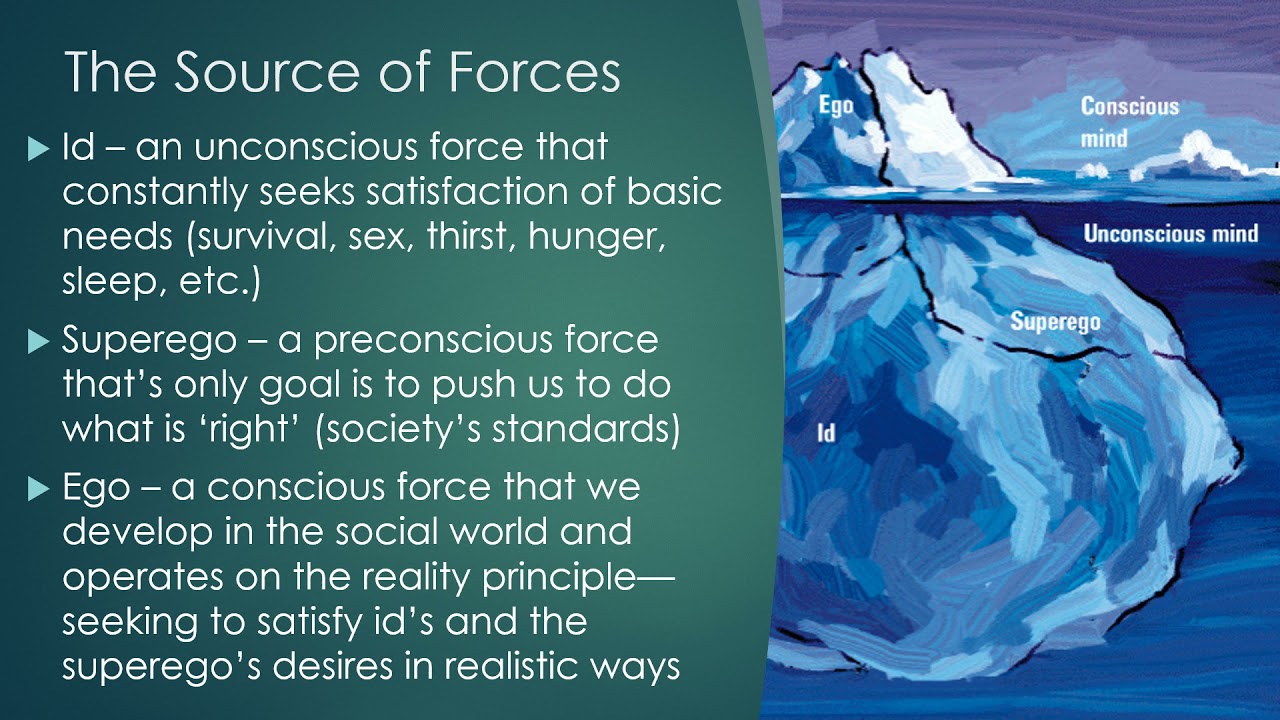
- The 'id' represents primal urges and the pursuit of immediate satisfaction (pleasure principle).
- The 'superego' represents internalized societal standards and morality (conscience).
- The 'ego' mediates between the id and superego, operating on the reality principle to balance desires with societal constraints.
- Psychoanalysis aims to uncover unconscious thoughts and desires by exploring childhood experiences and unmet needs through extensive talk therapy.
- Hypnosis, for Freud, was a tool to access the unconscious by inducing an altered state.
- Free association involves speaking impulsively to allow unconscious thoughts to surface.
- Dream interpretation suggests dreams are symbolic windows into the unconscious.
- Freudian slips (slips of the tongue) are seen as manifestations of hidden desires or unconscious thoughts.
- Freud theorized that psychosexual energy (libido) drives development through distinct stages, each focused on a different erogenous zone.
- The oral stage (0-18 months) focuses on the mouth; issues here can lead to oral fixations.
- The anal stage (18 months-3 years) focuses on toilet training and control; difficulties can lead to anal retentiveness.
- The phallic stage (3-6 years) involves focus on genitalia, gender identity, and the Oedipus/Electra complexes (though not detailed in this segment).
- The latency stage (6 years-puberty) is a period of reduced sexual interest, followed by the genital stage (puberty onwards) focused on mature sexual relationships.
- Freud's theories, particularly psychosexual development, often lacked scientific rigor and empirical evidence.
- His case studies, like Anna O. (Bertha Pappenheim), are criticized for potential fabrication, embellishment, and being influenced by his own drug use.
- Many of Freud's ideas, especially those centered on sex and power as primary motivators, are not well-supported by modern research.
- Despite criticisms, Freud's insistence on the mind-body interaction, the complexity of the individual beyond behavior, and the importance of childhood experiences hold some merit.
- His work provided the foundational framework for the development of personality and clinical psychology, even if modern versions are vastly different.
Key takeaways
- Sigmund Freud's theories, though often unscientific, were pivotal in shifting psychology's focus towards the unconscious mind and the impact of early experiences.
- The psychodynamic model, emphasizing the interplay of internal drives (id), societal rules (superego), and reality (ego), provides a framework for understanding internal conflict.
- Freud's therapeutic techniques, such as psychoanalysis and free association, pioneered methods for exploring the hidden aspects of the mind.
- The concept of psychosexual development, while controversial and largely unsupported, highlights Freud's belief in the formative power of childhood experiences.
- Criticism of Freud often centers on his lack of empirical evidence, reliance on case studies, and overemphasis on sexuality, yet his ideas spurred crucial developments in psychology.
- Modern personality and clinical psychology have evolved significantly from Freud's original concepts but owe him a debt for establishing these fields of study.
- Understanding Freud is essential for appreciating the historical trajectory and foundational ideas of major branches of psychology.
Key terms
Test your understanding
- What is the core idea of the psychodynamic movement that influenced Freud?
- How did Freud's concept of the unconscious mind differ from earlier psychological approaches?
- Explain the roles of the id, ego, and superego in Freud's model of the psyche.
- What were some of the therapeutic techniques Freud developed to access the unconscious mind?
- Why are Freud's theories, particularly his psychosexual stages, considered controversial and lacking scientific rigor?