AI-Generated Video Summary by NoteTube
Managed Exchange Rate Systems Part 1
Jason Welker
Overview
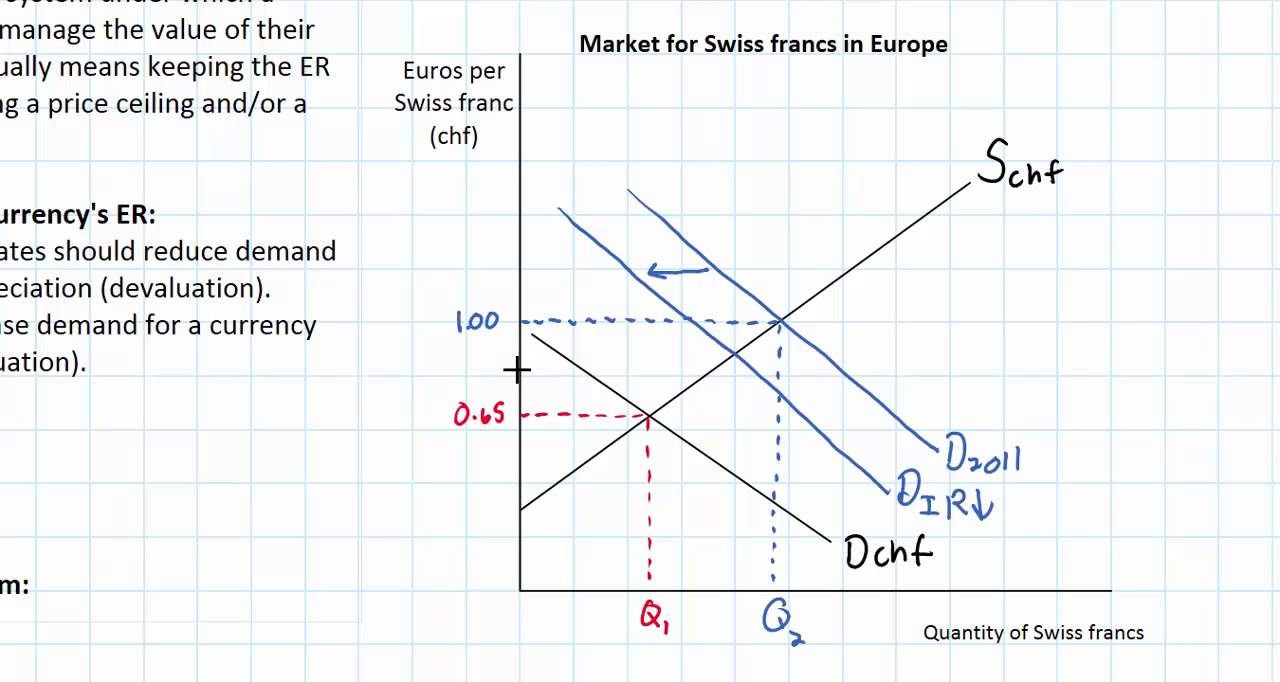
This video explains managed exchange rate systems, contrasting them with floating systems. It details how governments and central banks actively intervene in foreign exchange markets to maintain their currency's value within a target range, often by setting price ceilings or floors. The video uses the Swiss National Bank's intervention to devalue the Swiss franc against the Euro between 2011 and 2015 as a primary example. It illustrates how factors like the European financial crisis increased demand for the Swiss franc, causing it to appreciate significantly. To counter this, the Swiss National Bank employed expansionary monetary policy (lowering interest rates) and, when that proved insufficient, directly intervened by selling Swiss francs and buying euros to establish and maintain an exchange rate ceiling.
This summary expires in 30 days. Save it permanently with flashcards, quizzes & AI chat.
Chapters
- •Managed exchange rate systems involve active government and central bank intervention.
- •The goal is to keep the currency's value within an acceptable range.
- •This is achieved by setting price ceilings and/or price floors.
- •Contrasts with floating exchange rate systems where market forces determine value.
- •Focus on the Swiss franc (CHF) and its appreciation against the Euro (EUR).
- •Chart shows CHF appreciating from 0.65 EUR in 2005 to nearly 1 EUR by mid-2011.
- •This appreciation significantly harmed Swiss exporters.
- •The Swiss National Bank (SNB) intervened to devalue the franc.
- •The European financial crisis (starting 2008-2009) led to a 'flight to safety'.
- •Investors moved money from European assets to perceived safer assets like Swiss francs.
- •This increased demand for Swiss francs, driving up its value.
- •Demand for Swiss francs increased steadily from 2008 to 2011.
- •The SNB first used expansionary monetary policy (lowering interest rates).
- •Lower interest rates aim to discourage foreign investment in Swiss assets.
- •This should theoretically reduce demand for the franc and cause depreciation.
- •When a central bank intentionally lowers rates to weaken currency, it's called devaluation.
- •Lower interest rates were insufficient to devalue the franc sufficiently.
- •In July 2011, the SNB set a price ceiling of 0.83 EUR per CHF.
- •This meant the SNB would intervene to keep the franc's value at or below 83 cents.
- •The SNB used official reserves to directly intervene in the Forex market.
- •To lower the franc's value, the SNB had to sell Swiss francs.
- •Selling francs increases their supply on the market, pushing the price down.
- •Simultaneously, the SNB bought foreign currency (Euros).
- •This intervention maintained the exchange rate near the 0.83 ceiling from 2011-2015.
- •Discusses the hypothetical scenario of a central bank setting a price floor.
- •Explains that if the market rate falls below the floor, intervention is needed to buy the currency.
- •Briefly touches on revaluation (actively appreciating a currency) as the opposite of devaluation.
Key Takeaways
- 1Managed exchange rate systems involve central bank intervention to control currency value.
- 2Governments can set price ceilings or floors to manage their currency's exchange rate.
- 3External economic events (like crises) can significantly impact currency demand and value.
- 4Devaluation is the active weakening of a currency, often through monetary policy or direct intervention.
- 5Expansionary monetary policy (lower interest rates) can discourage foreign investment and weaken a currency.
- 6Direct intervention involves buying or selling currency using official reserves.
- 7To devalue a currency, a central bank sells its own currency and buys foreign currency.
- 8Maintaining an exchange rate ceiling requires continuous intervention if market forces push the currency higher.