9:48
Methods of Data Collection: Interview and Observation
Dan Magcuyao
Overview
This video explores two primary methods of data collection: interviews and observational research. It details various types of interviews, including in-person, telephone, online, mail questionnaires, and focus groups, outlining their respective advantages and disadvantages. The video then shifts to observational methods, explaining cross-sectional, case-control, cohort, and ecological designs, also highlighting their pros and cons. The content aims to equip learners with the knowledge to choose appropriate data collection techniques based on research goals, resources, and desired outcomes.
How was this?
Save this permanently with flashcards, quizzes, and AI chat
Chapters
- Interviews are a primary method for data collection, involving direct questioning of respondents.
- Various interview formats exist, each suited to different research contexts and constraints.
- Choosing the right interview method depends on factors like desired response rate, cost, time, and the sensitivity of the topic.
Understanding the different types of interviews helps researchers select the most effective and efficient method to gather rich, relevant data for their study.
None directly provided for the introduction to interviews as a category.
- In-person interviews offer high response rates and allow for in-depth, follow-up questions but are costly and time-consuming.
- Telephone interviews are quicker and cheaper than in-person but lack visual cues, potentially affecting trust and limiting data depth.
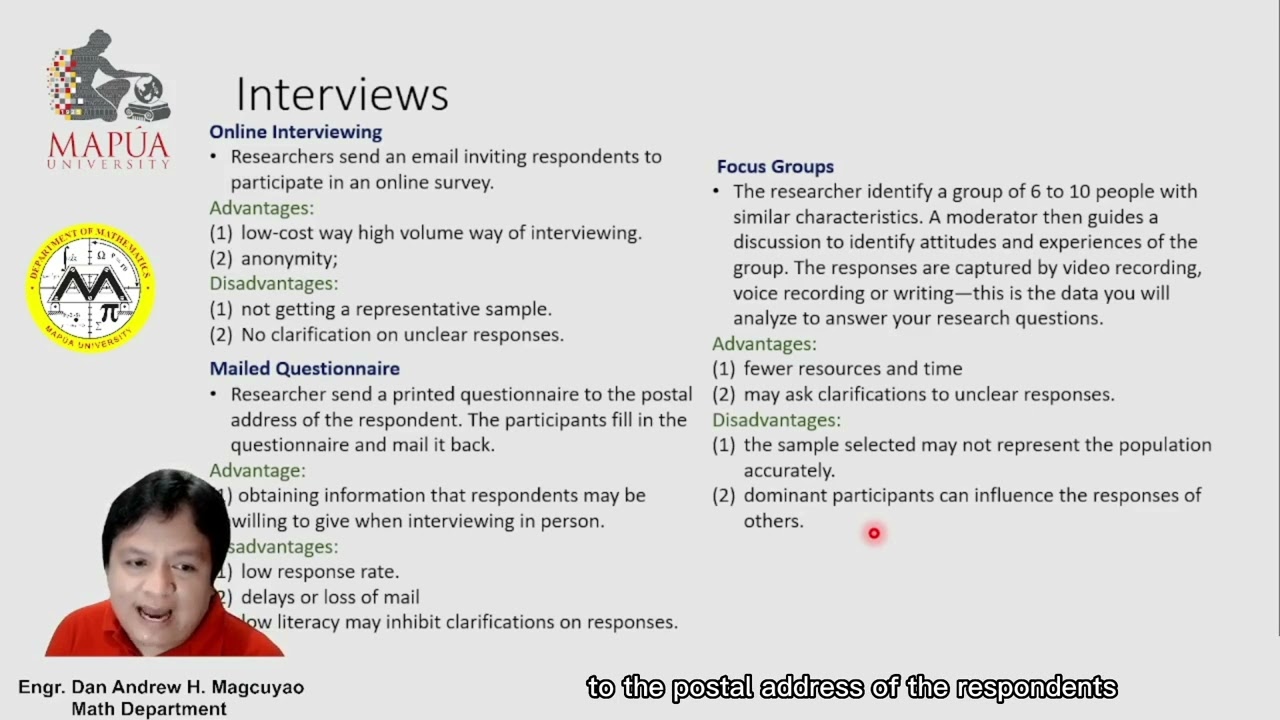
- Online interviews (e.g., surveys via Google Forms) are cost-effective for large volumes, allow anonymity for sensitive topics, but may lack representative samples and clarification.
These methods offer trade-offs between depth of information, cost, speed, and the ability to ensure respondent trust and clarity.
Using Google Forms or Microsoft Forms for online interviews allows researchers to quickly gather responses from many people anonymously.
- Mail questionnaires can gather information respondents might withhold in person but suffer from low response rates, delays, and potential clarification issues.
- Focus groups gather insights from a small group (6-10) guided by a moderator, offering a dynamic discussion but risking dominant personalities skewing results and non-representative samples.
- Both methods capture attitudes and experiences, but focus groups allow for immediate clarification, unlike mail questionnaires.
These techniques provide alternative ways to access information, with focus groups leveraging group dynamics and mail questionnaires offering a distanced approach.
A focus group might involve bringing together six people who recently used a new product to discuss their experiences and opinions.
- Observational research involves collecting data by watching and recording phenomena as they occur.
- Different observational designs cater to various research questions, timeframes, and the nature of the phenomenon being studied.
- The choice of observational method impacts cost, time investment, and the potential for bias.
Observation allows researchers to study behaviors and events directly, providing insights that might not be obtainable through self-report methods.
None directly provided for the introduction to observational research as a category.
- Cross-sectional studies collect data at a single point in time, offering a quick and inexpensive snapshot of relationships, but don't account for time progression.
- Case-control studies are retrospective, comparing individuals with a condition (cases) to those without (controls) by looking back at past exposures, which is cheaper and faster than cohort studies but relies on memory.
- Both methods are efficient for initial exploration but have limitations in establishing causality.
These designs offer efficient ways to explore potential links between exposures and outcomes, particularly when time or resources are limited.
A medical researcher might ask people with skin cancer (cases) and those without (controls) about their past use of a specific cosmetic to see if there's a link.
- Cohort studies follow a group with similar characteristics over time to observe the occurrence of outcomes, providing strong evidence but being time-consuming and costly.
- Ecological studies examine relationships at the population level (e.g., comparing disease rates between cities) rather than individuals, saving time and money but risking ecological fallacy (misattributing group-level findings to individuals).
- Cohort studies are prospective and detailed, while ecological studies are broad and comparative.
These methods allow for the study of disease progression and population-level trends, offering different perspectives on health and environmental influences.
Comparing lung cancer rates in Manila versus Cebu, and then hypothesizing potential environmental causes for the differences between the two cities.
Key takeaways
- Interviews offer direct interaction but vary greatly in cost, time, and depth of information gathered.
- Online and mail surveys provide scalability and anonymity but can suffer from low response rates and lack of immediate clarification.
- Focus groups leverage group dynamics for qualitative insights but require careful moderation to avoid bias.
- Observational research allows direct study of phenomena but requires careful design to avoid biases and limitations.
- Cross-sectional and case-control studies are efficient for initial exploration but are retrospective or snapshot-based.
- Cohort studies provide strong longitudinal data but are resource-intensive, while ecological studies offer population-level comparisons efficiently.
- The choice of data collection method significantly impacts the validity, reliability, and feasibility of research findings.
Key terms
In-person interviewingTelephone interviewingOnline interviewingMail questionnaireFocus groupsObservational researchCross-sectional studyCase-control studyCohort studyEcological studyRecall biasEcological fallacy
Test your understanding
- What are the primary advantages and disadvantages of in-person interviews compared to telephone interviews?
- How does the anonymity offered by online interviews influence the types of sensitive questions that can be asked?
- Why are case-control studies considered retrospective, and what is their main limitation?
- What is the key difference between cohort studies and ecological studies in terms of the unit of analysis?
- How can dominant participants in a focus group potentially bias the research findings?