How to Combo in Commander | The Complete Guide to Combo in EDH
Nitpicking Nerds
Overview
This video provides a comprehensive guide to understanding and executing combos in the Commander (EDH) format of Magic: The Gathering. It defines what constitutes a combo, differentiating it from mere loops, and explains why combos are the most efficient win condition in the format, especially in competitive play. The guide details how tutors facilitate combos, when to best attempt a combo, and critically, how to interact with and disrupt opponents' combos. It then breaks down numerous popular two-card and multi-card combos, explaining their mechanics, vulnerabilities, and common payoffs, offering insights for both players aiming to combo and those looking to prevent it.
Save this permanently with flashcards, quizzes, and AI chat
Chapters
- A combo is defined as any spell or effect that can be repeated indefinitely to win the game, requiring at least two cards working together.
- An infinite loop is a repeatable sequence of actions that does not inherently win the game.
- A 'payoff' is the crucial element that converts an infinite loop into a game-winning combo.
- Critical mass combos occur when many individually playable cards favorably interact to create a combo, rather than being actively assembled.
- Combos are the most efficient and fastest way to win in Commander, particularly in competitive (cEDH) metas where combat victories are rare.
- Tutors significantly increase combo consistency by allowing players to find the necessary combo pieces more reliably, reducing game variance.
- The efficiency of tutors in assembling combos is often the reason they receive criticism for making games feel repetitive or less fun.
- The optimal time to attempt a combo is when opponents have the least ability to interact, often when they are tapped out.
- Adding protection for a combo, like Grand Abolisher, can secure the win but often slows down the assembly process.
- Players should assess the mana and card cost required to initiate a combo; high-cost initiations are riskier if the combo is disrupted.
- Kiki-Jiki, Mirror Breaker combos with creatures that have abilities allowing it to untap Kiki-Jiki or provide an ETB effect, such as Restoration Angel.
- Heliod, Sun Crown + Walking Ballista creates an infinite damage combo by leveraging Heliod's ability to grant lifelink and add counters, which Walking Ballista uses to ping opponents and gain life.
- Mike, Trike + Heliod's Intervention (or similar) is a self-sustaining combo where Triskelion pings itself and returns with more counters due to Undying, allowing infinite pings.
- Dramatic Reversal + Isochron Scepter (with mana rocks) generates infinite mana by repeatedly untapping the Scepter and mana rocks.
- Exquisite Blood + Sanguine Bond creates an infinite life gain and damage loop, where gaining life from one triggers the other to deal damage, which in turn causes more life gain.
- Sensei's Divining Top + Bolas's Citadel + Etherflux Reservoir allows players to draw their entire deck and gain infinite life by repeatedly casting Top from the library using Citadel's ability.
- The Reveillark + Karmic Guide + Sacrifice Outlet combo generates infinite ETB/death triggers, often using a payoff like Elvish Visionary to draw the deck.
- Aggravated Assault + Savage Ventmaw (or similar mana-producing attacker) creates infinite combat steps and mana.
- Godo, Bandit Warlord + Helm of the Host generates infinite Godo tokens, leading to infinite combat steps.
- Food Chain + Misthollow Griffin (or Eternal Scourge/Squee, the Immortal) generates infinite mana of any color by repeatedly casting and exiling the creature.
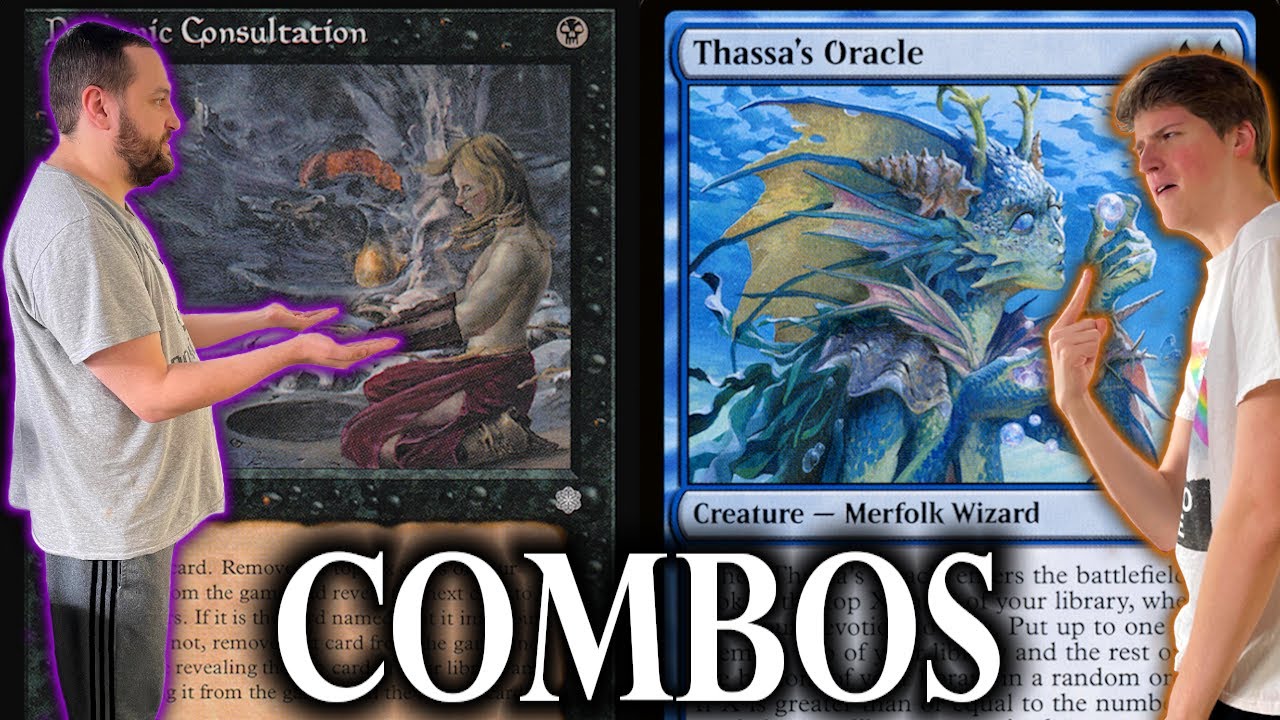
- Thassa's Oracle + Demonic Consultation (or Tainted Pact) is a highly efficient, non-infinite combo that wins by exiling the library.
- Niv-Mizzet, the Firemind + Curiosity (or similar effects) creates an infinite damage loop where drawing a card triggers Niv-Mizzet to deal damage, which triggers Curiosity to draw another card.
- Dockside Extortionist + Temur Sabertooth enables infinite treasures and mana by repeatedly bouncing Dockside to the hand.
- Umbral Mantle + a creature that taps for more mana than it costs to untap (e.g., Bloom Tender) generates infinite mana.
- Sharuum the Hegemon + an artifact that copies it (e.g., Phyrexian Metamorph) leverages the legend rule for infinite death triggers.
- Gravecrawler + Phyrexian Altar (or Rooftop Storm) + a payoff (e.g., Blood Artist) creates infinite death triggers.
- Brago, King Eternal + Strionic Resonator allows for infinite mana and ETB triggers by copying Brago's flicker ability.
- Food Chain + creatures castable from exile (Misthollow Griffin, etc.) generates infinite mana.
- Teferi, Temporal Archmage + The Chain Veil can generate infinite mana and activations by leveraging Teferi's loyalty and the Chain Veil's extra activations.
- Malcolm, Keen-Eyed Navigator + Glint-Horn Buccaneer creates a non-infinite but lethal loop of damage and treasure generation.
Key takeaways
- Combos are the most efficient win condition in Commander, often enabling faster wins than combat.
- Tutors increase combo consistency, making decks more reliable but potentially more repetitive.
- The best time to attempt a combo is when opponents have limited interaction, typically when they are tapped out.
- Understanding common combo pieces and their vulnerabilities is key to both executing and disrupting them.
- Many powerful combos rely on synergistic pieces that are individually strong, making them difficult to dismantle piece by piece.
- Interaction with combos often requires specific timing, such as responding to spells on the stack or targeting key enablers.
- Even non-infinite combos can be lethal if they generate enough damage or resources to overcome opponents' life totals or board states.
Key terms
Test your understanding
- What is the fundamental difference between an infinite loop and a combo in Magic: The Gathering?
- Why are tutors considered essential for combo decks in Commander, and what are the potential downsides of their use?
- How can a player determine the optimal moment to attempt a combo during a game of Commander?
- Describe the interaction between Kiki-Jiki, Mirror Breaker and Restoration Angel, and explain a common way to disrupt this combo.
- What are the key components of the Thassa's Oracle + Demonic Consultation combo, and why is it considered difficult to interact with?