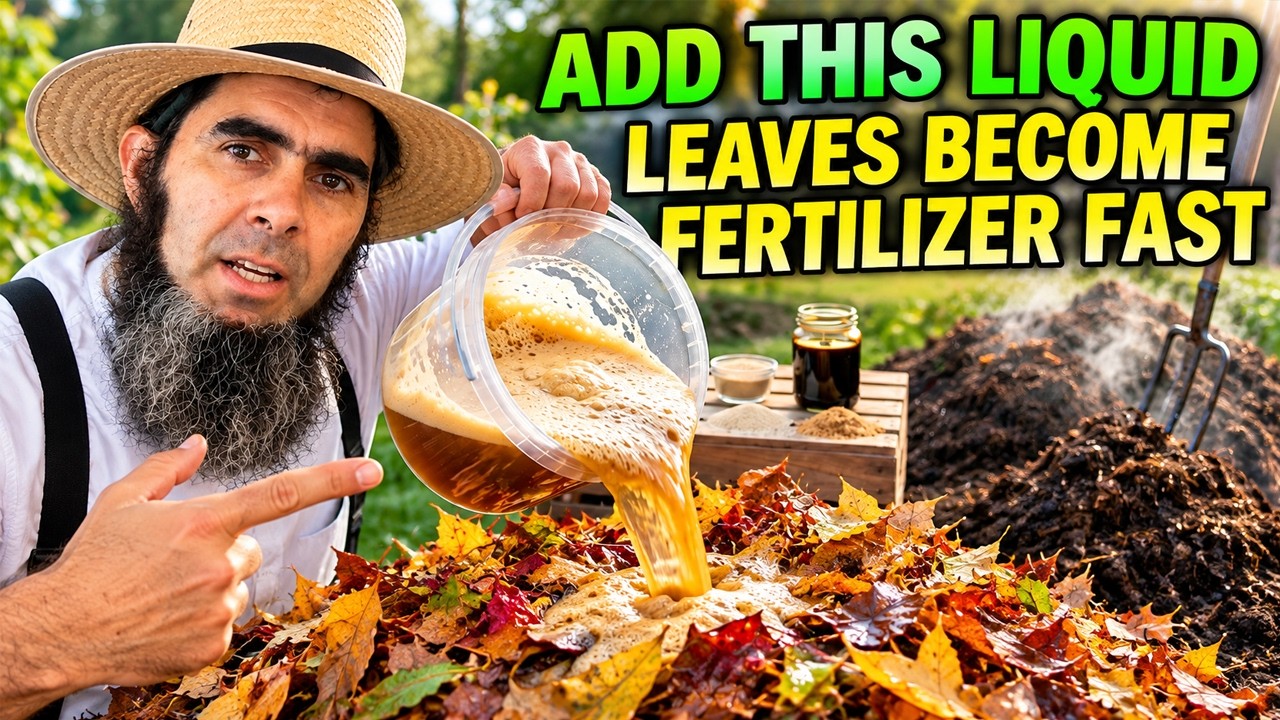
The Secret Liquid That Melts Leaves Into Compost in Just Days!
Elias Gardener
Overview
This video explains how to transform fallen leaves into nutrient-rich compost in as little as 18 days, a process often misunderstood or failed by gardeners. The key lies in understanding that leaves are primarily carbon and require a nitrogen source, like animal manure or blood meal, to fuel the microbial activity needed for rapid decomposition. Shredding the leaves is crucial to increase surface area and allow the nitrogen-rich liquid to penetrate, while building the pile on bare earth facilitates the integration of beneficial soil organisms. Proper layering, moisture balance, and periodic turning are essential to generate heat, kill weed seeds and pathogens, and ultimately create 'black gold' for the garden, fostering self-sufficiency and a deeper connection to the land.
Save this permanently with flashcards, quizzes, and AI chat
Chapters
- Most gardeners treat fallen leaves as waste, unaware they are a valuable, free resource for garden soil.
- Traditional composting methods (piling, occasional watering, waiting) often result in cold, wet, unusable leaf matter.
- This failure isn't the gardener's fault; the common advice is incomplete and leads to discouragement.
- The critical missing element is an understanding of what leaves are and what they need to decompose rapidly.
- Fallen leaves are the 'empty husk' of a tree, primarily composed of carbon, which is stored energy but resists change on its own.
- Decomposition requires microbes (bacteria) that need both carbon (from leaves) and nitrogen (protein) to multiply rapidly.
- Without sufficient nitrogen, microbes consume what they can, then go dormant, leaving the pile cold and stalled.
- This nitrogen requirement is why firewood (pure carbon) doesn't decompose without a spark (combustion), and leaf piles stall without a 'biological fire'.
- The solution is to introduce nitrogen in a liquid form that coats every leaf surface, not dry powder which washes through.
- A potent nitrogen source can be made from fresh chicken or rabbit manure mixed with water, creating a 'tea' alive with beneficial bacteria.
- Alternatively, use blood meal or pelletized chicken manure fertilizer dissolved in water.
- This 'liquid fire' provides the essential protein for microbes to multiply and generate heat, initiating rapid decomposition.
- Whole leaves have a waxy coating and shingle-like structure that repels water, preventing liquid from reaching the inner material.
- Shredding destroys this waterproof architecture, turning each leaf fragment into a sponge that readily absorbs moisture and nitrogen.
- Shredding dramatically increases the surface area available for microbes to colonize and feed, making decomposition much faster.
- A pile of shredded leaves can compost in 3 weeks, while whole leaves may take a year or more.
- Build the pile on bare earth to allow beneficial soil organisms (worms, fungi, bacteria) to migrate upwards and aid decomposition.
- Layer shredded leaves and the nitrogen-rich liquid, mixing each layer thoroughly by hand to ensure even saturation.
- Use the 'squeeze test': the material should hold its shape loosely like dough, yielding only a drop or two of water when squeezed hard.
- The pile needs to be at least 3 feet tall and wide to insulate itself and generate sufficient heat.
- After 3 days, the pile should generate significant heat (130-150°F), indicated by steam rising on a cool morning.
- This heat kills weed seeds and pathogens, performing in weeks what the forest floor does in years.
- Around day 5, the temperature drops as oxygen depletes; turning the pile is essential to reintroduce air and boost heat.
- Regular turning (every 2 days), light watering, and covering loosely with a tarp are key to maintaining the decomposition cycle.
- By day 10-12, the material darkens, loses its leafy appearance, and develops a rich, earthy smell.
- Around day 18-20, the pile stops heating, and worms and fungi move in to finish the curing process.
- The finished compost is dark, crumbly, and moist, resembling chocolate cake crumbs, with no trace of its original materials.
- This 'black gold' provides essential nutrients, closes the resource loop on a property, and offers a sense of independence and connection to the land.
Key takeaways
- Fallen leaves are a valuable carbon source for compost, not waste.
- Rapid leaf decomposition requires a nitrogen source to fuel microbial activity.
- Liquid nitrogen amendments (manure tea, blood meal solution) are more effective than dry powders.
- Shredding leaves is critical for increasing surface area and allowing liquid penetration.
- Building compost piles on bare earth integrates beneficial soil organisms.
- Proper moisture balance and regular turning are essential for heat generation and continued decomposition.
- Finished compost provides a closed-loop system for garden fertility, fostering self-sufficiency.
Key terms
Test your understanding
- Why do leaves, primarily carbon, fail to decompose quickly without additional inputs?
- What is the role of nitrogen in the composting process, and how can it be effectively added to a leaf pile?
- How does shredding leaves contribute to faster and more efficient composting?
- What are the key indicators that a compost pile is actively decomposing and generating heat?
- Why is building a compost pile on bare earth considered important for the overall success of the process?