21:54
Transformations of Functions | Precalculus
The Organic Chemistry Tutor
Overview
This video explains how to transform parent functions using shifts, stretches, shrinks, and reflections. It covers vertical and horizontal transformations, detailing how changes inside or outside the function affect its graph. The video demonstrates these transformations with various parent functions like quadratics, absolute values, and square roots, providing concrete examples and visual aids to help learners understand how to graph transformed functions accurately. It emphasizes recognizing transformations to sketch graphs without relying solely on point plotting.
How was this?
Save this permanently with flashcards, quizzes, and AI chat
Chapters
- Adding a constant to a function (f(x) + c) results in a vertical shift upwards.
- Subtracting a constant from a function (f(x) - c) results in a vertical shift downwards.
- Subtracting a constant from the input (f(x - c)) results in a horizontal shift to the right.
- Adding a constant to the input (f(x + c)) results in a horizontal shift to the left.
Understanding these basic shifts is fundamental to predicting how a graph will move on the coordinate plane, forming the basis for more complex transformations.
f(x) = x^2 shifted to f(x) = x^2 + 3 moves the parabola up by 3 units.
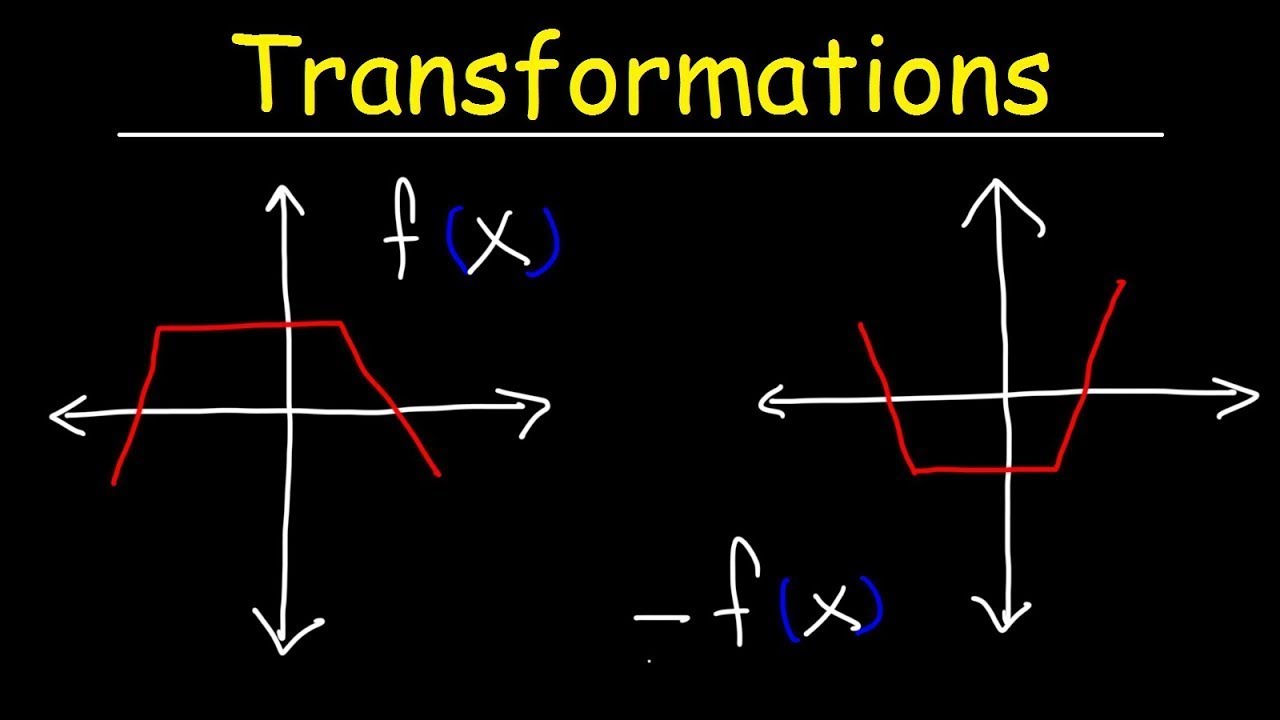
- A negative sign outside the function (-f(x)) reflects the graph across the x-axis.
- A negative sign inside the function (f(-x)) reflects the graph across the y-axis.
- A negative sign both inside and outside reflects the graph across the origin.
- A coefficient greater than 1 in front of the function (c*f(x)) causes a vertical stretch.
- A coefficient between 0 and 1 (c*f(x)) causes a vertical shrink.
These transformations alter the orientation and shape of the graph, allowing for a wider range of function behaviors to be represented and analyzed.
Multiplying the absolute value function by 2 (y = 2|x|) stretches the graph vertically, making it narrower.
- A coefficient greater than 1 inside the function (f(c*x)) causes a horizontal shrink.
- A coefficient between 0 and 1 inside the function (f(c*x)) causes a horizontal stretch.
- Horizontal transformations affect the x-values, often in the opposite way expected from their appearance.
- To distinguish horizontal from vertical stretches/shrinks, compare the x-values for the same y-value.
Understanding horizontal changes is crucial because they operate on the input (x-values) and can be counterintuitive compared to vertical changes.
The function sqrt(2x) results in a horizontal shrink compared to sqrt(x) because for the same y-value, the x-value is smaller.
- When combining transformations, it's often helpful to rewrite the function to clearly identify each component.
- Order matters: typically, horizontal shifts and stretches/shrinks are applied first, followed by reflections, and then vertical shifts and stretches/shrinks.
- Identify the parent function, then apply transformations step-by-step to sketch the new graph.
- For horizontal shifts, set the expression inside the function equal to zero to find the shift amount and direction.
Real-world functions are rarely simple parent functions; mastering combined transformations allows you to graph and understand complex functions accurately.
Graphing y = (x - 2)^2 + 3 involves shifting the parent function y = x^2 two units right and three units up.
- Familiarity with common parent functions (linear, quadratic, cubic, square root, absolute value) is essential.
- Complex transformations, like those involving negatives inside and outside the function, can be understood by breaking them down into individual reflections.
- Determining the direction of a transformed square root function involves considering the signs of the terms affecting x and y.
- Accurate graphing can be achieved by combining transformation rules with strategic point plotting.
This section reinforces how to apply all learned transformation rules to more complex scenarios, building confidence in analyzing and graphing unfamiliar functions.
Graphing y = 4 - sqrt(3 - x) involves identifying a vertical shift up 4, a horizontal shift right 3, a reflection over the y-axis, and a reflection over the x-axis.
Key takeaways
- Transformations change a parent function's position, orientation, or shape on the coordinate plane.
- Vertical shifts (up/down) are controlled by adding/subtracting constants outside the function.
- Horizontal shifts (left/right) are controlled by adding/subtracting constants inside the function, with shifts to the right corresponding to subtraction.
- Reflections occur when a negative sign is applied either inside (y-axis) or outside (x-axis) the function.
- Vertical stretches/shrinks are caused by multiplying the function by a constant; horizontal stretches/shrinks are caused by multiplying the input variable by a constant.
- Understanding the order of operations for transformations is key to accurately sketching complex functions.
- Recognizing common parent functions is the first step in applying transformations.
Key terms
Function TransformationVertical ShiftHorizontal ShiftReflection (x-axis, y-axis, origin)Vertical StretchVertical ShrinkHorizontal StretchHorizontal ShrinkParent FunctionAbsolute Value FunctionQuadratic FunctionSquare Root Function
Test your understanding
- How does adding a constant to the input of a function, f(x+c), affect its graph compared to the parent function f(x)?
- What is the difference between a vertical stretch and a horizontal stretch, and how are they represented mathematically?
- Explain how to determine if a function's graph is reflected across the x-axis or the y-axis.
- If you are given the function g(x) = -2 * sqrt(x - 3) + 1, what are the transformations applied to the parent function y = sqrt(x)?
- Why is it important to distinguish between horizontal and vertical stretches/shrinks when analyzing function graphs?