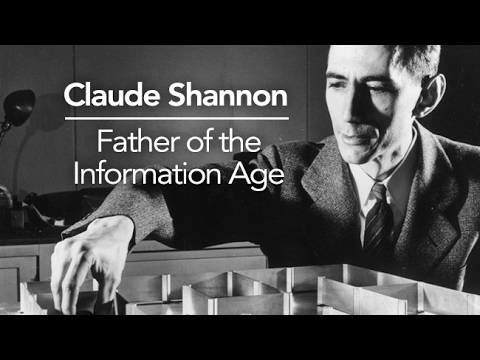
Claude Shannon - Father of the Information Age
University of California Television (UCTV)
Overview
Claude Shannon, often called the Father of the Information Age, revolutionized digital communication and storage with his 1948 paper, 'A Mathematical Theory of Communication.' While largely unknown to the public, his work laid the theoretical foundation for technologies like the internet, cell phones, and digital media. Shannon's genius extended beyond information theory to early contributions in computer circuits, artificial intelligence, and cryptography. His master's thesis on Boolean algebra created digital logic, and his concept of channel capacity established fundamental limits for data transmission. Despite his profound impact, Shannon remained a humble and private individual, more interested in tinkering and invention than public recognition.
Save this permanently with flashcards, quizzes, and AI chat
Chapters
- Claude Shannon's 1948 paper, 'A Mathematical Theory of Communication,' introduced information theory, a foundational concept for digital communication and storage.
- His work enabled the digitization of information, allowing it to be saved, stored, and transmitted reliably.
- Shannon's theories are the bedrock for technologies such as CDs, DVDs, fax machines, and wireless phones.
- He established the concept of a 'bit' as the fundamental unit of information, representing binary digits (0s and 1s).
- Shannon's 1938 master's thesis applied Boolean algebra to electrical switching circuits, creating the field of digital logic.
- He demonstrated how logical operations (AND, OR, NOT) could be implemented using electronic circuits.
- This innovation was pivotal for the design and invention of early computers.
- His thesis is considered one of the most influential in history, essentially inventing digital logic.
- During WWII, Shannon worked at Bell Laboratories on anti-aircraft devices and cryptography.
- He developed groundbreaking encryption techniques, including those used to secure communications between leaders like Roosevelt and Churchill.
- His paper 'Communication Theory of Secrecy Systems' laid out the fundamentals of modern cryptography.
- Key cryptographic principles like 'confusion' and 'diffusion' were influenced by his work.
- Shannon identified a fundamental limit, known as the Shannon limit or channel capacity, on the maximum rate of data transmission over a noisy channel.
- This limit is determined by bandwidth and signal-to-noise ratio, setting a theoretical barrier for communication efficiency.
- He proposed the concept of adding redundant bits to detect and correct errors, enabling reliable communication despite noise.
- Engineers have spent decades striving to reach this theoretical capacity, a goal largely achieved only in the last decade.
- Shannon explored early artificial intelligence, creating a mechanical mouse ('The Mouse') that could learn to solve mazes.
- He also delved into game theory, writing about computer chess algorithms and even collaborating on blackjack and roulette strategies.
- Shannon was a prolific inventor and tinkerer, creating numerous 'useless' but ingenious devices like unicycles and juggling machines.
- His playful and inventive spirit extended to applying information theory concepts to stock market analysis.
- Shannon's 1948 paper is considered the 'Magna Carta of the Information Age,' founding an entire field of study.
- He received numerous accolades, including the first Kyoto Prize, considered a Nobel Prize equivalent for fields not covered by Nobel.
- Despite his immense influence, he remained a humble and private person, often experiencing stage fright.
- His work, initially theoretical, took decades for technology to fully realize, with significant advancements occurring in the last 10-20 years.
- Shannon's contributions are estimated to have accelerated technological progress by 10-20 years.
Key takeaways
- Claude Shannon's information theory provided the mathematical framework for all digital communication and storage.
- The concept of the 'bit' as the fundamental unit of information is central to Shannon's work.
- Shannon's application of Boolean algebra to electrical circuits laid the groundwork for modern digital computers.
- Information theory establishes fundamental limits (Shannon capacity) on how much data can be reliably transmitted over a noisy channel.
- Shannon's work on error detection and correction codes enables the reliable transmission and storage of data, even in the presence of noise or damage.
- Shannon was a visionary who foresaw the potential of digital technology, influencing fields from AI to finance.
- The practical realization of Shannon's theories often required technological advancements that took decades to develop.
Key terms
Test your understanding
- What fundamental concept did Claude Shannon introduce in his 1948 paper that underpins all digital communication?
- How did Shannon's master's thesis contribute to the development of computers?
- What is the 'Shannon Limit,' and why is it significant for communication systems?
- Explain the role of 'redundant bits' in Shannon's theory and their practical application.
- Why is Claude Shannon considered the 'Father of the Information Age' despite not inventing specific technologies like the cell phone?