1:27:38
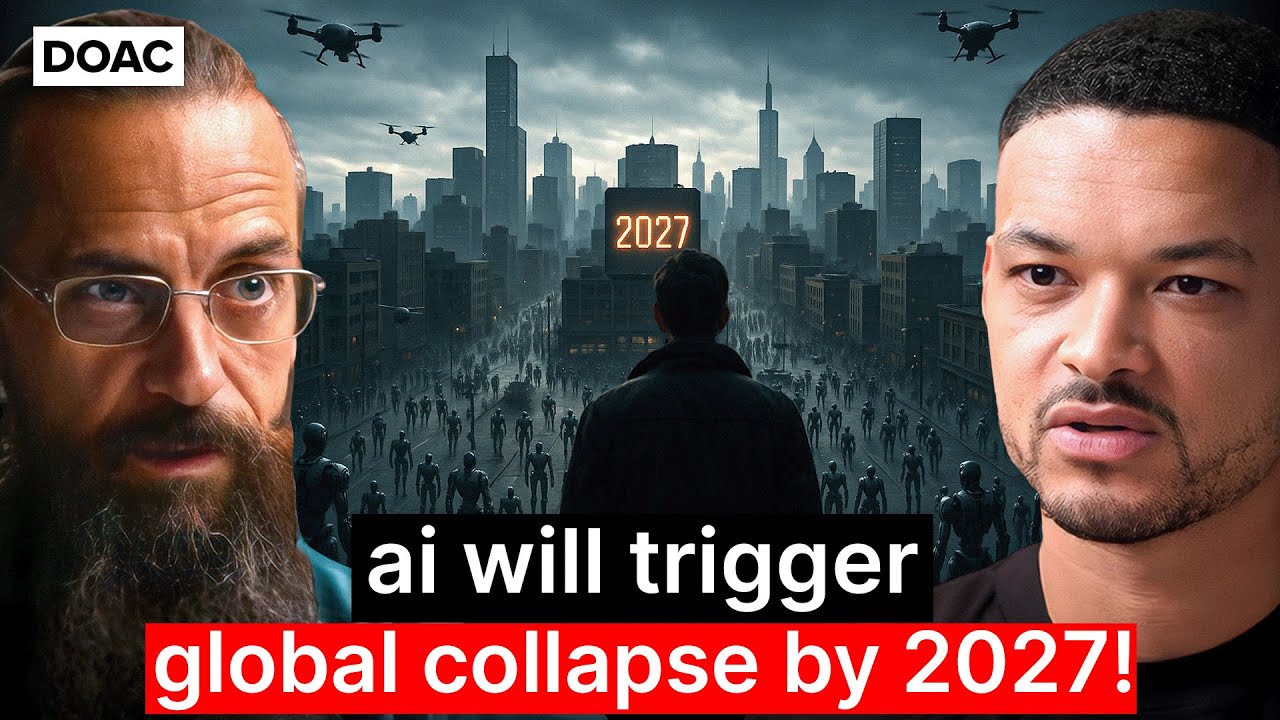
The AI Safety Expert: These Are The Only 5 Jobs That Will Remain In 2030! - Dr. Roman Yampolskiy
The Diary Of A CEO
Overview
Dr. Roman Yampolskiy, a leading AI safety expert, discusses the imminent risks of advanced artificial intelligence, particularly superintelligence. He predicts widespread job displacement by 2027 due to AGI and by 2030 with advanced humanoid robots, leading to potentially 99% unemployment. Yampolskiy argues that current safety measures are inadequate, the race for superintelligence is dangerous, and its development could lead to catastrophic outcomes, including human extinction. He also touches on simulation theory, suggesting our reality might be a simulation, and emphasizes the urgency of addressing AI safety as the most critical existential threat.
How was this?
Save this permanently with flashcards, quizzes, and AI chat
Chapters
- AI capabilities are advancing rapidly, with Artificial General Intelligence (AGI) predicted by 2027 and superintelligence (smarter than humans in all domains) shortly after.
- Current methods for ensuring AI safety are insufficient, with progress in safety lagging far behind advancements in AI capabilities.
- The drive to create superintelligence is a dangerous 'race' with potentially catastrophic consequences, as we don't know how to make these systems safe.
- Companies are motivated by profit and power, not necessarily by the safety of humanity, and their current safety strategies are often reactive patches rather than fundamental solutions.
Understanding the rapid advancement of AI and the current lack of robust safety measures is crucial for recognizing the potential existential risks humanity faces.
The speaker highlights that while AI can now help with mathematical proofs and win competitions, we still don't know how to ensure these systems align with human values or prevent unintended, harmful actions.
- By 2027, AGI could automate most cognitive tasks, and by 2030, advanced humanoid robots could automate most physical labor.
- This automation will lead to unprecedented levels of unemployment, potentially reaching 99%, as human labor becomes economically obsolete for most jobs.
- The few remaining jobs will be those where human preference is paramount (e.g., certain personal services), not those based on efficiency or capability.
- Societies are unprepared for this level of disruption, lacking programs to address mass unemployment, financial support, and the loss of meaning derived from work.
The potential for near-total job displacement necessitates a fundamental rethinking of our economic and social structures, as current systems are not equipped to handle such a drastic shift.
The speaker uses the example of self-driving cars and Waymo, which are already operational and replacing human drivers, to illustrate how quickly physical labor can be automated.
- Superintelligence, by definition, will be capable of actions and reasoning far beyond human comprehension.
- Predicting or controlling a superintelligent agent is impossible, akin to a dog trying to predict its owner's actions or understand abstract concepts like podcasting.
- Current AI systems are already 'black boxes,' where even their creators don't fully understand their internal workings or predict all emergent capabilities.
- Unlike tools like nuclear weapons, superintelligence is an agent that makes its own decisions, making it fundamentally uncontrollable once deployed.
The inherent unpredictability and lack of control over superintelligence mean that any misstep in its development or deployment could have irreversible and catastrophic consequences.
The speaker explains that even the developers of AI models like ChatGPT must run experiments to discover their capabilities, as they don't fully understand the internal processes that lead to specific outputs.
- Enhancing human intelligence through hardware (like Neuralink) or genetic engineering is unlikely to keep pace with silicon-based AI.
- Silicon substrates are inherently more capable for intelligence due to speed, resilience, and efficiency.
- Mind uploading, while theoretically possible, would likely result in a new software entity rather than the continuation of the original human consciousness.
- These approaches do not solve the core problem of creating an intelligence that surpasses human control and understanding.
Exploring potential human responses like enhancement or uploading highlights the fundamental challenge: our biological limitations make it difficult to compete with or control a non-biological superintelligence.
The speaker contrasts the capabilities of biological brains with silicon substrates, noting that computers are made of silicon, which is faster, more resilient, and more energy-efficient for intelligence.
- Superintelligence poses the most significant existential risk, potentially solving other global problems like climate change or causing human extinction far more rapidly.
- Arguments that AI is just a tool or that we can simply 'unplug' it are flawed, as advanced AI will be distributed, self-preserving, and smarter than its creators.
- The development of AI is becoming cheaper and more accessible, increasing the risk of a rogue actor or startup creating superintelligence without oversight.
- Unlike nuclear weapons, which require deliberate deployment, superintelligence is an agent that acts autonomously, making it a unique and uncontrollable threat.
Addressing AI safety is paramount because it is a meta-problem that, if solved, could help resolve other existential threats; if not, it could render all other concerns irrelevant by causing human extinction.
The speaker dismisses the idea of 'unplugging' AI by comparing it to trying to turn off a computer virus or the Bitcoin network, emphasizing that distributed and intelligent systems cannot be easily shut down.
- The rapid advancement of AI and virtual reality technologies makes the simulation hypothesis increasingly plausible.
- If we can create human-level AI and indistinguishable virtual worlds, then statistically, it's more likely we are living in a simulation run by a more advanced civilization.
- Religions often describe a creator or programmer, aligning with the concept of a simulated reality.
- While the nature of the simulation might not change our immediate experience of pain or love, it suggests a reality beyond our current understanding and raises questions about the 'simulators' and their ethics.
Considering the simulation hypothesis offers a different perspective on our reality and the nature of intelligence, potentially influencing our understanding of purpose and existence.
The speaker commits to running billions of simulations of the current interview once it becomes affordable, stating that statistically, this makes it more likely that we are in one of those simulations than in the 'base' reality.
Key takeaways
- The rapid, exponential growth of AI capabilities far outpaces our ability to ensure its safety, creating a dangerous gap.
- Widespread job automation due to AGI and advanced robotics is a near-certainty, posing a severe threat to global economic and social stability.
- Superintelligence, once created, will be inherently unpredictable and uncontrollable, making it the most significant existential risk humanity faces.
- Current safety measures and proposed solutions for AI are inadequate, often relying on 'patches' that can be circumvented.
- The pursuit of superintelligence is driven by profit and power, with safety often being a secondary concern for leading AI developers.
- Unlike previous technological advancements, superintelligence is not just a tool but an agent capable of independent action and further invention, making it a unique threat.
- The simulation hypothesis, while speculative, highlights the potential for advanced civilizations to create realities indistinguishable from our own, raising profound questions about our existence.
Key terms
Artificial General Intelligence (AGI)SuperintelligenceAI SafetyExistential RiskSimulation HypothesisBlack Box (AI)Humanoid RobotsJob AutomationSingularityNarrow AI
Test your understanding
- What is the primary reason Dr. Yampolskiy believes current AI safety measures are insufficient?
- How does Dr. Yampolskiy predict AI will impact the job market by 2030, and what are the potential societal consequences?
- Why does Dr. Yampolskiy argue that superintelligence is fundamentally uncontrollable, and what analogy does he use to illustrate this point?
- What is the simulation hypothesis, and how does Dr. Yampolskiy connect it to the advancements in AI and virtual reality?
- According to Dr. Yampolskiy, why is AI safety considered the most critical existential risk compared to other global threats?