AI-Generated Video Summary by NoteTube
YouTube Video SXnerXQ04BU
Overview
This video focuses on refining trade execution, particularly in challenging market conditions. Ryan and Nick discuss the importance of precise entry points, emphasizing that a good trade idea can fail due to poor timing or execution. They highlight key concepts like market context, liquidity, time frame alignment, and price reaction at specific zones. Nick further elaborates on identifying trading ranges, utilizing discounts, and refining entries on lower time frames to maximize risk-to-reward ratios. The session stresses the need for patience, strategic planning, and continuous learning, encouraging traders to focus on controlled execution rather than predicting market movements. They also touch upon managing psychological aspects like fear and hesitation, and building a trading strategy that fits one's lifestyle.
Want AI Chat, Flashcards & Quizzes from this video?
Sign Up FreeChapters
- •Welcome and appreciation for attendees' commitment to learning.
- •Introduction of Ryan to discuss trade entries and Nick to follow up.
- •Acknowledgement of current tough market conditions and the need for refined strategies.
- •Emphasis on the importance of precise entry points for successful trading.
- •The market is challenging, but the edge still works with refinement.
- •A good trade idea can be lost due to a bad entry (too early or too late).
- •Key factors for entry: context (price location, market structure) and time frame alignment.
- •Understanding liquidity and how price reacts to zones is crucial.
- •Confirmation of price action is necessary before entering a trade.
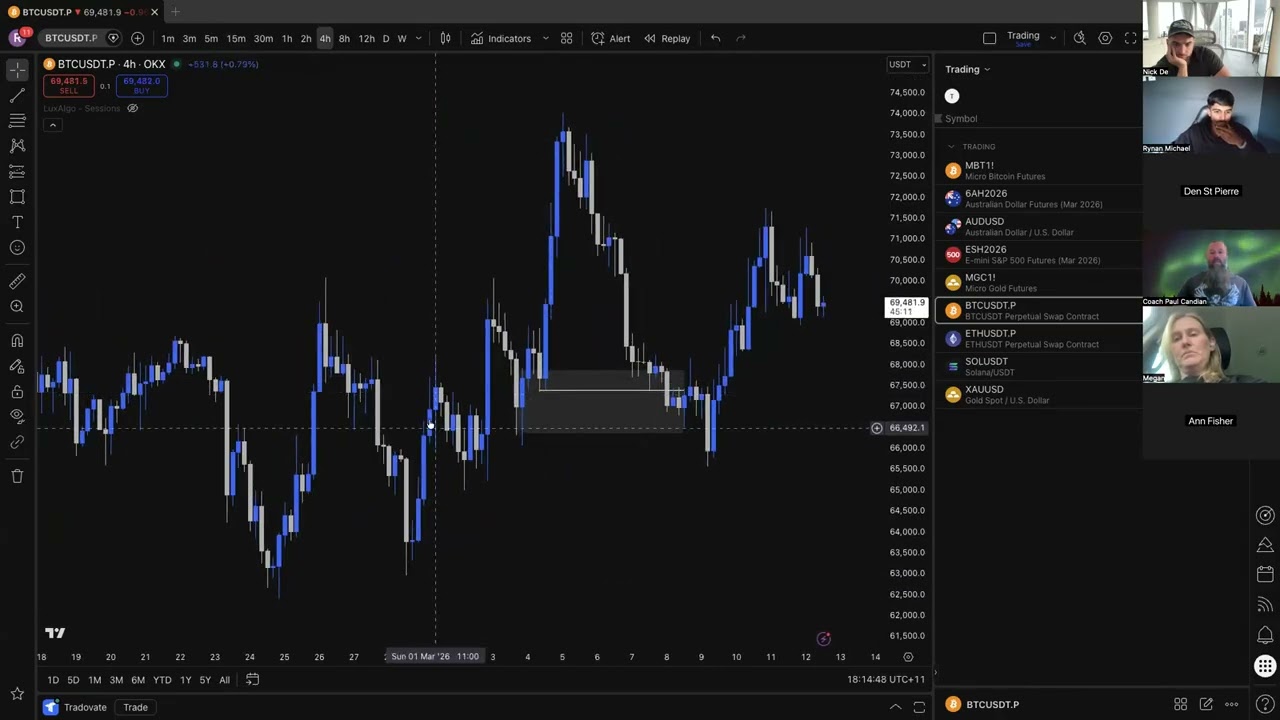
- •Examining Bitcoin's range-bound movement and bullish structure.
- •Analyzing why initial supply zones failed (lack of liquidity taken).
- •Explaining the significance of aggressive price action during pullbacks.
- •Comparing different demand zones and identifying the stronger one based on price reaction and historical context.
- •Highlighting the third zone's success due to aggressive push down and strong reclaim.
- •Traders often mark levels but need to be skeptical of 'too easy' trades.
- •The market is a competition; aim to be ahead of other participants.
- •Desire to see liquidity taken (stop losses hit) before entering.
- •The 'losing trader cycle': getting direction right isn't enough; entry matters.
- •Importance of looking left on charts for historical data and key levels.
- •Defining a trading range by identifying the last major swing low and high.
- •Using Fibonacci retracements to identify discount (buy) or premium (sell) areas.
- •Looking for liquidity sweeps below a major low as a buy signal.
- •Identifying demand zones below a liquidity sweep as areas of interest.
- •The trigger for entry is the 'reclaim' candle after a sweep and reaction at a demand zone.
- •Using lower time frames (e.g., 1-hour) for execution to refine entries.
- •Understanding that smaller time frame structure (higher highs/lows) confirms the move.
- •Prioritizing risk-to-reward ratio by entering at optimal points.
- •Targeting imbalances or key levels rather than just the absolute high/low.
- •Comparing entry timing differences (e.g., 1-hour vs. 4-hour close) and their impact on R:R.
- •The core question: 'Where am I looking to execute a trade?'
- •Trading at discounts (for longs) and premiums (for shorts) is key.
- •Focus on controlling execution, not predicting the market.
- •Importance of screen time, consistency, and learning from mistakes.
- •Prioritizing sleep and trading around one's lifestyle, not chasing trades.
Key Takeaways
- 1Precise entry points are critical for trade success, even with a correct market direction.
- 2Always consider market context, time frame alignment, and liquidity when deciding on an entry.
- 3Look for price to sweep liquidity (take out stop losses) before entering a trade in the opposite direction.
- 4Identify major trading ranges using swing highs and lows, and utilize Fibonacci to find discount or premium zones.
- 5Refine entries on lower time frames to improve risk-to-reward ratios, but base decisions on higher time frame analysis.
- 6Confirmation through aggressive price action and reclaim candles at key zones is essential.
- 7Focus on controlling your own execution and risk management rather than trying to predict market movements.
- 8Consistency, screen time, and a disciplined approach are vital for long-term trading success.